
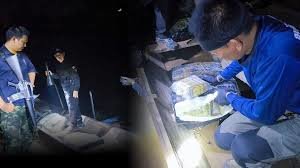
Mass Drug Seizure at Thai Border Highlights Intensifying Meth Trafficking Routes in the Mekong Region
A Lao national was arrested in Thailand with 249 kilograms of methamphetamine, underscoring the scale and cross-border nature of synthetic drug flows from the Golden Triangle into Southeast Asia.
The arrest of a Lao national in Thailand with 249 kilograms of methamphetamine is an event-driven case highlighting the persistent and expanding flow of synthetic drugs across Southeast Asia’s northern border regions.
The seizure reflects ongoing law enforcement pressure on trafficking routes that originate in the Golden Triangle, a long-established production zone spanning parts of Myanmar, Laos, and Thailand.
What is confirmed is that Thai authorities intercepted a large quantity of methamphetamine during a border-related operation involving a foreign suspect identified as a Lao national.
The drugs, weighing nearly a quarter of a metric ton, represent a significant single seizure in regional enforcement terms and indicate the continued use of land-based smuggling routes for large-volume drug transport.
Methamphetamine, commonly referred to as “meth” or “ya ba” in its tablet form in Thailand, is one of the most widely trafficked synthetic drugs in Asia.
Production has increasingly been linked to industrial-scale facilities operating in border regions where state control is limited or fragmented.
From there, shipments are transported through Laos and into Thailand, which serves both as a consumer market and a transit corridor to other countries in the region.
The scale of the seizure suggests organized trafficking rather than individual smuggling.
In operations of this magnitude, drugs are typically concealed in commercial vehicles, agricultural shipments, or cross-border logistics channels.
The involvement of a foreign national reflects the transnational structure of trafficking networks, which often rely on couriers and intermediaries operating across multiple jurisdictions.
Thai authorities have long identified northern provinces as key transit points for narcotics entering from Laos and Myanmar.
Increased enforcement, surveillance technology, and cross-border cooperation have led to periodic large seizures, but supply remains resilient due to high production volumes and strong regional demand.
Synthetic drug manufacturing has the advantage of not relying on seasonal crops, allowing year-round output at industrial scale.
The broader context is the continued expansion of methamphetamine production in the Mekong subregion.
Over the past decade, production capacity has increased significantly, driven by organized criminal networks that exploit remote terrain, porous borders, and shifting regional security conditions.
This has resulted in sustained pressure on law enforcement agencies in Thailand, Laos, and neighboring states.
The implications of the arrest extend beyond a single trafficking case.
Large seizures like this typically trigger further investigations into upstream supply chains and downstream distribution networks.
They also reinforce the role of Thailand as both a frontline enforcement state and a critical transit hub in regional drug flows.
The suspect is now in Thai custody, and the seized narcotics have been taken for forensic and legal processing.
Authorities are expected to pursue further investigations to determine the broader network behind the shipment, consistent with standard anti-trafficking procedures in cases involving high-volume synthetic drugs.
The seizure reflects ongoing law enforcement pressure on trafficking routes that originate in the Golden Triangle, a long-established production zone spanning parts of Myanmar, Laos, and Thailand.
What is confirmed is that Thai authorities intercepted a large quantity of methamphetamine during a border-related operation involving a foreign suspect identified as a Lao national.
The drugs, weighing nearly a quarter of a metric ton, represent a significant single seizure in regional enforcement terms and indicate the continued use of land-based smuggling routes for large-volume drug transport.
Methamphetamine, commonly referred to as “meth” or “ya ba” in its tablet form in Thailand, is one of the most widely trafficked synthetic drugs in Asia.
Production has increasingly been linked to industrial-scale facilities operating in border regions where state control is limited or fragmented.
From there, shipments are transported through Laos and into Thailand, which serves both as a consumer market and a transit corridor to other countries in the region.
The scale of the seizure suggests organized trafficking rather than individual smuggling.
In operations of this magnitude, drugs are typically concealed in commercial vehicles, agricultural shipments, or cross-border logistics channels.
The involvement of a foreign national reflects the transnational structure of trafficking networks, which often rely on couriers and intermediaries operating across multiple jurisdictions.
Thai authorities have long identified northern provinces as key transit points for narcotics entering from Laos and Myanmar.
Increased enforcement, surveillance technology, and cross-border cooperation have led to periodic large seizures, but supply remains resilient due to high production volumes and strong regional demand.
Synthetic drug manufacturing has the advantage of not relying on seasonal crops, allowing year-round output at industrial scale.
The broader context is the continued expansion of methamphetamine production in the Mekong subregion.
Over the past decade, production capacity has increased significantly, driven by organized criminal networks that exploit remote terrain, porous borders, and shifting regional security conditions.
This has resulted in sustained pressure on law enforcement agencies in Thailand, Laos, and neighboring states.
The implications of the arrest extend beyond a single trafficking case.
Large seizures like this typically trigger further investigations into upstream supply chains and downstream distribution networks.
They also reinforce the role of Thailand as both a frontline enforcement state and a critical transit hub in regional drug flows.
The suspect is now in Thai custody, and the seized narcotics have been taken for forensic and legal processing.
Authorities are expected to pursue further investigations to determine the broader network behind the shipment, consistent with standard anti-trafficking procedures in cases involving high-volume synthetic drugs.