
Apple Briefly Crosses Five Trillion Dollar Valuation as Investors Retreat From AI Bets
The iPhone maker became the second company to reach the milestone, benefiting from strong product demand and a comparatively restrained approach to artificial-intelligence infrastructure spending.
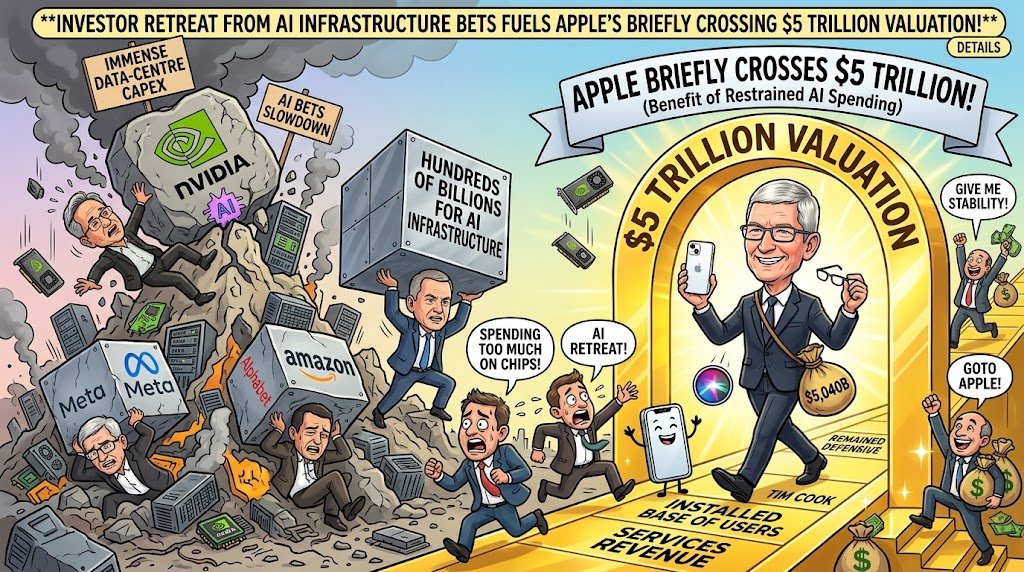
Apple briefly surpassed a market value of five trillion dollars for the first time, becoming only the second listed company to reach the threshold as investors shifted away from heavily exposed artificial-intelligence and semiconductor stocks.
The company’s shares reached an intraday high of 342 dollars and 89 cents, placing its market capitalisation at roughly five trillion and 40 billion dollars before easing back.
The retreat left the shares close to, but fractionally below, the landmark at the close.
The distinction matters technically, but it does not alter the significance of the moment: Apple has now joined Nvidia in the small group of companies to have crossed five trillion dollars in market value.
Apple has reclaimed the position of the world’s most valuable listed business from Nvidia, whose shares have been hit by a broader reassessment of the artificial-intelligence trade.
Apple stock has risen by about a quarter this year, substantially outperforming several large technology peers and the wider US equity market.
The immediate driver is not that Apple has abandoned artificial intelligence.
It has introduced Apple Intelligence features, is developing a more capable version of Siri and continues to invest in custom silicon, software and product integration.
The key difference is financial structure.
Apple has not matched the immense data-centre capital expenditure programmes being undertaken by companies seeking to build and operate the world’s largest artificial-intelligence computing networks.
That relative restraint has become attractive as investors question whether the extraordinary spending on chips, servers, electricity and data centres will generate sufficient returns.
Alphabet, Amazon, Microsoft, Meta and other major technology groups are committing hundreds of billions of dollars to artificial-intelligence infrastructure.
Such investment may prove strategically necessary and commercially rewarding, but it also depresses free cash flow and introduces the risk that capacity is built faster than profitable demand emerges.
The latest sell-off in semiconductor and artificial-intelligence stocks reflects those concerns.
Chipmakers and companies closely associated with the construction of data-centre capacity have fallen as investors weigh elevated valuations, rising borrowing requirements, competition from Chinese developers and the possibility that cheaper models could reduce the pricing power of established leaders.
Nvidia remains central to the artificial-intelligence economy because its processors and software are widely used to train and run advanced models.
Its decline does not indicate a collapse in demand for computing power.
Rather, it shows that investors are becoming more demanding about the price they are willing to pay for future growth, particularly when the companies buying the chips are spending at a pace that challenges their former reputation as reliable cash generators.
Apple offers a different proposition.
Its value rests on a large installed base of device users, recurring services revenue, control of its hardware and software ecosystem, and an ability to incorporate new technology into products already used by hundreds of millions of people.
Investors have treated that model as comparatively defensive during a period of volatility in more speculative corners of the technology market.
Strong demand for iPhones, Macs, wearables and services has reinforced that view.
Apple has also sought to protect consumer demand by keeping flagship-device pricing relatively stable and offering financing and upgrade options.
Those measures can support sales volumes, although they may also place pressure on margins if component costs rise.
The company’s position is not without risk.
Apple faces intense competition in smartphones, regulatory scrutiny of its App Store and services business, supply-chain exposure in Asia, and uncertainty over whether its artificial-intelligence features will prove sufficiently distinctive to drive the next major upgrade cycle.
It must also contend with increasing memory-chip costs and the possibility that consumer spending weakens if the global economy slows.
A five-trillion-dollar valuation implies exceptionally high expectations.
For Apple to sustain it, investors will want evidence that product sales remain resilient, services continue to grow and artificial intelligence strengthens the appeal of its ecosystem without requiring the same level of capital intensity burdening its rivals.
A company can be rewarded for spending less only while that restraint does not become a strategic handicap.
The milestone also illustrates a wider market rotation rather than a decisive verdict on artificial intelligence.
Investors are not necessarily rejecting the technology’s long-term potential; they are questioning the near-term economics of the race to build its infrastructure.
Apple has benefited because it is perceived as a beneficiary of artificial intelligence without being among the largest immediate funders of the underlying computing build-out.
The company is due to report quarterly earnings later this week.
Its results, guidance and comments on demand, margins and artificial-intelligence products will determine whether the five-trillion-dollar mark becomes a durable valuation level or remains an intraday milestone in a volatile technology market.
The company’s shares reached an intraday high of 342 dollars and 89 cents, placing its market capitalisation at roughly five trillion and 40 billion dollars before easing back.
The retreat left the shares close to, but fractionally below, the landmark at the close.
The distinction matters technically, but it does not alter the significance of the moment: Apple has now joined Nvidia in the small group of companies to have crossed five trillion dollars in market value.
Apple has reclaimed the position of the world’s most valuable listed business from Nvidia, whose shares have been hit by a broader reassessment of the artificial-intelligence trade.
Apple stock has risen by about a quarter this year, substantially outperforming several large technology peers and the wider US equity market.
The immediate driver is not that Apple has abandoned artificial intelligence.
It has introduced Apple Intelligence features, is developing a more capable version of Siri and continues to invest in custom silicon, software and product integration.
The key difference is financial structure.
Apple has not matched the immense data-centre capital expenditure programmes being undertaken by companies seeking to build and operate the world’s largest artificial-intelligence computing networks.
That relative restraint has become attractive as investors question whether the extraordinary spending on chips, servers, electricity and data centres will generate sufficient returns.
Alphabet, Amazon, Microsoft, Meta and other major technology groups are committing hundreds of billions of dollars to artificial-intelligence infrastructure.
Such investment may prove strategically necessary and commercially rewarding, but it also depresses free cash flow and introduces the risk that capacity is built faster than profitable demand emerges.
The latest sell-off in semiconductor and artificial-intelligence stocks reflects those concerns.
Chipmakers and companies closely associated with the construction of data-centre capacity have fallen as investors weigh elevated valuations, rising borrowing requirements, competition from Chinese developers and the possibility that cheaper models could reduce the pricing power of established leaders.
Nvidia remains central to the artificial-intelligence economy because its processors and software are widely used to train and run advanced models.
Its decline does not indicate a collapse in demand for computing power.
Rather, it shows that investors are becoming more demanding about the price they are willing to pay for future growth, particularly when the companies buying the chips are spending at a pace that challenges their former reputation as reliable cash generators.
Apple offers a different proposition.
Its value rests on a large installed base of device users, recurring services revenue, control of its hardware and software ecosystem, and an ability to incorporate new technology into products already used by hundreds of millions of people.
Investors have treated that model as comparatively defensive during a period of volatility in more speculative corners of the technology market.
Strong demand for iPhones, Macs, wearables and services has reinforced that view.
Apple has also sought to protect consumer demand by keeping flagship-device pricing relatively stable and offering financing and upgrade options.
Those measures can support sales volumes, although they may also place pressure on margins if component costs rise.
The company’s position is not without risk.
Apple faces intense competition in smartphones, regulatory scrutiny of its App Store and services business, supply-chain exposure in Asia, and uncertainty over whether its artificial-intelligence features will prove sufficiently distinctive to drive the next major upgrade cycle.
It must also contend with increasing memory-chip costs and the possibility that consumer spending weakens if the global economy slows.
A five-trillion-dollar valuation implies exceptionally high expectations.
For Apple to sustain it, investors will want evidence that product sales remain resilient, services continue to grow and artificial intelligence strengthens the appeal of its ecosystem without requiring the same level of capital intensity burdening its rivals.
A company can be rewarded for spending less only while that restraint does not become a strategic handicap.
The milestone also illustrates a wider market rotation rather than a decisive verdict on artificial intelligence.
Investors are not necessarily rejecting the technology’s long-term potential; they are questioning the near-term economics of the race to build its infrastructure.
Apple has benefited because it is perceived as a beneficiary of artificial intelligence without being among the largest immediate funders of the underlying computing build-out.
The company is due to report quarterly earnings later this week.
Its results, guidance and comments on demand, margins and artificial-intelligence products will determine whether the five-trillion-dollar mark becomes a durable valuation level or remains an intraday milestone in a volatile technology market.