
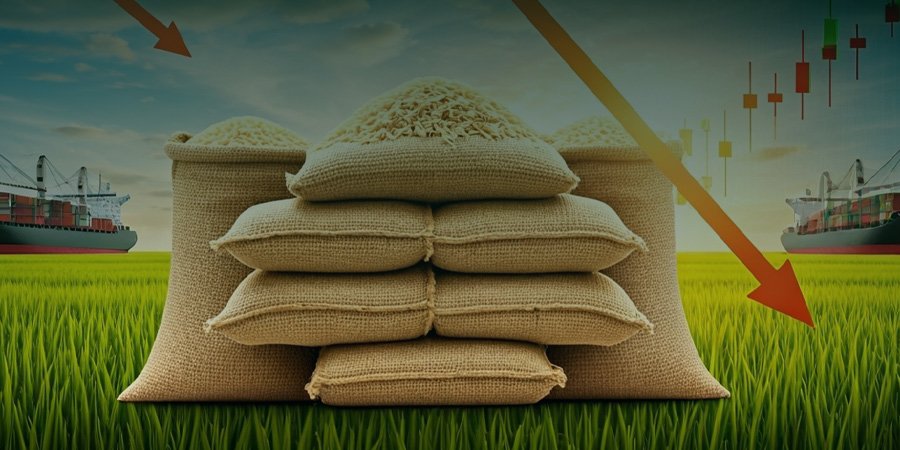
Thailand’s Rice Sector Faces Crisis as Prices Plunge and Costs Skyrocket
Yields remain low, production costs exceed income, and export prices fall to 15-year lows amid rising global competition
Thailand’s once-resilient rice sector is now under severe pressure, as farmers contend with collapsing domestic paddy prices, rising input costs and intensifying global competition that have eroded the country’s comparative advantage.
Common white paddy that sold above ten thousand baht per tonne last year is now fetching below eight thousand baht, and freshly harvested high-moisture paddy trades at only five to six thousand baht — well under the estimated production cost of seven-thousand two-hundred to seven-thousand-five-hundred baht per tonne.
Yields are also among the lowest in Southeast Asia.
Most Thai farms realise only three-hundred-seventy to six-hundred kilograms per rai, compared with roughly eight-hundred kilograms per rai in Vietnam and seven-hundred to eight-hundred kilograms per rai in India.
Lack of varietal progress, limited mechanisation and dependence on subsidised rather than efficiency-driven farming have compounded the problem, analysts say.
Export markets provide little relief.
Thai rice export volumes have fallen for ten consecutive months, and the value of shipments declined by around thirty per cent in recent reported periods.
Revenue from August 2025 exports, for example, fell to about US$3.95 billion (approximately twelve-point six billion baht) on a volume of 739,497 tonnes, marking the tenth straight month of contraction.
Global white-rice benchmark prices for Thai supply recently dropped to US$372.50 per tonne — the lowest level since 2017 — as India resumed exporting large volumes at lower costs.
Industry experts warn that Thailand’s policy model has become stuck in a subsidy-driven cycle rather than productivity growth.
Over the past fourteen years and four administrations, spending of approximately one-point-two to one-point-three trillion baht on pledging schemes and income guarantees has failed to prompt upgrades in seed quality, farming technology or cost structure.
Meanwhile competitors such as Vietnam and India have accelerated seed development, mechanisation and export-oriented strategies, enabling higher yields and lower costs.
Recommendations for reform abound.
Analysts propose agricultural zoning and mixed-farming systems to ensure year-round income; scaling up research and development into high-yield soft-texture varieties such as RD113, RD117 and RD119; expanding seed-production capacity; and promoting low-carbon rice production aligned with global climate-smart trends.
They also flag the need for up-skilling the ageing farmer base to adopt modern technologies.
Without such structural change, the risk is that Thailand’s global rice export standing will further erode, while rural livelihoods tied to small-scale rice production will face increasing hardship.
The crisis in the rice sector signals both economic and social urgency: the combination of high costs, low yields and depressed prices places significant pressure on Thailand’s agricultural communities and challenges the country’s broader food-security and export-diversification goals.
Common white paddy that sold above ten thousand baht per tonne last year is now fetching below eight thousand baht, and freshly harvested high-moisture paddy trades at only five to six thousand baht — well under the estimated production cost of seven-thousand two-hundred to seven-thousand-five-hundred baht per tonne.
Yields are also among the lowest in Southeast Asia.
Most Thai farms realise only three-hundred-seventy to six-hundred kilograms per rai, compared with roughly eight-hundred kilograms per rai in Vietnam and seven-hundred to eight-hundred kilograms per rai in India.
Lack of varietal progress, limited mechanisation and dependence on subsidised rather than efficiency-driven farming have compounded the problem, analysts say.
Export markets provide little relief.
Thai rice export volumes have fallen for ten consecutive months, and the value of shipments declined by around thirty per cent in recent reported periods.
Revenue from August 2025 exports, for example, fell to about US$3.95 billion (approximately twelve-point six billion baht) on a volume of 739,497 tonnes, marking the tenth straight month of contraction.
Global white-rice benchmark prices for Thai supply recently dropped to US$372.50 per tonne — the lowest level since 2017 — as India resumed exporting large volumes at lower costs.
Industry experts warn that Thailand’s policy model has become stuck in a subsidy-driven cycle rather than productivity growth.
Over the past fourteen years and four administrations, spending of approximately one-point-two to one-point-three trillion baht on pledging schemes and income guarantees has failed to prompt upgrades in seed quality, farming technology or cost structure.
Meanwhile competitors such as Vietnam and India have accelerated seed development, mechanisation and export-oriented strategies, enabling higher yields and lower costs.
Recommendations for reform abound.
Analysts propose agricultural zoning and mixed-farming systems to ensure year-round income; scaling up research and development into high-yield soft-texture varieties such as RD113, RD117 and RD119; expanding seed-production capacity; and promoting low-carbon rice production aligned with global climate-smart trends.
They also flag the need for up-skilling the ageing farmer base to adopt modern technologies.
Without such structural change, the risk is that Thailand’s global rice export standing will further erode, while rural livelihoods tied to small-scale rice production will face increasing hardship.
The crisis in the rice sector signals both economic and social urgency: the combination of high costs, low yields and depressed prices places significant pressure on Thailand’s agricultural communities and challenges the country’s broader food-security and export-diversification goals.