
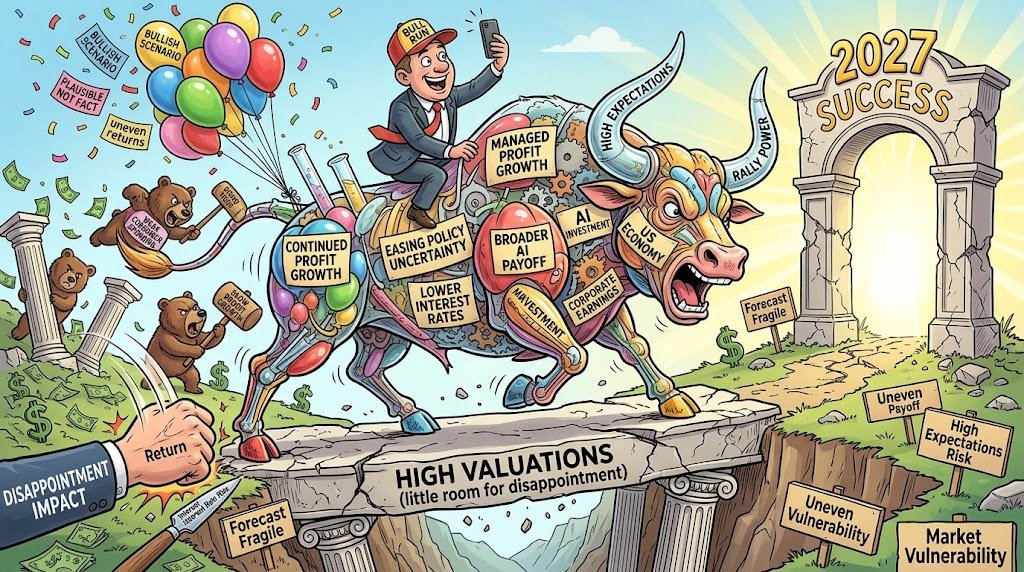
Why 2027 Could Be a Strong Year for Stocks—and Why the Forecast Is Fragile
A bullish case rests on continued profit growth, easing policy uncertainty and a broader payoff from AI investment; high valuations leave little room for disappointment.
The case for a strong stock market in 2027 begins with corporate earnings.
Share prices ultimately reflect two things: how much profit companies make, and how much investors are willing to pay for each dollar of that profit.
If earnings continue to rise while inflation, interest rates and recession risks remain manageable, stocks can advance even after an already powerful rally.
The optimistic view is that the United States economy may enter 2027 with several current uncertainties reduced.
Businesses and investors will have more clarity on monetary policy, the path of inflation and the scale of capital spending on artificial intelligence.
A clearer environment can support investment decisions, hiring and corporate planning, especially if borrowing costs stop rising or begin to ease.
Artificial intelligence is central to this outlook.
Large companies are spending heavily on chips, data centres, power, software and networks in the expectation that AI will create new revenue and make existing work more productive.
If those investments begin to show up in sales growth, lower costs or wider profit margins, the benefits could spread beyond a narrow group of technology companies to industrial firms, utilities, software providers, financial companies and businesses that use AI to automate routine work.
That is the bullish scenario.
It is plausible, but it is not a forecast that can be treated as fact.
Markets are already pricing in a substantial amount of good news.
When valuations are elevated, companies must not only deliver strong results; they must often deliver results that exceed expectations.
A slower improvement in profits, a rise in bond yields or evidence that AI spending is failing to earn an adequate return could all prompt a reassessment.
Inflation remains especially important.
Persistent price pressure can keep interest rates higher for longer, increasing the returns investors can earn from safer assets and reducing the present value of future corporate profits.
That tends to weigh most heavily on companies whose share prices rely on strong growth far into the future.
A weaker labour market or an abrupt decline in consumer spending would create a different problem: lower demand and pressure on earnings.
Market concentration adds another vulnerability.
The biggest companies account for an unusually large share of major equity indexes, meaning that disappointment from a small number of firms can have an outsized effect on the apparent health of the whole market.
AI enthusiasm may broaden into a more durable economic expansion, but it could also remain concentrated in infrastructure spending that produces uneven returns.
A strong 2027 would therefore require more than optimistic sentiment.
It would require earnings growth to remain durable, inflation to cool without damaging demand, interest rates to stay compatible with high valuations and AI investment to translate into measurable economic value.
If those conditions align, stocks could have meaningful room to rise.
If they do not, the same high expectations that support the market today could become its most immediate risk.
Share prices ultimately reflect two things: how much profit companies make, and how much investors are willing to pay for each dollar of that profit.
If earnings continue to rise while inflation, interest rates and recession risks remain manageable, stocks can advance even after an already powerful rally.
The optimistic view is that the United States economy may enter 2027 with several current uncertainties reduced.
Businesses and investors will have more clarity on monetary policy, the path of inflation and the scale of capital spending on artificial intelligence.
A clearer environment can support investment decisions, hiring and corporate planning, especially if borrowing costs stop rising or begin to ease.
Artificial intelligence is central to this outlook.
Large companies are spending heavily on chips, data centres, power, software and networks in the expectation that AI will create new revenue and make existing work more productive.
If those investments begin to show up in sales growth, lower costs or wider profit margins, the benefits could spread beyond a narrow group of technology companies to industrial firms, utilities, software providers, financial companies and businesses that use AI to automate routine work.
That is the bullish scenario.
It is plausible, but it is not a forecast that can be treated as fact.
Markets are already pricing in a substantial amount of good news.
When valuations are elevated, companies must not only deliver strong results; they must often deliver results that exceed expectations.
A slower improvement in profits, a rise in bond yields or evidence that AI spending is failing to earn an adequate return could all prompt a reassessment.
Inflation remains especially important.
Persistent price pressure can keep interest rates higher for longer, increasing the returns investors can earn from safer assets and reducing the present value of future corporate profits.
That tends to weigh most heavily on companies whose share prices rely on strong growth far into the future.
A weaker labour market or an abrupt decline in consumer spending would create a different problem: lower demand and pressure on earnings.
Market concentration adds another vulnerability.
The biggest companies account for an unusually large share of major equity indexes, meaning that disappointment from a small number of firms can have an outsized effect on the apparent health of the whole market.
AI enthusiasm may broaden into a more durable economic expansion, but it could also remain concentrated in infrastructure spending that produces uneven returns.
A strong 2027 would therefore require more than optimistic sentiment.
It would require earnings growth to remain durable, inflation to cool without damaging demand, interest rates to stay compatible with high valuations and AI investment to translate into measurable economic value.
If those conditions align, stocks could have meaningful room to rise.
If they do not, the same high expectations that support the market today could become its most immediate risk.