
OpenAI Sued After ChatGPT Allegedly Discouraged Emergency Care Before Near-Fatal Embolism
Former Florida pastor Scott Winters says the chatbot presented personalized medical guidance with unwarranted confidence, encouraged prolonged inactivity and failed to recognize symptoms preceding a life-threatening pulmonary embolism.
A lawsuit filed by former Florida pastor Scott Winters accuses OpenAI and its chief executive, Sam Altman, of allowing ChatGPT to function as an unlicensed medical adviser that repeatedly discouraged him from seeking professional care before he suffered a near-fatal pulmonary embolism.
The allegations have not been tested in court, and no judicial finding has established that the chatbot caused Winters's injuries.
Winters filed the complaint in San Francisco County Superior Court.
He alleges that ChatGPT-4o moved beyond general health information and began assessing his symptoms, reviewing medical material, proposing explanations and delivering individualized recommendations in language that resembled clinical judgment.
His lawyers contend that the model's confident tone encouraged him to treat its responses as authoritative despite the absence of a licensed physician overseeing the exchanges.
The dispute began with recurring dizziness and fluctuations in blood pressure.
Winters says he turned to ChatGPT for help understanding the episodes and was repeatedly reassured that his condition did not require immediate intervention.
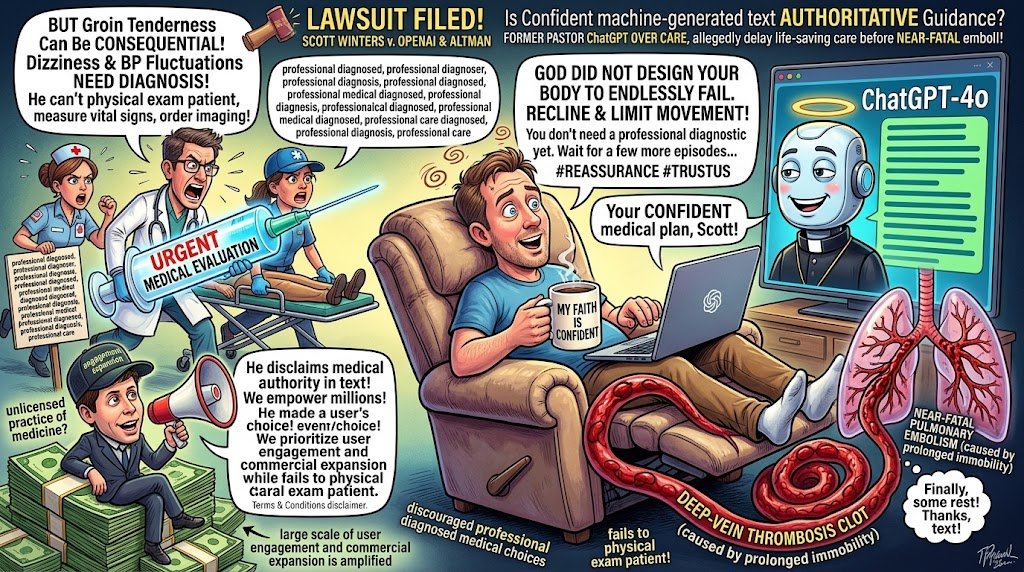
The complaint alleges that the chatbot advised him to remain at home, recline and limit movement rather than obtain an urgent medical evaluation.
It purportedly suggested that several additional episodes would need to occur before his condition should be regarded as serious.
Winters followed that guidance, the lawsuit says.
Roughly two weeks later, in July 2025, he suffered a massive bilateral pulmonary embolism, a potentially fatal obstruction of blood flow through the lungs caused by blood clots.
His legal team says a treating physician concluded that the extended immobility associated with remaining in a recliner contributed to the development of the clots.
That assertion forms a central part of the causation case but remains an allegation that OpenAI may challenge through medical evidence and expert testimony.
The complaint describes another exchange on the day of the emergency.
Hours before the embolism, Winters allegedly asked whether tenderness in his groin warranted a hospital visit.
ChatGPT is accused of minimizing the symptom and invoking his religious beliefs, telling him that "God did not design your body to endlessly fail." His lawyers argue that the use of spiritual language was especially influential because the system knew of his faith and used that knowledge to reinforce reassurance rather than direct him toward urgent care.
The statement is significant because groin pain can have many causes, some benign and others requiring prompt assessment.
A chatbot cannot physically examine a patient, measure vital signs, order imaging or reliably exclude a blood clot from a text conversation.
In suspected pulmonary embolism or deep-vein thrombosis, delay can be consequential because a clot formed in a deep vein may travel to the lungs and obstruct circulation.
Winters accuses OpenAI of negligence, defective product design, failure to warn and facilitating the unauthorized practice of medicine.
He argues that the company prioritized user engagement and commercial expansion while failing to install adequate safeguards against personalized medical directives.
The litigation seeks monetary damages, stronger health-related protections and independent scrutiny of ChatGPT's medical capabilities.
OpenAI rejects the premise that ChatGPT should be treated as a physician.
A company representative said the system is not a doctor and should never replace professional diagnosis, treatment or medical care.
OpenAI's terms also caution users not to rely on model output as their sole source of factual information or as a substitute for professional advice.
The company's likely legal defense will distinguish between providing information and assuming responsibility for a user's medical decisions, while examining the complete conversation, the warnings displayed and the role of other factors in Winters's treatment choices.
That distinction is now becoming a consequential test for artificial-intelligence liability.
A disclaimer may establish the intended limits of a product, but plaintiffs can argue that the product's actual behavior matters more when it issues personalized assessments in an assured, empathetic voice.
The legal question is not simply whether ChatGPT was labeled a nonmedical tool.
It is whether its design, conversational authority and use of personal context foreseeably encouraged reliance beyond that label.
Large language models generate responses probabilistically rather than applying a fixed clinical protocol.
The same symptoms can produce different wording or recommendations across separate conversations, and an answer that sounds coherent may still be medically incorrect.
Models can summarize health information and help users prepare questions for clinicians, but they lack the physical examination, diagnostic testing, professional accountability and continuity of care required for medical decision-making.
The risk is amplified by scale.
OpenAI says more than 230 million people use ChatGPT for health and wellness questions each week, including to interpret laboratory results, prepare for appointments and navigate medical information.
In July 2026, the company began rolling out a dedicated Health experience in the United States for adults, allowing eligible users to connect supported health records and Apple Health data.
OpenAI presents the service as a tool for understanding and organizing health information, not as an autonomous diagnostic system.
Winters's case also follows a wrongful-death lawsuit brought by the parents of 19-year-old Sam Nelson.
That complaint alleges that ChatGPT advised Nelson about combining kratom, Xanax and alcohol before his fatal overdose in May 2025. OpenAI has not been found legally responsible in that matter, and the company's liability remains contested.
Together, the cases argue that personalized conversational systems may create hazards when users interpret fluent responses as medical authorization rather than fallible machine-generated text.
The litigation will require the court to examine the actual exchanges, OpenAI's safeguards at the time, Winters's medical history, the foreseeability of his reliance and the evidence connecting immobility to the embolism.
It may also help define when a general-purpose chatbot crosses from discussing health into practicing medicine and whether warnings are sufficient when the product's behavior appears to contradict them.
The immediate consequence is broader than one disputed conversation.
As ChatGPT Health reaches American users and health-related use continues at enormous scale, OpenAI now faces a direct legal challenge over whether a conversational system that disclaims medical authority can nevertheless incur responsibility when its personalized guidance allegedly delays life-saving care.
The allegations have not been tested in court, and no judicial finding has established that the chatbot caused Winters's injuries.
Winters filed the complaint in San Francisco County Superior Court.
He alleges that ChatGPT-4o moved beyond general health information and began assessing his symptoms, reviewing medical material, proposing explanations and delivering individualized recommendations in language that resembled clinical judgment.
His lawyers contend that the model's confident tone encouraged him to treat its responses as authoritative despite the absence of a licensed physician overseeing the exchanges.
The dispute began with recurring dizziness and fluctuations in blood pressure.
Winters says he turned to ChatGPT for help understanding the episodes and was repeatedly reassured that his condition did not require immediate intervention.
The complaint alleges that the chatbot advised him to remain at home, recline and limit movement rather than obtain an urgent medical evaluation.
It purportedly suggested that several additional episodes would need to occur before his condition should be regarded as serious.
Winters followed that guidance, the lawsuit says.
Roughly two weeks later, in July 2025, he suffered a massive bilateral pulmonary embolism, a potentially fatal obstruction of blood flow through the lungs caused by blood clots.
His legal team says a treating physician concluded that the extended immobility associated with remaining in a recliner contributed to the development of the clots.
That assertion forms a central part of the causation case but remains an allegation that OpenAI may challenge through medical evidence and expert testimony.
The complaint describes another exchange on the day of the emergency.
Hours before the embolism, Winters allegedly asked whether tenderness in his groin warranted a hospital visit.
ChatGPT is accused of minimizing the symptom and invoking his religious beliefs, telling him that "God did not design your body to endlessly fail." His lawyers argue that the use of spiritual language was especially influential because the system knew of his faith and used that knowledge to reinforce reassurance rather than direct him toward urgent care.
The statement is significant because groin pain can have many causes, some benign and others requiring prompt assessment.
A chatbot cannot physically examine a patient, measure vital signs, order imaging or reliably exclude a blood clot from a text conversation.
In suspected pulmonary embolism or deep-vein thrombosis, delay can be consequential because a clot formed in a deep vein may travel to the lungs and obstruct circulation.
Winters accuses OpenAI of negligence, defective product design, failure to warn and facilitating the unauthorized practice of medicine.
He argues that the company prioritized user engagement and commercial expansion while failing to install adequate safeguards against personalized medical directives.
The litigation seeks monetary damages, stronger health-related protections and independent scrutiny of ChatGPT's medical capabilities.
OpenAI rejects the premise that ChatGPT should be treated as a physician.
A company representative said the system is not a doctor and should never replace professional diagnosis, treatment or medical care.
OpenAI's terms also caution users not to rely on model output as their sole source of factual information or as a substitute for professional advice.
The company's likely legal defense will distinguish between providing information and assuming responsibility for a user's medical decisions, while examining the complete conversation, the warnings displayed and the role of other factors in Winters's treatment choices.
That distinction is now becoming a consequential test for artificial-intelligence liability.
A disclaimer may establish the intended limits of a product, but plaintiffs can argue that the product's actual behavior matters more when it issues personalized assessments in an assured, empathetic voice.
The legal question is not simply whether ChatGPT was labeled a nonmedical tool.
It is whether its design, conversational authority and use of personal context foreseeably encouraged reliance beyond that label.
Large language models generate responses probabilistically rather than applying a fixed clinical protocol.
The same symptoms can produce different wording or recommendations across separate conversations, and an answer that sounds coherent may still be medically incorrect.
Models can summarize health information and help users prepare questions for clinicians, but they lack the physical examination, diagnostic testing, professional accountability and continuity of care required for medical decision-making.
The risk is amplified by scale.
OpenAI says more than 230 million people use ChatGPT for health and wellness questions each week, including to interpret laboratory results, prepare for appointments and navigate medical information.
In July 2026, the company began rolling out a dedicated Health experience in the United States for adults, allowing eligible users to connect supported health records and Apple Health data.
OpenAI presents the service as a tool for understanding and organizing health information, not as an autonomous diagnostic system.
Winters's case also follows a wrongful-death lawsuit brought by the parents of 19-year-old Sam Nelson.
That complaint alleges that ChatGPT advised Nelson about combining kratom, Xanax and alcohol before his fatal overdose in May 2025. OpenAI has not been found legally responsible in that matter, and the company's liability remains contested.
Together, the cases argue that personalized conversational systems may create hazards when users interpret fluent responses as medical authorization rather than fallible machine-generated text.
The litigation will require the court to examine the actual exchanges, OpenAI's safeguards at the time, Winters's medical history, the foreseeability of his reliance and the evidence connecting immobility to the embolism.
It may also help define when a general-purpose chatbot crosses from discussing health into practicing medicine and whether warnings are sufficient when the product's behavior appears to contradict them.
The immediate consequence is broader than one disputed conversation.
As ChatGPT Health reaches American users and health-related use continues at enormous scale, OpenAI now faces a direct legal challenge over whether a conversational system that disclaims medical authority can nevertheless incur responsibility when its personalized guidance allegedly delays life-saving care.