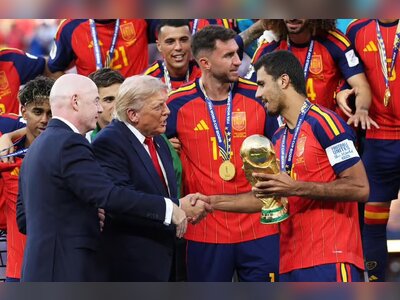
Spain Defeats Argentina in Extra Time to Win Second World Cup
Ferran Torres scored in the one hundred and sixth minute as Spain beat the defending champions one-nil in New Jersey and reclaimed the title sixteen years after its first triumph.
Spain won the 2026 FIFA World Cup because its sustained control finally broke an Argentina side reduced to ten players, with Ferran Torres scoring the decisive goal in the one hundred and sixth minute of a tense final at New York New Jersey Stadium.
The one-nil victory delivered Spain its second men's world championship, sixteen years after the generation led by Andrés Iniesta claimed the country's first title in South Africa.
The final was goalless after ninety minutes, but the balance of play had already tilted sharply toward Spain.
Luis de la Fuente's team monopolized possession, compressed Argentina into its own half and generated repeated attempts against goalkeeper Emiliano Martínez.
Argentina offered little attacking threat during regulation time and relied heavily on defensive organization, tactical fouls and Martínez's interventions to remain level.
The pivotal disciplinary moment arrived late in normal time when midfielder Enzo Fernández received a second yellow card and was sent off.
Argentina entered extra time with ten players against a Spanish side already dictating the tempo, leaving the defending champions with even less capacity to press, counterattack or retain the ball.
Spain initially appeared to have found the breakthrough through Nico Williams, but the effort was disallowed following an infringement in the buildup.
The pressure continued.
Early in the second period of extra time, Williams helped create another opening, and Torres converted from inside the penalty area to place Spain ahead.
Argentina attempted a late response, including a rare effort from Lionel Messi, but could not force an equalizer.
The result ended Argentina's attempt to retain the trophy it won in Qatar in 2022. It also brought a painful conclusion to what may have been Messi's final World Cup appearance.
At thirty-nine, the Argentine captain was tightly contained for most of the match and struggled to influence a game in which his team spent long periods without meaningful possession or service in advanced areas.
For Spain, the championship completed a broader return to the summit of international football.
The team arrived as reigning European champion and advanced through the knockout rounds with a blend of territorial control, technical precision and defensive discipline.
Its triumph was not built around a single veteran core but around a younger generation capable of combining Spain's traditional possession game with greater directness and speed.
The final also underlined the depth of the Spanish squad.
Torres began outside the central narrative surrounding the tournament's biggest stars, yet became the player who settled its most important match.
Williams provided penetration from the flank, while Spain's midfield restricted Argentina's routes into the final third and repeatedly recovered possession before counterattacks could develop.
Argentina's defeat was severe in competitive terms but did not erase the achievements of the previous four years.
The team entered the final as defending world champion after a cycle that included continental success and a sustained period near the top of the international game.
In New Jersey, however, its strategy became increasingly dependent on survival rather than creation, and Fernández's dismissal made that approach harder to sustain.
The match concluded the first forty-eight-team men's World Cup, staged across the United States, Canada and Mexico.
Spain received the trophy after a final defined less by open exchanges than by accumulated pressure, defensive resistance and one clinical extra-time finish.
What is confirmed is that Spain has returned to the top of world football with a second title, while Argentina's reign ended after four years.
Torres's extra-time goal now joins Iniesta's winner in 2010 as the strike that secured a World Cup for Spain.
The one-nil victory delivered Spain its second men's world championship, sixteen years after the generation led by Andrés Iniesta claimed the country's first title in South Africa.
The final was goalless after ninety minutes, but the balance of play had already tilted sharply toward Spain.
Luis de la Fuente's team monopolized possession, compressed Argentina into its own half and generated repeated attempts against goalkeeper Emiliano Martínez.
Argentina offered little attacking threat during regulation time and relied heavily on defensive organization, tactical fouls and Martínez's interventions to remain level.
The pivotal disciplinary moment arrived late in normal time when midfielder Enzo Fernández received a second yellow card and was sent off.
Argentina entered extra time with ten players against a Spanish side already dictating the tempo, leaving the defending champions with even less capacity to press, counterattack or retain the ball.
Spain initially appeared to have found the breakthrough through Nico Williams, but the effort was disallowed following an infringement in the buildup.
The pressure continued.
Early in the second period of extra time, Williams helped create another opening, and Torres converted from inside the penalty area to place Spain ahead.
Argentina attempted a late response, including a rare effort from Lionel Messi, but could not force an equalizer.
The result ended Argentina's attempt to retain the trophy it won in Qatar in 2022. It also brought a painful conclusion to what may have been Messi's final World Cup appearance.
At thirty-nine, the Argentine captain was tightly contained for most of the match and struggled to influence a game in which his team spent long periods without meaningful possession or service in advanced areas.
For Spain, the championship completed a broader return to the summit of international football.
The team arrived as reigning European champion and advanced through the knockout rounds with a blend of territorial control, technical precision and defensive discipline.
Its triumph was not built around a single veteran core but around a younger generation capable of combining Spain's traditional possession game with greater directness and speed.
The final also underlined the depth of the Spanish squad.
Torres began outside the central narrative surrounding the tournament's biggest stars, yet became the player who settled its most important match.
Williams provided penetration from the flank, while Spain's midfield restricted Argentina's routes into the final third and repeatedly recovered possession before counterattacks could develop.
Argentina's defeat was severe in competitive terms but did not erase the achievements of the previous four years.
The team entered the final as defending world champion after a cycle that included continental success and a sustained period near the top of the international game.
In New Jersey, however, its strategy became increasingly dependent on survival rather than creation, and Fernández's dismissal made that approach harder to sustain.
The match concluded the first forty-eight-team men's World Cup, staged across the United States, Canada and Mexico.
Spain received the trophy after a final defined less by open exchanges than by accumulated pressure, defensive resistance and one clinical extra-time finish.
What is confirmed is that Spain has returned to the top of world football with a second title, while Argentina's reign ended after four years.
Torres's extra-time goal now joins Iniesta's winner in 2010 as the strike that secured a World Cup for Spain.