
Thailand and Cambodia Sign Expanded Peace Declaration with U.S. Mediation
Joint declaration witnessed by President Trump seeks to formalise ceasefire and strengthen regional stability
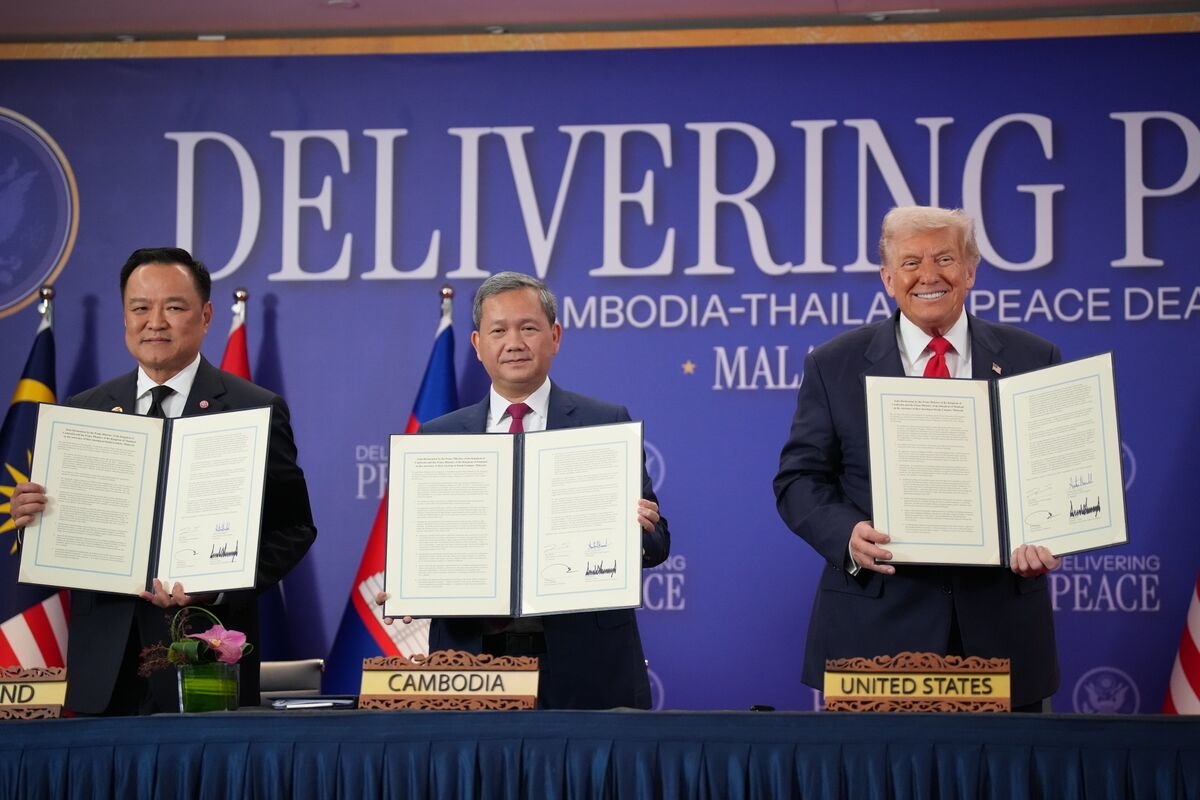
An expanded peace declaration between Thailand and Cambodia was signed on October 26, 2025 in Kuala Lumpur under the witness of Donald Trump, marking a key step in resolving border conflict that erupted in July.
The agreement builds on a truce negotiated in July after five days of intense clashes along the 500-mile border, which resulted in nearly four dozen deaths and displaced an estimated 300,000 people.
The new document, titled the “Kuala Lumpur Peace Accord”, was signed by Thai Prime Minister Anutin Charnvirakul and Cambodian Prime Minister Hun Manet, and witnessed by Malaysian Prime Minister Anwar Ibrahim and President Trump.
The declaration commits both nations to withdraw heavy weapons from the border zones, release eighteen Cambodian detainees, launch joint de-mining efforts and invite an observer team from the Association of Southeast Asian Nations (ASEAN) to monitor compliance.
President Trump described the accord as a “historic achievement for the region”, citing U.S. diplomatic pressure and trade incentives as a factor in bringing the two sides to the table.
Thai officials, for their part, emphasised that the agreement affirms Thailand’s commitment to peaceful, rule-based resolution of its territorial disputes and underlines the country’s role as a stabilising force in Southeast Asia.
Despite its promise, analysts caution that the core territorial issues between Cambodia and Thailand—dating back more than a century—remain unresolved and the agreement lacks a permanent binding settlement mechanism.
The success of the declaration will depend on the timely implementation of withdrawal protocols, mine-clearance efforts and restoration of border trade and the livelihoods of displaced populations.
For Thailand this agreement represents a diplomatic milestone, reinforcing its international stature and signalling its readiness to settle regional disputes through dialogue and partnership.
The coming months will test whether this formal step can translate into lasting peace and renewed cross-border cooperation.
The agreement builds on a truce negotiated in July after five days of intense clashes along the 500-mile border, which resulted in nearly four dozen deaths and displaced an estimated 300,000 people.
The new document, titled the “Kuala Lumpur Peace Accord”, was signed by Thai Prime Minister Anutin Charnvirakul and Cambodian Prime Minister Hun Manet, and witnessed by Malaysian Prime Minister Anwar Ibrahim and President Trump.
The declaration commits both nations to withdraw heavy weapons from the border zones, release eighteen Cambodian detainees, launch joint de-mining efforts and invite an observer team from the Association of Southeast Asian Nations (ASEAN) to monitor compliance.
President Trump described the accord as a “historic achievement for the region”, citing U.S. diplomatic pressure and trade incentives as a factor in bringing the two sides to the table.
Thai officials, for their part, emphasised that the agreement affirms Thailand’s commitment to peaceful, rule-based resolution of its territorial disputes and underlines the country’s role as a stabilising force in Southeast Asia.
Despite its promise, analysts caution that the core territorial issues between Cambodia and Thailand—dating back more than a century—remain unresolved and the agreement lacks a permanent binding settlement mechanism.
The success of the declaration will depend on the timely implementation of withdrawal protocols, mine-clearance efforts and restoration of border trade and the livelihoods of displaced populations.
For Thailand this agreement represents a diplomatic milestone, reinforcing its international stature and signalling its readiness to settle regional disputes through dialogue and partnership.
The coming months will test whether this formal step can translate into lasting peace and renewed cross-border cooperation.