Thailand Implements Emergency Measures to Tackle PM2.5 Pollution Crisis
The government takes urgent action, including free public transport and work-from-home measures, to combat severe air pollution in Bangkok and other regions.
Thailand's Prime Minister Paetongtarn Shinawatra announced urgent measures on Friday to address the ongoing PM2.5 pollution crisis, particularly in Bangkok.
The measures, which are aimed at mitigating the harmful effects of ultra-fine dust particles, include offering free bus and electric train rides and encouraging private companies to allow employees to work from home in order to reduce vehicle emissions, a major source of the pollutants.
These measures were rolled out starting Saturday, with the Transport Ministry subsidizing transport services for seven days.
In addition, the government instructed the Department of Rainmaking and Agricultural Aviation to conduct cloud-seeding operations to increase rainfall and improve air quality.
The Ministry of Natural Resources and Environment has been tasked with monitoring slash-and-burn farming practices, which contribute significantly to the haze, and taking legal action against violators.
The Digital Economy and Society Ministry will also launch an app to report instances of waste burning.
Bangkok Governor Chadchart Sittipunt has been instructed to inspect construction sites in the capital to ensure proper dust shields are in place.
In cases of poor air circulation, construction will be temporarily halted.
The government also announced stricter enforcement on vehicle emissions, with police instructed to carry out inspections on vehicles emitting excessive black smoke.
As part of the response, a 140-million-baht budget will be allocated to subsidize electric train fares for seven days.
Former Prime Minister Thaksin Shinawatra, who is also the father of the current Prime Minister, defended the government's actions and acknowledged the severity of the pollution problem.
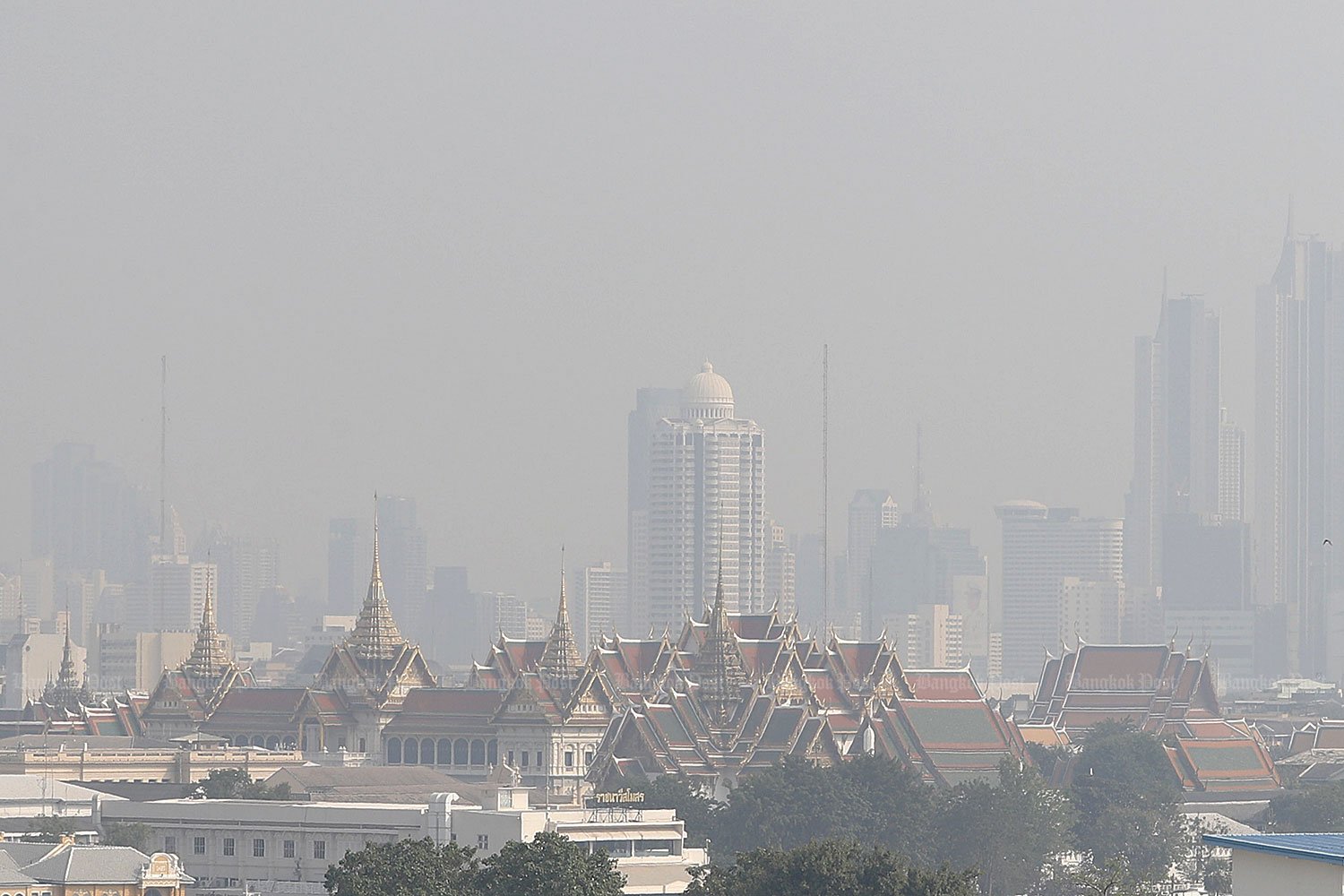
As of Friday, Bangkok ranked as the fourth-worst city in the world for air quality, with the air quality index reaching 188, significantly higher than the government-set safe threshold of 37.5 micrograms per cubic meter.
The city’s 50 districts were largely categorized as hazardous, and residents were urged to limit outdoor activities.
Chiang Mai, also affected by high pollution levels, ranked 23rd with an air quality index of 127.
The measures, which are aimed at mitigating the harmful effects of ultra-fine dust particles, include offering free bus and electric train rides and encouraging private companies to allow employees to work from home in order to reduce vehicle emissions, a major source of the pollutants.
These measures were rolled out starting Saturday, with the Transport Ministry subsidizing transport services for seven days.
In addition, the government instructed the Department of Rainmaking and Agricultural Aviation to conduct cloud-seeding operations to increase rainfall and improve air quality.
The Ministry of Natural Resources and Environment has been tasked with monitoring slash-and-burn farming practices, which contribute significantly to the haze, and taking legal action against violators.
The Digital Economy and Society Ministry will also launch an app to report instances of waste burning.
Bangkok Governor Chadchart Sittipunt has been instructed to inspect construction sites in the capital to ensure proper dust shields are in place.
In cases of poor air circulation, construction will be temporarily halted.
The government also announced stricter enforcement on vehicle emissions, with police instructed to carry out inspections on vehicles emitting excessive black smoke.
As part of the response, a 140-million-baht budget will be allocated to subsidize electric train fares for seven days.
Former Prime Minister Thaksin Shinawatra, who is also the father of the current Prime Minister, defended the government's actions and acknowledged the severity of the pollution problem.
As of Friday, Bangkok ranked as the fourth-worst city in the world for air quality, with the air quality index reaching 188, significantly higher than the government-set safe threshold of 37.5 micrograms per cubic meter.
The city’s 50 districts were largely categorized as hazardous, and residents were urged to limit outdoor activities.
Chiang Mai, also affected by high pollution levels, ranked 23rd with an air quality index of 127.