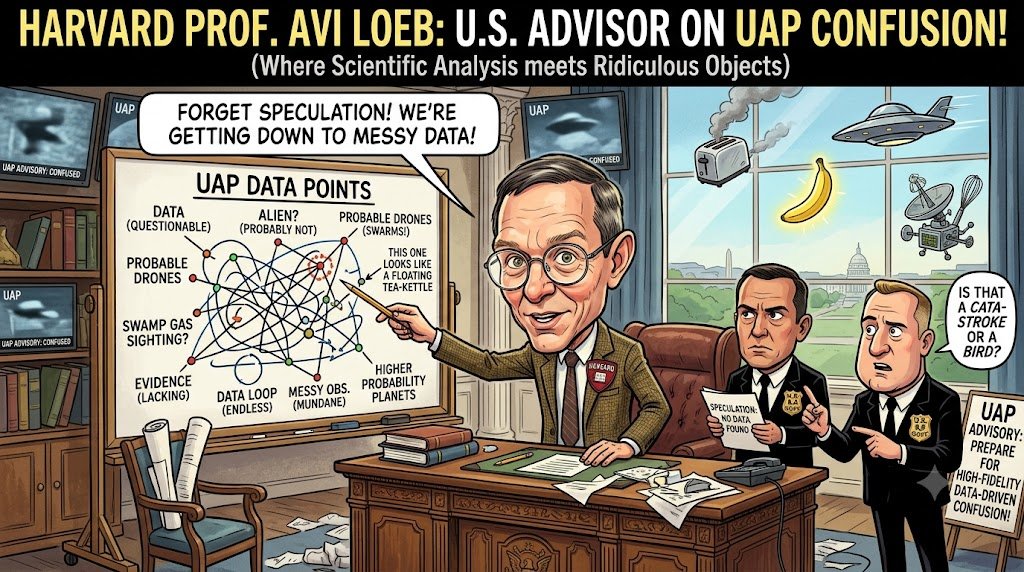
Harvard Astrophysicist to Lead U.S. Scientific Advisory on Unidentified Aerial Phenomena
Professor Avi Loeb appointed to advise the government on UAP data collection and analysis, emphasizing a data-driven approach over speculation.
Systematic scientific analysis of Unidentified Aerial Phenomena (UAP) is moving to the forefront of U.S. government priorities, marked by the appointment of Harvard University astrophysicist Professor Avi Loeb to lead a new scientific advisory board.
This initiative, stemming from actions during the Trump administration to open classified files, tasks Loeb with advising the government on resolving the nature of unexplained objects that defy standard categorization as either known technology or natural phenomena.
The primary mechanism for this investigation involves assessing existing data, identifying gaps, and recommending the deployment of specific instruments to secure high-fidelity evidence, transforming the subject from popular speculation into a disciplined, evidence-based inquiry.
The objects of interest include reports of maneuvers inconsistent with known aerodynamic capabilities, such as rapidly moving fireballs that occasionally fragment, documented not only by pilot accounts but also through sophisticated intelligence and defense sensor networks.
Crucially, the advisory mission is dual-natured: definitively identifying these objects is considered essential for national security, regardless of their origin, as it would expose potential technological leaps by foreign adversaries.
Loeb, known for leading Harvard’s Galileo Project, contends that while a human source remains a possibility, the statistically high probability of habitable planets suggests extraterrestrial technology cannot be scientifically dismissed.
He maintains that if data were to confirm even a single object originated from a non-human civilization, it would constitute the most significant discovery in scientific history, fundamentally altering humanity's cosmic perspective.
Despite acknowledgment that mainstream scientific consensus remains highly skeptical, the focus moves toward establishing high-quality, unclassified data repositories to resolve the enduring discrepancy between official observations and verified explanations, aiming to replicate the forensic clarity of a detective investigation.
This initiative, stemming from actions during the Trump administration to open classified files, tasks Loeb with advising the government on resolving the nature of unexplained objects that defy standard categorization as either known technology or natural phenomena.
The primary mechanism for this investigation involves assessing existing data, identifying gaps, and recommending the deployment of specific instruments to secure high-fidelity evidence, transforming the subject from popular speculation into a disciplined, evidence-based inquiry.
The objects of interest include reports of maneuvers inconsistent with known aerodynamic capabilities, such as rapidly moving fireballs that occasionally fragment, documented not only by pilot accounts but also through sophisticated intelligence and defense sensor networks.
Crucially, the advisory mission is dual-natured: definitively identifying these objects is considered essential for national security, regardless of their origin, as it would expose potential technological leaps by foreign adversaries.
Loeb, known for leading Harvard’s Galileo Project, contends that while a human source remains a possibility, the statistically high probability of habitable planets suggests extraterrestrial technology cannot be scientifically dismissed.
He maintains that if data were to confirm even a single object originated from a non-human civilization, it would constitute the most significant discovery in scientific history, fundamentally altering humanity's cosmic perspective.
Despite acknowledgment that mainstream scientific consensus remains highly skeptical, the focus moves toward establishing high-quality, unclassified data repositories to resolve the enduring discrepancy between official observations and verified explanations, aiming to replicate the forensic clarity of a detective investigation.