Bangkok Motor Show Signals Accelerating EV Transition in Thailand’s Auto Market
Rising electric vehicle sales and aggressive manufacturer competition suggest Thailand is entering a structural shift, though infrastructure and affordability gaps remain significant constraints
The structure of Thailand’s automotive market is undergoing a SYSTEM-DRIVEN transition as electric vehicle adoption accelerates alongside policy incentives, industrial investment, and shifting consumer demand.
The question raised by the Bangkok Motor Show—whether Thailand has reached an EV tipping point—reflects a broader inflection in the country’s role as Southeast Asia’s largest vehicle manufacturing hub.
What is confirmed in recent market data is that electric vehicle sales in Thailand have grown rapidly over the past two years, driven primarily by Chinese manufacturers expanding aggressively into the region.
Brands such as BYD and other major Chinese EV producers have gained substantial market share through competitive pricing, local assembly investments, and government-supported incentives tied to Thailand’s EV promotion policies.
Thailand’s government has positioned the country as a regional EV manufacturing base, offering subsidies for battery electric vehicles, tax reductions for manufacturers, and investment incentives aimed at converting domestic production capacity from internal combustion engines to electric drivetrains.
These measures are designed to preserve Thailand’s export-oriented auto industry while aligning it with global decarbonization trends.
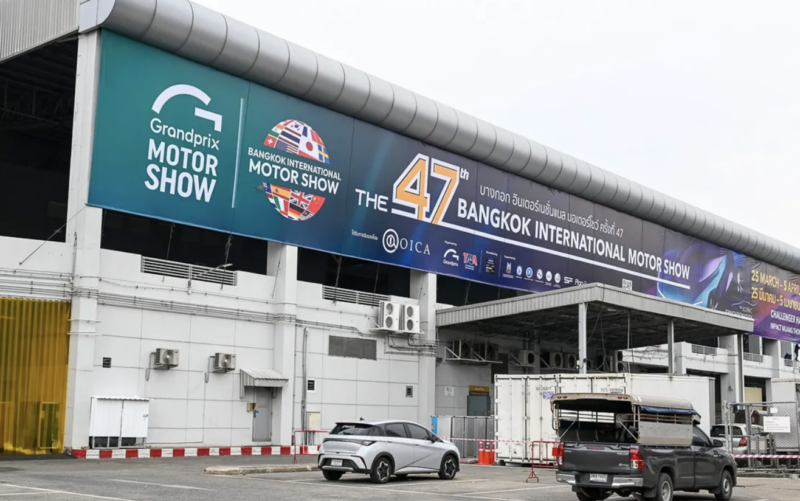
The Bangkok Motor Show has increasingly become a platform where this transition is visible.
Recent editions have featured a marked rise in EV models compared to traditional internal combustion vehicles, with both established Japanese automakers and newer Chinese entrants competing directly in the same price segments.
The visibility of EVs at such a major consumer event reflects not only marketing strategy but also underlying changes in production pipelines and dealer networks.
However, whether this constitutes a “tipping point” is more complex.
EV adoption in Thailand is growing from a relatively low base, meaning percentage increases appear large even as total market penetration remains uneven.
Internal combustion vehicles still dominate overall vehicle ownership and usage patterns, particularly outside urban centers.
Infrastructure remains a key constraint.
Charging networks are expanding, but coverage is still concentrated in Bangkok and major tourist or industrial corridors.
This limits adoption in rural provinces and creates a dual-speed market in which urban consumers can transition more easily than the broader population.
Affordability is another structural factor.
While EV prices have declined due to competition, they remain higher than many comparable internal combustion models in entry-level segments.
Government subsidies have helped narrow the gap, but long-term sustainability depends on continued price compression and domestic battery supply chain development.
The competitive landscape is also reshaping industrial strategy.
Japanese automakers, historically dominant in Thailand’s car market, are accelerating their own electrification plans to defend market share.
Chinese manufacturers, meanwhile, are using Thailand as both a sales hub and a production base for regional exports, intensifying pressure on established players.
The stakes extend beyond consumer choice.
Thailand’s automotive sector accounts for a significant share of industrial employment and export revenue.
A rapid but unmanaged transition could disrupt supply chains tied to combustion engine manufacturing, while a successful transition could reposition Thailand as a regional EV production leader.
What is not yet established is whether current EV growth rates will sustain long enough to constitute a permanent structural shift rather than a cyclical surge driven by incentives and new model launches.
The trajectory will depend on infrastructure scaling, long-term policy consistency, and the ability of domestic industry to integrate into global EV supply chains.
The broader implication is that Thailand is no longer merely observing the global EV transition—it is now a contested manufacturing and consumption battleground where Chinese expansion, Japanese incumbency, and domestic industrial policy are converging.
The Bangkok Motor Show reflects not a completed tipping point, but an accelerating transition whose outcome will redefine the country’s automotive identity.
The question raised by the Bangkok Motor Show—whether Thailand has reached an EV tipping point—reflects a broader inflection in the country’s role as Southeast Asia’s largest vehicle manufacturing hub.
What is confirmed in recent market data is that electric vehicle sales in Thailand have grown rapidly over the past two years, driven primarily by Chinese manufacturers expanding aggressively into the region.
Brands such as BYD and other major Chinese EV producers have gained substantial market share through competitive pricing, local assembly investments, and government-supported incentives tied to Thailand’s EV promotion policies.
Thailand’s government has positioned the country as a regional EV manufacturing base, offering subsidies for battery electric vehicles, tax reductions for manufacturers, and investment incentives aimed at converting domestic production capacity from internal combustion engines to electric drivetrains.
These measures are designed to preserve Thailand’s export-oriented auto industry while aligning it with global decarbonization trends.
The Bangkok Motor Show has increasingly become a platform where this transition is visible.
Recent editions have featured a marked rise in EV models compared to traditional internal combustion vehicles, with both established Japanese automakers and newer Chinese entrants competing directly in the same price segments.
The visibility of EVs at such a major consumer event reflects not only marketing strategy but also underlying changes in production pipelines and dealer networks.
However, whether this constitutes a “tipping point” is more complex.
EV adoption in Thailand is growing from a relatively low base, meaning percentage increases appear large even as total market penetration remains uneven.
Internal combustion vehicles still dominate overall vehicle ownership and usage patterns, particularly outside urban centers.
Infrastructure remains a key constraint.
Charging networks are expanding, but coverage is still concentrated in Bangkok and major tourist or industrial corridors.
This limits adoption in rural provinces and creates a dual-speed market in which urban consumers can transition more easily than the broader population.
Affordability is another structural factor.
While EV prices have declined due to competition, they remain higher than many comparable internal combustion models in entry-level segments.
Government subsidies have helped narrow the gap, but long-term sustainability depends on continued price compression and domestic battery supply chain development.
The competitive landscape is also reshaping industrial strategy.
Japanese automakers, historically dominant in Thailand’s car market, are accelerating their own electrification plans to defend market share.
Chinese manufacturers, meanwhile, are using Thailand as both a sales hub and a production base for regional exports, intensifying pressure on established players.
The stakes extend beyond consumer choice.
Thailand’s automotive sector accounts for a significant share of industrial employment and export revenue.
A rapid but unmanaged transition could disrupt supply chains tied to combustion engine manufacturing, while a successful transition could reposition Thailand as a regional EV production leader.
What is not yet established is whether current EV growth rates will sustain long enough to constitute a permanent structural shift rather than a cyclical surge driven by incentives and new model launches.
The trajectory will depend on infrastructure scaling, long-term policy consistency, and the ability of domestic industry to integrate into global EV supply chains.
The broader implication is that Thailand is no longer merely observing the global EV transition—it is now a contested manufacturing and consumption battleground where Chinese expansion, Japanese incumbency, and domestic industrial policy are converging.
The Bangkok Motor Show reflects not a completed tipping point, but an accelerating transition whose outcome will redefine the country’s automotive identity.