Continental Expands Thailand Manufacturing Base With New Motorcycle Tire Production
The German automotive supplier has launched radial motorcycle tire production in Rayong as it deepens investment in Southeast Asia and shifts more manufacturing capacity closer to Asian demand centers.
Continental, the German automotive technology and tire manufacturer, has formally launched radial motorcycle tire production at its expanded Rayong plant in Thailand, marking a significant step in the company’s long-term manufacturing strategy in Asia-Pacific.
The expansion is fundamentally system-driven.
The move is not simply about one factory opening or one product line entering operation.
It reflects a broader restructuring of global tire manufacturing around regional supply chains, lower-cost production bases, faster delivery cycles, and rising demand for premium motorcycle and electric-vehicle-related mobility products across Asia.
What is confirmed is that Continental inaugurated the second expansion phase of its Rayong tire facility on May twenty-second, alongside the start of local radial motorcycle tire manufacturing.
The company said the project forms part of an investment program exceeding three hundred million euros, or roughly thirteen billion Thai baht.
The expansion increases annual passenger and light truck tire capacity by three million units and creates approximately six hundred additional jobs.
The Rayong facility already played an important role inside Continental’s global tire network before the latest expansion.
The plant had been producing passenger vehicle and motorcycle tires for regional and export markets since operations began several years ago.
Continental previously identified Southeast Asia as one of its strategic growth regions, particularly because of rising vehicle ownership, expanding logistics activity, and strong motorcycle demand across ASEAN economies.
The key development now is the introduction of radial motorcycle tire production at scale.
Radial tires differ from older diagonal or bias-ply designs because they use cord layers arranged at ninety degrees to the direction of travel, improving heat management, grip stability, durability, and high-speed performance.
They are widely used in premium motorcycles, sport touring bikes, and increasingly in electric two-wheelers.
Continental said the Rayong operation will manufacture both radial and diagonal motorcycle tires.
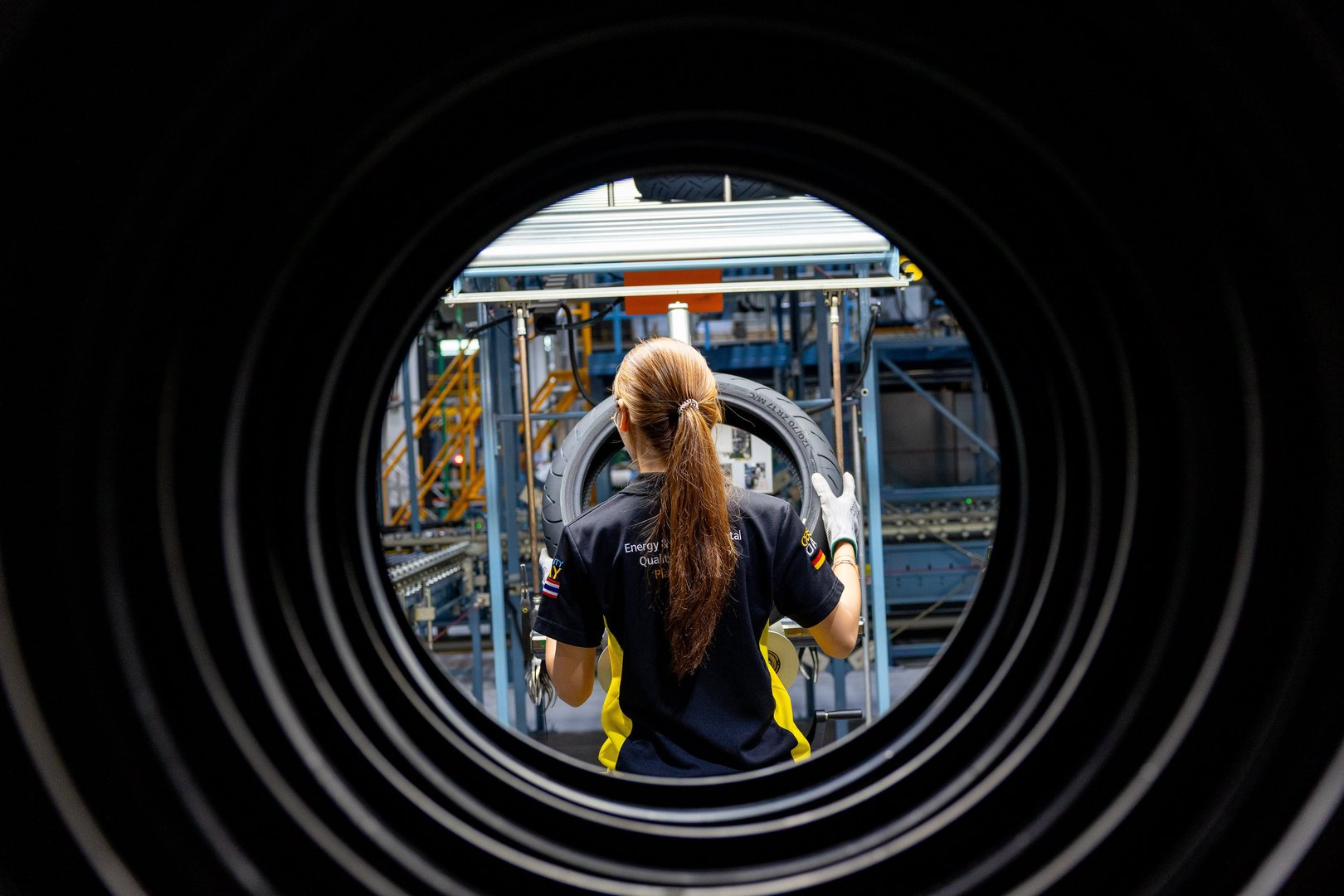
The company also stated that the facility uses highly automated production systems, including automated quality monitoring, digital traceability systems, profilometers, camera inspection tools, and automated handling processes intended to reduce production errors and standardize quality across global markets.
The expansion matters because Thailand has become one of the world’s most important automotive manufacturing hubs.
The country already serves as Southeast Asia’s largest vehicle production base and is aggressively positioning itself as a regional center for electric vehicles, advanced auto parts, and export-oriented manufacturing.
Tire producers benefit from Thailand’s established industrial estates, logistics infrastructure, skilled labor base, and proximity to major Asian shipping routes.
Thailand also occupies a critical position in the global rubber economy.
It remains one of the world’s largest natural rubber producers, giving tire manufacturers easier access to core raw materials while reducing transportation costs and supply-chain complexity.
That advantage has become more important after years of global shipping disruptions, pandemic-era supply shocks, and rising geopolitical pressure on multinational manufacturing networks.
The Rayong expansion also reflects how European industrial companies are adapting to slower growth conditions in parts of Europe while demand remains stronger in Asia.
Motorcycle usage continues to grow across Southeast Asia and South Asia, where two-wheel vehicles remain essential for commuting, logistics, and lower-cost transportation.
The investment comes during a period of intensified competition inside the global tire market.
Chinese tire manufacturers have rapidly improved manufacturing quality while competing aggressively on price.
Japanese, Korean, and Indian manufacturers are also expanding regional production capacity.
For premium European brands like Continental, maintaining market share increasingly depends on balancing advanced engineering with lower-cost regional manufacturing.
Continental has also emphasized sustainability and energy efficiency as part of the Rayong expansion.
The company stated that solar installations currently provide around thirteen percent of the facility’s electricity demand.
The plant was also recently awarded IATF certification, an international automotive manufacturing quality standard important for supplying original equipment manufacturers.
That certification has commercial significance beyond branding.
Major automakers increasingly require tightly documented production traceability, standardized quality control, and resilient supply reliability from component suppliers.
Securing international certification strengthens the Rayong plant’s role inside Continental’s global original-equipment supply chain, including potential supply relationships linked to electric vehicles and advanced motorcycle platforms.
The expansion also highlights Thailand’s continued success in attracting foreign industrial investment at a time when some multinational manufacturers are reassessing supply-chain exposure to China alone.
Rather than abandoning China, many global firms are diversifying production across multiple Asian jurisdictions.
Thailand has emerged as one of the largest beneficiaries of that strategy because it combines relatively stable industrial policy with deep automotive manufacturing experience.
For Thailand, the economic implications extend beyond direct employment.
Large-scale automotive manufacturing projects support local suppliers, logistics companies, industrial contractors, and technology transfer.
They also reinforce the government’s broader effort to move Thai manufacturing toward higher-value industrial production instead of competing solely on labor costs.
For Continental, the Rayong launch is ultimately about positioning.
The company is building manufacturing flexibility closer to future demand centers while protecting margins in a highly competitive global tire industry.
The combination of expanded passenger tire output and new radial motorcycle tire production gives the Thai facility a larger role inside Continental’s global production network and strengthens Southeast Asia’s position in the next phase of automotive supply-chain restructuring.
The expansion is fundamentally system-driven.
The move is not simply about one factory opening or one product line entering operation.
It reflects a broader restructuring of global tire manufacturing around regional supply chains, lower-cost production bases, faster delivery cycles, and rising demand for premium motorcycle and electric-vehicle-related mobility products across Asia.
What is confirmed is that Continental inaugurated the second expansion phase of its Rayong tire facility on May twenty-second, alongside the start of local radial motorcycle tire manufacturing.
The company said the project forms part of an investment program exceeding three hundred million euros, or roughly thirteen billion Thai baht.
The expansion increases annual passenger and light truck tire capacity by three million units and creates approximately six hundred additional jobs.
The Rayong facility already played an important role inside Continental’s global tire network before the latest expansion.
The plant had been producing passenger vehicle and motorcycle tires for regional and export markets since operations began several years ago.
Continental previously identified Southeast Asia as one of its strategic growth regions, particularly because of rising vehicle ownership, expanding logistics activity, and strong motorcycle demand across ASEAN economies.
The key development now is the introduction of radial motorcycle tire production at scale.
Radial tires differ from older diagonal or bias-ply designs because they use cord layers arranged at ninety degrees to the direction of travel, improving heat management, grip stability, durability, and high-speed performance.
They are widely used in premium motorcycles, sport touring bikes, and increasingly in electric two-wheelers.
Continental said the Rayong operation will manufacture both radial and diagonal motorcycle tires.
The company also stated that the facility uses highly automated production systems, including automated quality monitoring, digital traceability systems, profilometers, camera inspection tools, and automated handling processes intended to reduce production errors and standardize quality across global markets.
The expansion matters because Thailand has become one of the world’s most important automotive manufacturing hubs.
The country already serves as Southeast Asia’s largest vehicle production base and is aggressively positioning itself as a regional center for electric vehicles, advanced auto parts, and export-oriented manufacturing.
Tire producers benefit from Thailand’s established industrial estates, logistics infrastructure, skilled labor base, and proximity to major Asian shipping routes.
Thailand also occupies a critical position in the global rubber economy.
It remains one of the world’s largest natural rubber producers, giving tire manufacturers easier access to core raw materials while reducing transportation costs and supply-chain complexity.
That advantage has become more important after years of global shipping disruptions, pandemic-era supply shocks, and rising geopolitical pressure on multinational manufacturing networks.
The Rayong expansion also reflects how European industrial companies are adapting to slower growth conditions in parts of Europe while demand remains stronger in Asia.
Motorcycle usage continues to grow across Southeast Asia and South Asia, where two-wheel vehicles remain essential for commuting, logistics, and lower-cost transportation.
The investment comes during a period of intensified competition inside the global tire market.
Chinese tire manufacturers have rapidly improved manufacturing quality while competing aggressively on price.
Japanese, Korean, and Indian manufacturers are also expanding regional production capacity.
For premium European brands like Continental, maintaining market share increasingly depends on balancing advanced engineering with lower-cost regional manufacturing.
Continental has also emphasized sustainability and energy efficiency as part of the Rayong expansion.
The company stated that solar installations currently provide around thirteen percent of the facility’s electricity demand.
The plant was also recently awarded IATF certification, an international automotive manufacturing quality standard important for supplying original equipment manufacturers.
That certification has commercial significance beyond branding.
Major automakers increasingly require tightly documented production traceability, standardized quality control, and resilient supply reliability from component suppliers.
Securing international certification strengthens the Rayong plant’s role inside Continental’s global original-equipment supply chain, including potential supply relationships linked to electric vehicles and advanced motorcycle platforms.
The expansion also highlights Thailand’s continued success in attracting foreign industrial investment at a time when some multinational manufacturers are reassessing supply-chain exposure to China alone.
Rather than abandoning China, many global firms are diversifying production across multiple Asian jurisdictions.
Thailand has emerged as one of the largest beneficiaries of that strategy because it combines relatively stable industrial policy with deep automotive manufacturing experience.
For Thailand, the economic implications extend beyond direct employment.
Large-scale automotive manufacturing projects support local suppliers, logistics companies, industrial contractors, and technology transfer.
They also reinforce the government’s broader effort to move Thai manufacturing toward higher-value industrial production instead of competing solely on labor costs.
For Continental, the Rayong launch is ultimately about positioning.
The company is building manufacturing flexibility closer to future demand centers while protecting margins in a highly competitive global tire industry.
The combination of expanded passenger tire output and new radial motorcycle tire production gives the Thai facility a larger role inside Continental’s global production network and strengthens Southeast Asia’s position in the next phase of automotive supply-chain restructuring.