
Energy Risk, Uneven Growth and the New Geography of Global Capital
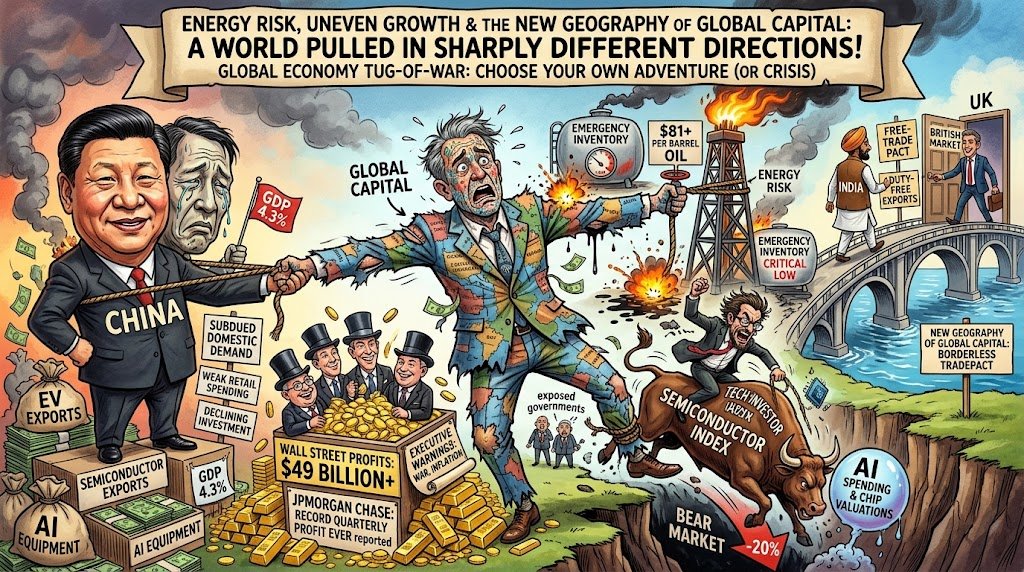
Oil-market pressure, China’s slowdown, record Wall Street profits, a semiconductor sell-off and a newly active India-United Kingdom trade pact revealed a global economy being pulled in sharply different directions.
Energy risk moved back to the center of the global economy as renewed Middle East tensions pushed oil above eighty-one dollars a barrel and lifted borrowing costs in the United States and Britain.
Emergency inventories have helped prevent a deeper supply shock, but those reserves have been drawn down substantially, leaving governments and central banks more exposed if disruption persists and inflationary pressure intensifies.
That vulnerability is arriving as China’s economy loses momentum.
Gross domestic product expanded four-point-three percent from a year earlier in the second quarter, the country’s weakest growth since late 2022. Strong exports of electric vehicles, semiconductors and artificial-intelligence equipment contrasted with weak retail spending, declining investment and continued strain in the property sector, reinforcing the gap between China’s industrial strength and its subdued domestic demand.
Wall Street presented the opposite picture.
JPMorgan Chase, Goldman Sachs, Bank of America, Citigroup and Wells Fargo earned more than forty-nine billion dollars during the quarter, a thirty-nine percent increase from a year earlier, driven by investment banking, equity trading and market financing.
JPMorgan recorded the largest quarterly profit ever reported by an American bank, even as executives warned that war, inflation and elevated asset prices could weaken the outlook.
The technology market exposed that tension almost immediately.
The Philadelphia Semiconductor Index fell four-point-eight percent on Friday and entered a bear market after losing roughly twenty percent during the month, as investors reassessed whether artificial-intelligence spending and chip valuations could continue rising at the same speed.
Against that fragmentation, India and the United Kingdom formally activated their free-trade agreement on July fifteenth.
The pact gives almost all Indian exports duty-free access to the British market while reducing barriers across manufacturing, services and professional mobility, placing a major bilateral trade corridor into active operation.
Emergency inventories have helped prevent a deeper supply shock, but those reserves have been drawn down substantially, leaving governments and central banks more exposed if disruption persists and inflationary pressure intensifies.
That vulnerability is arriving as China’s economy loses momentum.
Gross domestic product expanded four-point-three percent from a year earlier in the second quarter, the country’s weakest growth since late 2022. Strong exports of electric vehicles, semiconductors and artificial-intelligence equipment contrasted with weak retail spending, declining investment and continued strain in the property sector, reinforcing the gap between China’s industrial strength and its subdued domestic demand.
Wall Street presented the opposite picture.
JPMorgan Chase, Goldman Sachs, Bank of America, Citigroup and Wells Fargo earned more than forty-nine billion dollars during the quarter, a thirty-nine percent increase from a year earlier, driven by investment banking, equity trading and market financing.
JPMorgan recorded the largest quarterly profit ever reported by an American bank, even as executives warned that war, inflation and elevated asset prices could weaken the outlook.
The technology market exposed that tension almost immediately.
The Philadelphia Semiconductor Index fell four-point-eight percent on Friday and entered a bear market after losing roughly twenty percent during the month, as investors reassessed whether artificial-intelligence spending and chip valuations could continue rising at the same speed.
Against that fragmentation, India and the United Kingdom formally activated their free-trade agreement on July fifteenth.
The pact gives almost all Indian exports duty-free access to the British market while reducing barriers across manufacturing, services and professional mobility, placing a major bilateral trade corridor into active operation.