Mass Flight Disruptions Hit Asia as Airlines Across Region Face Widespread Delays and Cancellations
Hundreds of cancellations and thousands of delays ripple through major hubs in Thailand, Singapore, Japan, Hong Kong, Malaysia, China, and Indonesia, exposing system-wide aviation strain.
An EVENT-DRIVEN disruption has swept across Asia’s aviation network, triggering widespread flight cancellations and delays across multiple major hubs and exposing the fragility of tightly interconnected regional air traffic systems.
What is confirmed is that large-scale operational disruptions have affected airlines and airports across Thailand, Singapore, Japan, Hong Kong, Malaysia, China, and Indonesia, with reported figures indicating hundreds of cancellations and several thousand delayed flights across the region.
Major carriers including Cathay Pacific, ANA, Air China, and other regional airlines have been impacted as cascading scheduling disruptions spread through tightly linked airport networks.
The scale of disruption reflects how modern aviation systems operate as interdependent networks rather than isolated national infrastructures.
When congestion, weather disturbances, air traffic control constraints, or airport operational limits emerge in one major hub, delays propagate rapidly across connected routes, affecting aircraft rotations, crew scheduling, and gate availability far beyond the original disruption point.
The key issue is that Asia’s aviation sector has high-density routing concentrated through a limited number of major hubs.
Airports in Hong Kong, Singapore, Tokyo, Bangkok, and major Chinese cities serve as critical transfer and scheduling nodes for both regional and long-haul traffic.
When these nodes experience disruption, recovery is slow because aircraft, crews, and passengers are all part of tightly synchronized logistical systems that cannot be quickly decoupled.
Airlines such as Cathay Pacific, ANA, and Air China operate complex international networks that depend on precise timing for connecting flights.
Even minor disruptions in departure windows or landing slots can generate compounding delays across entire daily schedules.
As a result, initial interruptions often expand into multi-hour delays and widespread cancellations affecting both inbound and outbound routes.
The operational consequences extend beyond passenger inconvenience.
Airline revenue management systems rely on aircraft utilization efficiency, and prolonged delays reduce fleet productivity while increasing fuel consumption, crew overtime costs, and airport handling expenses.
In highly optimized aviation systems, even short-term disruption can generate disproportionate financial and logistical strain.
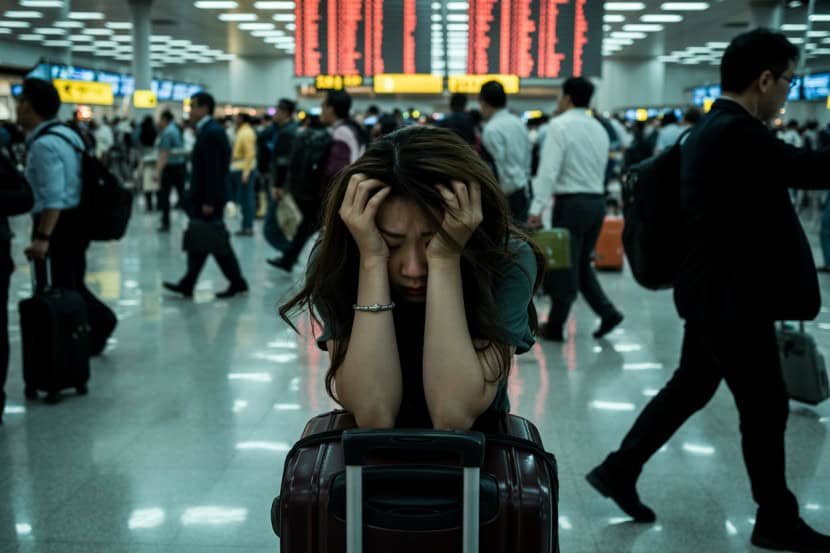
For passengers, the immediate impact has been missed connections, extended waiting times, and rebooking congestion at major airports.
Secondary effects include hotel demand spikes near airports, increased pressure on customer service systems, and cascading disruptions to travel itineraries across business and tourism sectors.
The broader implication is that Asia’s aviation growth—driven by rising middle-class travel demand and expanding regional connectivity—has outpaced some elements of operational resilience.
As traffic density increases, the margin for error in scheduling, air traffic coordination, and airport throughput narrows significantly.
The disruption underscores a structural reality of global aviation: tightly optimized systems deliver high efficiency in normal conditions but become vulnerable to rapid cascading failure when stress exceeds operational buffers.
Recovery will depend on normalization of flight schedules, rebalancing of aircraft positioning, and gradual clearing of backlog across major hubs.
What is confirmed is that large-scale operational disruptions have affected airlines and airports across Thailand, Singapore, Japan, Hong Kong, Malaysia, China, and Indonesia, with reported figures indicating hundreds of cancellations and several thousand delayed flights across the region.
Major carriers including Cathay Pacific, ANA, Air China, and other regional airlines have been impacted as cascading scheduling disruptions spread through tightly linked airport networks.
The scale of disruption reflects how modern aviation systems operate as interdependent networks rather than isolated national infrastructures.
When congestion, weather disturbances, air traffic control constraints, or airport operational limits emerge in one major hub, delays propagate rapidly across connected routes, affecting aircraft rotations, crew scheduling, and gate availability far beyond the original disruption point.
The key issue is that Asia’s aviation sector has high-density routing concentrated through a limited number of major hubs.
Airports in Hong Kong, Singapore, Tokyo, Bangkok, and major Chinese cities serve as critical transfer and scheduling nodes for both regional and long-haul traffic.
When these nodes experience disruption, recovery is slow because aircraft, crews, and passengers are all part of tightly synchronized logistical systems that cannot be quickly decoupled.
Airlines such as Cathay Pacific, ANA, and Air China operate complex international networks that depend on precise timing for connecting flights.
Even minor disruptions in departure windows or landing slots can generate compounding delays across entire daily schedules.
As a result, initial interruptions often expand into multi-hour delays and widespread cancellations affecting both inbound and outbound routes.
The operational consequences extend beyond passenger inconvenience.
Airline revenue management systems rely on aircraft utilization efficiency, and prolonged delays reduce fleet productivity while increasing fuel consumption, crew overtime costs, and airport handling expenses.
In highly optimized aviation systems, even short-term disruption can generate disproportionate financial and logistical strain.
For passengers, the immediate impact has been missed connections, extended waiting times, and rebooking congestion at major airports.
Secondary effects include hotel demand spikes near airports, increased pressure on customer service systems, and cascading disruptions to travel itineraries across business and tourism sectors.
The broader implication is that Asia’s aviation growth—driven by rising middle-class travel demand and expanding regional connectivity—has outpaced some elements of operational resilience.
As traffic density increases, the margin for error in scheduling, air traffic coordination, and airport throughput narrows significantly.
The disruption underscores a structural reality of global aviation: tightly optimized systems deliver high efficiency in normal conditions but become vulnerable to rapid cascading failure when stress exceeds operational buffers.
Recovery will depend on normalization of flight schedules, rebalancing of aircraft positioning, and gradual clearing of backlog across major hubs.