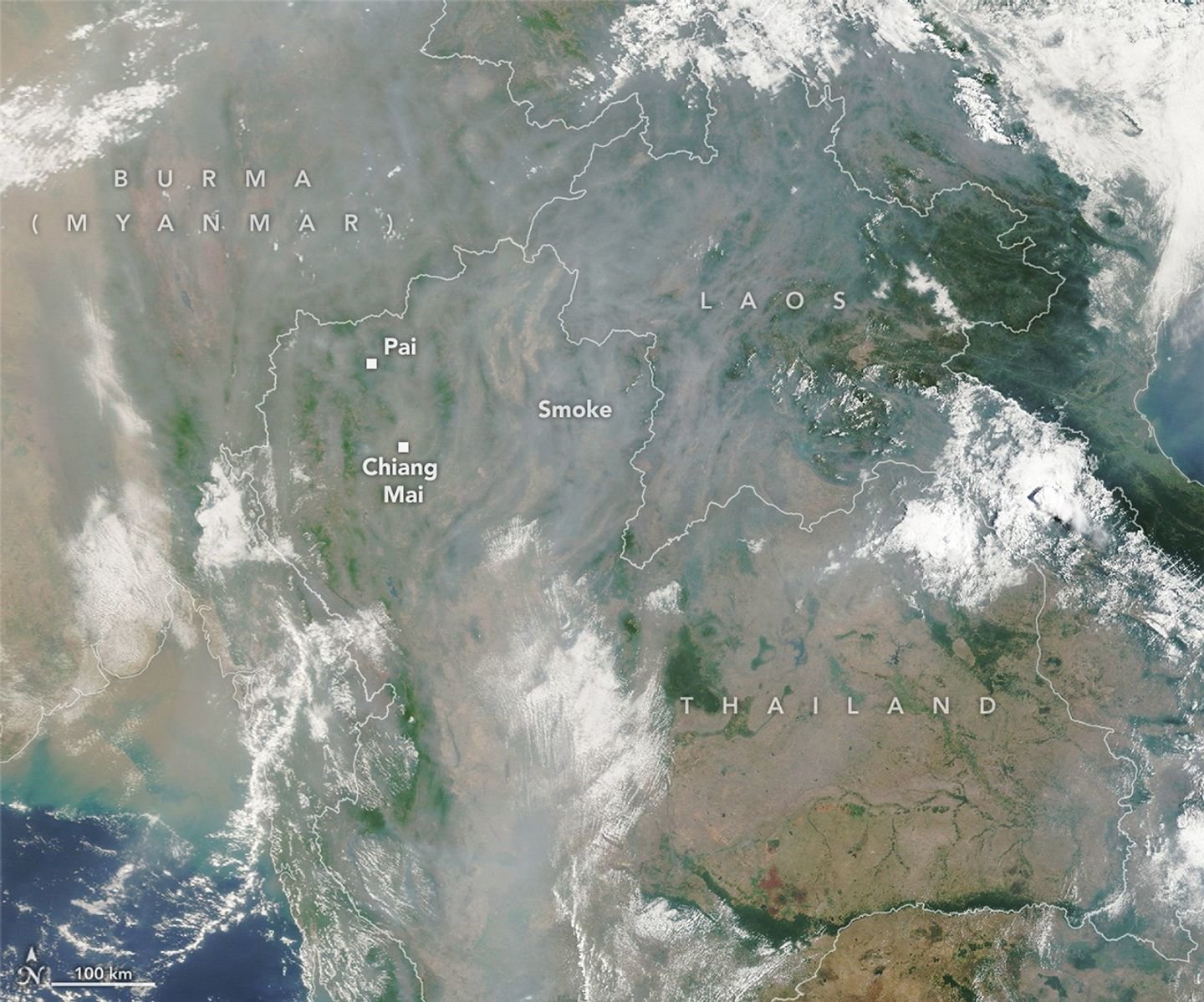
Thick haze blankets northern Thailand as seasonal fires drive severe air pollution crisis
Satellite imagery and ground reports confirm widespread smoke over Chiang Mai and surrounding provinces, with authorities warning of persistently hazardous air quality during peak burning season
Northern Thailand has been engulfed by dense smoke as seasonal fires and agricultural burning combine with stagnant weather conditions to create a severe air pollution episode across the region, with Chiang Mai and surrounding provinces among the worst affected.
Satellite observations captured on April 22 show extensive haze shrouding valleys and mountain ranges that are normally visible across northern Thailand, with smoke layers significantly reducing visibility over large areas.
The conditions reflect the annual dry-season pattern, when fire activity linked to land clearing and forest management intensifies across the Mekong sub-region.
Ground-based monitoring has recorded persistently elevated levels of fine particulate matter (PM2.5), particularly in Chiang Mai, Chiang Rai, Lamphun, and other northern provinces.
Air quality readings in recent days have frequently fallen into unhealthy and very unhealthy categories, with some locations experiencing hazardous spikes during periods of intensified burning and weak air dispersion.
Authorities have identified a combination of agricultural burning, forest fires, and regional smoke transport as the primary drivers of the haze.
Meteorological conditions, including dry weather and limited atmospheric ventilation, have further contributed to the accumulation of pollutants in low-lying valleys where major population centres are located.
The situation has drawn renewed attention to the structural nature of northern Thailand’s seasonal haze, which typically peaks between March and April before easing with the arrival of the monsoon rains.
During this period, smoke from both domestic and cross-border fire activity can spread widely across the Mekong region, occasionally affecting neighbouring countries as well.
Local officials have continued to coordinate fire suppression efforts, monitoring hotspots and deploying resources to contain burning areas where possible.
At the same time, public health advisories have urged residents to limit outdoor exposure during periods of elevated pollution, particularly vulnerable groups such as children, the elderly, and those with respiratory conditions.
Despite recurring challenges, the region’s authorities emphasise ongoing efforts to manage fire activity and improve coordination across agencies, while longer-term discussions continue on reducing reliance on seasonal burning practices and strengthening air quality management strategies.
As conditions remain closely tied to weather patterns and fire activity, improvement is expected only when sustained rainfall arrives and suppresses ongoing hotspots across the northern highlands.
Satellite observations captured on April 22 show extensive haze shrouding valleys and mountain ranges that are normally visible across northern Thailand, with smoke layers significantly reducing visibility over large areas.
The conditions reflect the annual dry-season pattern, when fire activity linked to land clearing and forest management intensifies across the Mekong sub-region.
Ground-based monitoring has recorded persistently elevated levels of fine particulate matter (PM2.5), particularly in Chiang Mai, Chiang Rai, Lamphun, and other northern provinces.
Air quality readings in recent days have frequently fallen into unhealthy and very unhealthy categories, with some locations experiencing hazardous spikes during periods of intensified burning and weak air dispersion.
Authorities have identified a combination of agricultural burning, forest fires, and regional smoke transport as the primary drivers of the haze.
Meteorological conditions, including dry weather and limited atmospheric ventilation, have further contributed to the accumulation of pollutants in low-lying valleys where major population centres are located.
The situation has drawn renewed attention to the structural nature of northern Thailand’s seasonal haze, which typically peaks between March and April before easing with the arrival of the monsoon rains.
During this period, smoke from both domestic and cross-border fire activity can spread widely across the Mekong region, occasionally affecting neighbouring countries as well.
Local officials have continued to coordinate fire suppression efforts, monitoring hotspots and deploying resources to contain burning areas where possible.
At the same time, public health advisories have urged residents to limit outdoor exposure during periods of elevated pollution, particularly vulnerable groups such as children, the elderly, and those with respiratory conditions.
Despite recurring challenges, the region’s authorities emphasise ongoing efforts to manage fire activity and improve coordination across agencies, while longer-term discussions continue on reducing reliance on seasonal burning practices and strengthening air quality management strategies.
As conditions remain closely tied to weather patterns and fire activity, improvement is expected only when sustained rainfall arrives and suppresses ongoing hotspots across the northern highlands.