Chulalongkorn University Advances Global AI Tool for Gastrointestinal Cancer Detection
Thai research team develops real-time AI-assisted diagnostic system to enhance detection of GI cancers during endoscopy
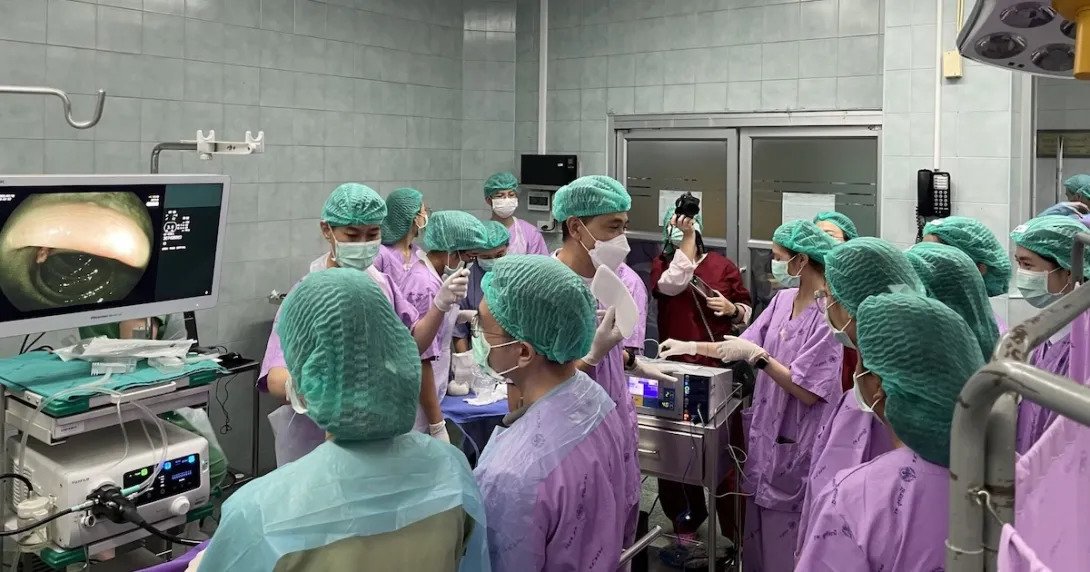
Chulalongkorn University researchers in Thailand are developing a cutting-edge artificial intelligence system aimed at improving the real-time detection of gastrointestinal cancers during endoscopic procedures, with significant implications for global cancer screening and diagnosis.
The project — known as “DeepGI” and driven by collaboration between the Faculty of Engineering and the Faculty of Medicine — leverages deep learning to analyse endoscopic video data and identify abnormal tissue with high precision.{{turn0search0}}{{turn0search14}}
DeepGI has been shortlisted for the prestigious THE Awards Asia 2026 in the Research Project of the Year: STEM category, underscoring its potential impact on preventive medicine and public health.
The system is designed to support physicians during colonoscopy and upper gastrointestinal endoscopy by detecting and classifying abnormal tissue in real time with accuracy exceeding ninety per cent, enhancing early detection of colorectal and potentially other GI cancers.{{turn0search0}}
The innovation builds on broader global trends in computer-aided detection for gastrointestinal diagnostics, where AI systems are increasingly shown to match or exceed human performance in identifying precancerous lesions and tumors during endoscopic screening.
Emerging research underscores the role of AI in reducing missed lesions and improving diagnostic workflows in digestive oncology.{{turn0search13}}{{turn0search16}}
Researchers behind DeepGI envision broad deployment of the technology to support clinicians in both high-resource and resource-limited settings, facilitating more consistent screening outcomes and reducing variability tied to operator experience.
By translating deep learning advances into clinical assistance tools, the initiative aligns with global efforts to harness AI for earlier cancer detection, a critical factor in improving treatment success rates.
The project’s recognition at the Asia-wide awards highlights Thailand’s contribution to innovation at the intersection of engineering, medicine and artificial intelligence, with implications for public health far beyond its borders.
The project — known as “DeepGI” and driven by collaboration between the Faculty of Engineering and the Faculty of Medicine — leverages deep learning to analyse endoscopic video data and identify abnormal tissue with high precision.{{turn0search0}}{{turn0search14}}
DeepGI has been shortlisted for the prestigious THE Awards Asia 2026 in the Research Project of the Year: STEM category, underscoring its potential impact on preventive medicine and public health.
The system is designed to support physicians during colonoscopy and upper gastrointestinal endoscopy by detecting and classifying abnormal tissue in real time with accuracy exceeding ninety per cent, enhancing early detection of colorectal and potentially other GI cancers.{{turn0search0}}
The innovation builds on broader global trends in computer-aided detection for gastrointestinal diagnostics, where AI systems are increasingly shown to match or exceed human performance in identifying precancerous lesions and tumors during endoscopic screening.
Emerging research underscores the role of AI in reducing missed lesions and improving diagnostic workflows in digestive oncology.{{turn0search13}}{{turn0search16}}
Researchers behind DeepGI envision broad deployment of the technology to support clinicians in both high-resource and resource-limited settings, facilitating more consistent screening outcomes and reducing variability tied to operator experience.
By translating deep learning advances into clinical assistance tools, the initiative aligns with global efforts to harness AI for earlier cancer detection, a critical factor in improving treatment success rates.
The project’s recognition at the Asia-wide awards highlights Thailand’s contribution to innovation at the intersection of engineering, medicine and artificial intelligence, with implications for public health far beyond its borders.