
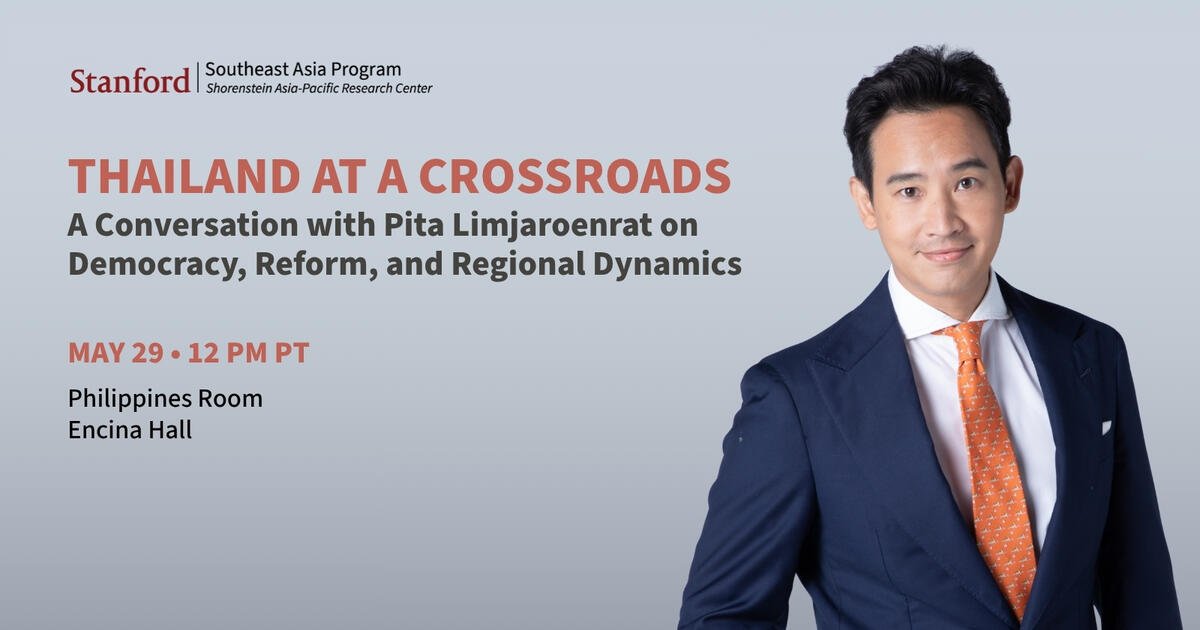
Pita Limjaroenrat and Thailand’s Democratic Stalemate: Reform Leader Returns to the Spotlight Amid Deep Political Uncertainty
As Thailand’s former opposition leader re-emerges on the global stage, his trajectory highlights unresolved tensions between electoral mandate, judicial power, and the country’s fragile democratic system.
Thailand’s political trajectory continues to be shaped by a structural clash between electoral mandates and entrenched institutional power, a dynamic embodied by former opposition leader Pita Limjaroenrat.
The central driver of the story is not a single event but an institutional system in which elected parties repeatedly confront legal and constitutional constraints that can override electoral outcomes.
Pita Limjaroenrat, formerly the leader of the Move Forward Party, rose to national prominence after his party won the most votes and seats in Thailand’s 2023 general election.
Despite that outcome, he was unable to become prime minister, as parliamentary arithmetic and Senate approval rules prevented his coalition from forming a government.
His party was later dissolved by court order, and he was banned from political activity for a period of years under rulings linked to alleged violations of electoral and political regulations.
These developments placed Pita at the center of a broader debate over the balance of democratic legitimacy in Thailand.
On one side is the electorate, which in 2023 delivered a clear mandate for reformist and anti-establishment policies.
On the other is a network of institutions—including the military-aligned Senate and the Constitutional Court—that retain decisive influence over government formation and party survival.
What is confirmed in recent reporting and public events is that Pita remains politically active despite his formal exclusion from elected office.
He continues to participate in international forums and policy discussions focused on Thailand’s democratic trajectory, economic inequality, and regional geopolitical pressures.
A recent high-profile public discussion framed his perspective on Thailand as a country facing unresolved questions about constitutional reform, military influence in politics, and the future of political competition.
The stakes surrounding his role extend beyond personal political ambition.
His party’s electoral success demonstrated a generational shift in Thai voting behavior, particularly among younger citizens who have increasingly supported structural reforms.
The subsequent legal and institutional pushback against his party has intensified concerns among observers about the durability of competitive elections in Thailand.
At the same time, the political vacuum created by the dissolution of his party has reshaped the opposition landscape.
Successor movements and rebranded political groups have attempted to maintain momentum, but they operate under persistent legal scrutiny and shifting regulatory constraints that limit their strategic flexibility.
Regionally, Thailand’s domestic instability intersects with broader Southeast Asian dynamics, including supply chain realignment, regional security tensions, and competition between major powers.
Pita’s commentary in recent discussions has emphasized that Thailand’s internal governance structure increasingly affects its external economic and diplomatic positioning, particularly within ASEAN frameworks.
The immediate consequence of this trajectory is a political system characterized by recurring cycles: electoral mobilization followed by institutional containment, and then reorganization of opposition forces under new legal identities.
This pattern has become a defining feature of Thailand’s modern political environment, shaping investor confidence, policy continuity, and long-term governance planning.
As Pita continues to reappear in policy and academic forums outside formal office, Thailand’s core political question remains unchanged: whether electoral victories can translate into governing authority, or whether institutional mechanisms will continue to determine political outcomes regardless of voter preference.