Thailand Approves TikTok-Linked Data Center as Digital Investment Push Accelerates
Board of Investment clears major infrastructure projects including a large-scale data facility tied to ByteDance amid Thailand’s bid to strengthen its regional tech hub status
SYSTEM-DRIVEN investment policy in Thailand’s digital economy has taken a further step forward after the country’s Board of Investment approved a package of infrastructure projects that includes a major data centre linked to TikTok’s parent company, ByteDance, alongside two additional technology-related developments.
What is confirmed is that Thailand’s Board of Investment, the agency responsible for approving and incentivizing large-scale foreign and domestic investment projects, has granted approval for multiple projects collectively aimed at expanding the country’s digital infrastructure capacity.
Among them is a data centre project associated with ByteDance, the Chinese technology group that owns TikTok, marking one of the most high-profile digital infrastructure commitments in Southeast Asia this year.
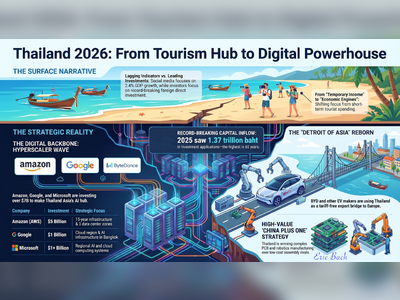
The approvals are part of Thailand’s broader strategy to position itself as a regional hub for cloud computing, data storage, and digital services.
Authorities have been actively courting foreign technology investment in recent years, offering tax incentives and streamlined regulatory pathways for companies willing to establish long-term infrastructure in the country.
The TikTok-linked data centre project is significant because data infrastructure is increasingly central to global digital platforms.
Large social media and AI-driven companies require geographically distributed data centres to reduce latency, comply with local data governance rules, and improve service reliability.
Thailand’s location, energy availability, and relatively developed digital backbone make it an attractive node for such investments within ASEAN.
Alongside the ByteDance-linked project, two additional approved developments focus on expanding Thailand’s digital and industrial capacity, reinforcing a pattern of investment clustering in high-tech infrastructure rather than traditional manufacturing alone.
Officials have framed these approvals as part of a transition toward a more knowledge- and data-driven economy.
The investment approvals also reflect broader regional competition.
Southeast Asian economies including Malaysia, Singapore, and Vietnam are actively competing to attract hyperscale data centres and cloud infrastructure projects from global technology firms.
Thailand’s latest approvals signal an effort to remain competitive in that race by offering scale, regulatory stability, and infrastructure readiness.
A key mechanism underpinning these approvals is the Board of Investment’s incentive structure, which can include corporate tax exemptions, land-use facilitation, and relaxed import duties on equipment.
These tools are designed to reduce upfront costs for foreign investors building capital-intensive infrastructure such as data centres, which require substantial power supply, cooling systems, and network connectivity.
The implications extend beyond foreign direct investment figures.
Data centres are energy-intensive facilities, and their expansion raises questions about electricity demand, grid capacity, and long-term sustainability planning.
At the same time, they create demand for high-skilled technical labor and strengthen domestic digital ecosystems by improving latency and data sovereignty for regional users.
For Thailand, the approval of a TikTok-linked infrastructure project also reflects the deepening entanglement between global consumer platforms and national infrastructure policy.
Digital services that operate across borders increasingly depend on physical infrastructure embedded within individual countries, giving governments more leverage but also increasing regulatory complexity.
The latest approvals therefore signal both continuity and escalation: continuity in Thailand’s long-term strategy to become a regional digital hub, and escalation in the scale and visibility of foreign technology infrastructure now being integrated into its economy.
The next phase will be execution, including construction timelines, energy provisioning, and integration into regional data networks, all of which will determine how quickly these approved projects translate into operational capacity.
What is confirmed is that Thailand’s Board of Investment, the agency responsible for approving and incentivizing large-scale foreign and domestic investment projects, has granted approval for multiple projects collectively aimed at expanding the country’s digital infrastructure capacity.
Among them is a data centre project associated with ByteDance, the Chinese technology group that owns TikTok, marking one of the most high-profile digital infrastructure commitments in Southeast Asia this year.
The approvals are part of Thailand’s broader strategy to position itself as a regional hub for cloud computing, data storage, and digital services.
Authorities have been actively courting foreign technology investment in recent years, offering tax incentives and streamlined regulatory pathways for companies willing to establish long-term infrastructure in the country.
The TikTok-linked data centre project is significant because data infrastructure is increasingly central to global digital platforms.
Large social media and AI-driven companies require geographically distributed data centres to reduce latency, comply with local data governance rules, and improve service reliability.
Thailand’s location, energy availability, and relatively developed digital backbone make it an attractive node for such investments within ASEAN.
Alongside the ByteDance-linked project, two additional approved developments focus on expanding Thailand’s digital and industrial capacity, reinforcing a pattern of investment clustering in high-tech infrastructure rather than traditional manufacturing alone.
Officials have framed these approvals as part of a transition toward a more knowledge- and data-driven economy.
The investment approvals also reflect broader regional competition.
Southeast Asian economies including Malaysia, Singapore, and Vietnam are actively competing to attract hyperscale data centres and cloud infrastructure projects from global technology firms.
Thailand’s latest approvals signal an effort to remain competitive in that race by offering scale, regulatory stability, and infrastructure readiness.
A key mechanism underpinning these approvals is the Board of Investment’s incentive structure, which can include corporate tax exemptions, land-use facilitation, and relaxed import duties on equipment.
These tools are designed to reduce upfront costs for foreign investors building capital-intensive infrastructure such as data centres, which require substantial power supply, cooling systems, and network connectivity.
The implications extend beyond foreign direct investment figures.
Data centres are energy-intensive facilities, and their expansion raises questions about electricity demand, grid capacity, and long-term sustainability planning.
At the same time, they create demand for high-skilled technical labor and strengthen domestic digital ecosystems by improving latency and data sovereignty for regional users.
For Thailand, the approval of a TikTok-linked infrastructure project also reflects the deepening entanglement between global consumer platforms and national infrastructure policy.
Digital services that operate across borders increasingly depend on physical infrastructure embedded within individual countries, giving governments more leverage but also increasing regulatory complexity.
The latest approvals therefore signal both continuity and escalation: continuity in Thailand’s long-term strategy to become a regional digital hub, and escalation in the scale and visibility of foreign technology infrastructure now being integrated into its economy.
The next phase will be execution, including construction timelines, energy provisioning, and integration into regional data networks, all of which will determine how quickly these approved projects translate into operational capacity.