Thailand’s Push Against Wrong-Way Motorcyclists Exposes a Deadly Road Design Problem
New safety campaigns targeting illegal opposite-direction riding highlight how infrastructure gaps, enforcement limits, and rider behavior combine to drive high motorcycle fatality rates
SYSTEM-DRIVEN: The campaign against wrong-way motorcyclists in Thailand reflects a broader structural road safety failure rather than a single enforcement effort.
It sits at the intersection of infrastructure design, traffic law compliance, and long-standing behavioral patterns among riders.
Wrong-way motorcycling—riding against the legal flow of traffic—has become a persistent and dangerous feature of Thailand’s road system, particularly on urban arterials, suburban highways, and service roads.
Authorities and insurers have increasingly framed it not as isolated misconduct but as a systemic safety issue linked to road layouts that force long detours for U-turns, inconsistent enforcement, and rider decisions driven by speed and convenience.
Recent safety campaigns have begun explicitly targeting this behavior.
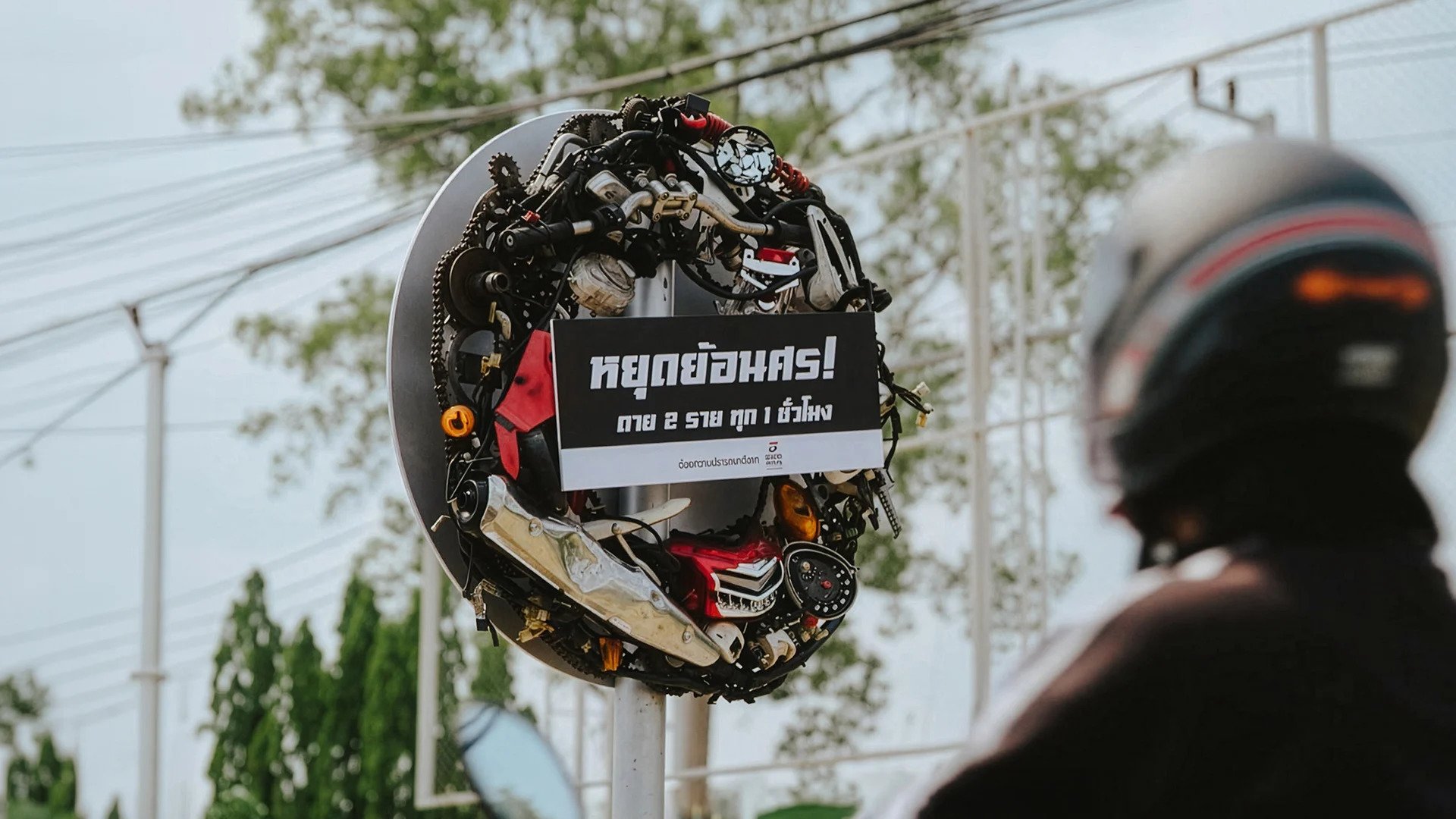
One initiative, framed around the idea that the most dangerous violations are often invisible to the rider until it is too late, highlights a core design flaw: standard traffic signage is oriented for compliant traffic flow.
Riders moving in the wrong direction often never see warnings intended to prevent them from entering hazardous zones.
This insight has led to experimental signage and enforcement strategies aimed specifically at confronting riders traveling against traffic in real time rather than relying on general awareness campaigns.
Wrong-way riding is widely recognized as especially lethal because it increases the likelihood of head-on collisions at high relative speeds.
Road safety research in Thailand has repeatedly identified motorcyclists as the dominant victim group in traffic fatalities, with motorcycles accounting for the majority of road deaths.
Structural factors such as limited protected lanes, mixed traffic conditions, and high reliance on motorcycles for short-distance travel amplify exposure to these risks.
The problem is not solely behavioral.
Analysts and transport researchers have pointed to road design features that encourage shortcuts through illegal maneuvers.
In some areas, legal U-turn points or junctions are spaced far apart, prompting riders to cross medians or travel briefly against traffic to save time.
Combined with uneven enforcement, this creates a normalized pattern of risk-taking that persists even in high-visibility corridors.
Authorities have responded with stepped-up policing in selected districts, including fines for wrong-way driving and roadside enforcement operations.
However, enforcement intensity varies significantly by location and time, and public commentary around these measures frequently notes that short-term crackdowns do not fully change ingrained riding habits without sustained monitoring and redesign of road access points.
Insurance-linked safety campaigns have also entered the space, framing prevention as a financial as well as public health issue.
With motorcycles dominating injury statistics, insurers and partners have increasingly positioned targeted interventions—rather than broad messaging—as more effective tools for reducing fatalities.
These initiatives attempt to intervene at the exact moment of rule-breaking rather than relying on post-incident consequences.
The stakes are high and measurable.
Thailand continues to rank among countries with the highest road fatality burdens, and motorcyclists remain disproportionately affected.
Wrong-way riding adds a particularly severe risk multiplier because it removes the natural expectation of traffic direction, leaving both riders and oncoming drivers with minimal reaction time.
The emerging policy direction is therefore shifting away from generic warnings toward behavior-specific interventions, combining enforcement, design experimentation, and real-time visual cues.
The effectiveness of these measures will depend on whether they can overcome the underlying structural incentives that make wrong-way riding an attractive shortcut in the first place.
It sits at the intersection of infrastructure design, traffic law compliance, and long-standing behavioral patterns among riders.
Wrong-way motorcycling—riding against the legal flow of traffic—has become a persistent and dangerous feature of Thailand’s road system, particularly on urban arterials, suburban highways, and service roads.
Authorities and insurers have increasingly framed it not as isolated misconduct but as a systemic safety issue linked to road layouts that force long detours for U-turns, inconsistent enforcement, and rider decisions driven by speed and convenience.
Recent safety campaigns have begun explicitly targeting this behavior.
One initiative, framed around the idea that the most dangerous violations are often invisible to the rider until it is too late, highlights a core design flaw: standard traffic signage is oriented for compliant traffic flow.
Riders moving in the wrong direction often never see warnings intended to prevent them from entering hazardous zones.
This insight has led to experimental signage and enforcement strategies aimed specifically at confronting riders traveling against traffic in real time rather than relying on general awareness campaigns.
Wrong-way riding is widely recognized as especially lethal because it increases the likelihood of head-on collisions at high relative speeds.
Road safety research in Thailand has repeatedly identified motorcyclists as the dominant victim group in traffic fatalities, with motorcycles accounting for the majority of road deaths.
Structural factors such as limited protected lanes, mixed traffic conditions, and high reliance on motorcycles for short-distance travel amplify exposure to these risks.
The problem is not solely behavioral.
Analysts and transport researchers have pointed to road design features that encourage shortcuts through illegal maneuvers.
In some areas, legal U-turn points or junctions are spaced far apart, prompting riders to cross medians or travel briefly against traffic to save time.
Combined with uneven enforcement, this creates a normalized pattern of risk-taking that persists even in high-visibility corridors.
Authorities have responded with stepped-up policing in selected districts, including fines for wrong-way driving and roadside enforcement operations.
However, enforcement intensity varies significantly by location and time, and public commentary around these measures frequently notes that short-term crackdowns do not fully change ingrained riding habits without sustained monitoring and redesign of road access points.
Insurance-linked safety campaigns have also entered the space, framing prevention as a financial as well as public health issue.
With motorcycles dominating injury statistics, insurers and partners have increasingly positioned targeted interventions—rather than broad messaging—as more effective tools for reducing fatalities.
These initiatives attempt to intervene at the exact moment of rule-breaking rather than relying on post-incident consequences.
The stakes are high and measurable.
Thailand continues to rank among countries with the highest road fatality burdens, and motorcyclists remain disproportionately affected.
Wrong-way riding adds a particularly severe risk multiplier because it removes the natural expectation of traffic direction, leaving both riders and oncoming drivers with minimal reaction time.
The emerging policy direction is therefore shifting away from generic warnings toward behavior-specific interventions, combining enforcement, design experimentation, and real-time visual cues.
The effectiveness of these measures will depend on whether they can overcome the underlying structural incentives that make wrong-way riding an attractive shortcut in the first place.