
Thailand’s Traffic Lights Get Romantic Makeover for Valentine’s Day
Heart-shaped signals and festive displays add charm to Bangkok streets in celebration of love and road safety
Motorists and pedestrians in parts of Thailand were greeted with an unexpected sight this Valentine’s Day as traffic lights in selected areas took on a romantic twist.
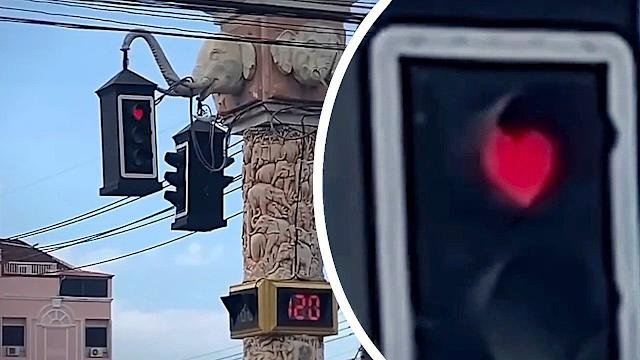
In a creative seasonal gesture, standard red signals were replaced with illuminated heart shapes, transforming routine road junctions into festive symbols of celebration.
The initiative, introduced in busy districts of Bangkok and other urban centres, was designed to mark Valentine’s Day while promoting road safety awareness.
Authorities said the heart-shaped red lights maintained the same traffic-control function and visibility standards as conventional signals, ensuring that safety remained paramount even as the city embraced the occasion’s lighter spirit.
The decorative adaptation quickly drew attention on social media, with residents and visitors sharing photographs of intersections glowing with red hearts.
Many described the initiative as a welcome moment of levity amid the pace of urban life, blending civic infrastructure with cultural celebration.
Officials emphasised that the modified signals were temporary and carefully monitored to avoid confusion for drivers.
Traffic police were deployed in high-footfall areas to ensure smooth vehicle flow and pedestrian crossings, particularly in popular commercial and shopping districts where Valentine’s Day activity was at its peak.
Thailand has in recent years encouraged creative public campaigns to enhance community engagement and public awareness.
By incorporating festive elements into everyday settings, authorities aim to strengthen civic participation while maintaining order and safety.
The Valentine’s Day traffic lights offered a vivid example of how infrastructure can be adapted to reflect national celebrations without compromising functionality.
As evening fell, the glowing heart signals added a distinctive backdrop to the city’s festivities, underscoring how public spaces can be transformed to reflect shared cultural moments while continuing to serve their essential purpose.
In a creative seasonal gesture, standard red signals were replaced with illuminated heart shapes, transforming routine road junctions into festive symbols of celebration.
The initiative, introduced in busy districts of Bangkok and other urban centres, was designed to mark Valentine’s Day while promoting road safety awareness.
Authorities said the heart-shaped red lights maintained the same traffic-control function and visibility standards as conventional signals, ensuring that safety remained paramount even as the city embraced the occasion’s lighter spirit.
The decorative adaptation quickly drew attention on social media, with residents and visitors sharing photographs of intersections glowing with red hearts.
Many described the initiative as a welcome moment of levity amid the pace of urban life, blending civic infrastructure with cultural celebration.
Officials emphasised that the modified signals were temporary and carefully monitored to avoid confusion for drivers.
Traffic police were deployed in high-footfall areas to ensure smooth vehicle flow and pedestrian crossings, particularly in popular commercial and shopping districts where Valentine’s Day activity was at its peak.
Thailand has in recent years encouraged creative public campaigns to enhance community engagement and public awareness.
By incorporating festive elements into everyday settings, authorities aim to strengthen civic participation while maintaining order and safety.
The Valentine’s Day traffic lights offered a vivid example of how infrastructure can be adapted to reflect national celebrations without compromising functionality.
As evening fell, the glowing heart signals added a distinctive backdrop to the city’s festivities, underscoring how public spaces can be transformed to reflect shared cultural moments while continuing to serve their essential purpose.