Thailand Tightens Cross-Border Vehicle Rules at Mae Sot–Myawaddy Frontier
Stricter ownership verification is reshaping daily trade and mobility across one of Southeast Asia’s most sensitive border crossings amid rising security and fuel pressures
A SYSTEM-DRIVEN tightening of border control procedures is reshaping cross-border mobility between Thailand and Myanmar, with Thai authorities introducing stricter ownership verification for Myanmar-registered vehicles entering Mae Sot from Myawaddy, a key commercial and transit corridor on the Thai–Myanmar frontier.
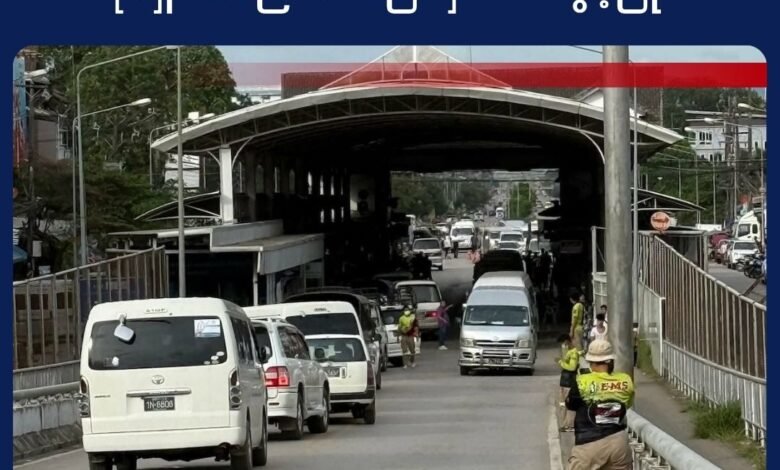
What is confirmed is that Thai border officials in Tak province have recently enforced new rules requiring Myanmar vehicles crossing at the Mae Sot–Myawaddy Friendship Bridge to present clear, verifiable proof of ownership that matches registration documents.
Vehicles with mismatched ownership records are being turned back unless drivers can provide documented proof of purchase or valid transfer papers linking them to the original registered owner.
The change represents a tightening of an earlier, more flexible system in which vehicles with legitimate registration and tax compliance could cross even if ownership details did not fully align with the current user.
Under the revised enforcement approach, documentation integrity has become the decisive factor for border passage, significantly raising the compliance threshold for private vehicles and small commercial operators.
The mechanism driving the shift is administrative risk control.
Authorities are responding to long-standing concerns in the border region over document irregularities, informal vehicle transfers, and the use of improperly registered vehicles in cross-border activity.
The Mae Sot–Myawaddy crossing is one of the most heavily used land routes between Thailand and Myanmar, supporting trade, transport services, tourism, and daily commuting for residents in both directions.
The policy change has immediate operational consequences.
Vehicles lacking complete or consistent documentation are being denied entry at the checkpoint, creating disruption for individuals who purchased vehicles through informal resale channels or whose paperwork does not reflect updated ownership records.
For some operators, tracing original owners to validate transfers has become a practical obstacle, especially in cases involving secondary or informal markets.
The tighter controls also intersect with broader border management pressures.
In recent years, the Mae Sot–Myawaddy corridor has experienced fluctuating restrictions linked to security concerns, fuel shortages, and enforcement campaigns targeting smuggling and illicit cross-border flows.
This includes periodic crackdowns on fuel transport and heightened inspections of goods and vehicles moving across the border.
The consequences extend beyond individual vehicle owners.
The crossing is a critical artery for local economies on both sides of the Moei River, supporting small-scale commerce, transport services, and supply chains tied to markets in Tak province and Myanmar’s Karen State.
Any friction at the checkpoint translates quickly into delays, reduced traffic flow, and increased costs for cross-border movement.
For Thailand, the tightening aligns with a broader trend of intensified border governance, where documentation compliance, customs enforcement, and security screening are being applied more rigorously in response to irregular trade flows and regional instability.
For Myanmar-linked operators, it raises the administrative bar for participation in cross-border mobility, particularly for privately owned vehicles operating in semi-formal transport ecosystems.
The immediate outcome is a more restrictive entry regime at one of the most active land crossings between the two countries, where vehicle passage now depends on strict alignment between ownership records and physical users, effectively shifting the border from a permissive transit point to a documentation-controlled checkpoint environment.
What is confirmed is that Thai border officials in Tak province have recently enforced new rules requiring Myanmar vehicles crossing at the Mae Sot–Myawaddy Friendship Bridge to present clear, verifiable proof of ownership that matches registration documents.
Vehicles with mismatched ownership records are being turned back unless drivers can provide documented proof of purchase or valid transfer papers linking them to the original registered owner.
The change represents a tightening of an earlier, more flexible system in which vehicles with legitimate registration and tax compliance could cross even if ownership details did not fully align with the current user.
Under the revised enforcement approach, documentation integrity has become the decisive factor for border passage, significantly raising the compliance threshold for private vehicles and small commercial operators.
The mechanism driving the shift is administrative risk control.
Authorities are responding to long-standing concerns in the border region over document irregularities, informal vehicle transfers, and the use of improperly registered vehicles in cross-border activity.
The Mae Sot–Myawaddy crossing is one of the most heavily used land routes between Thailand and Myanmar, supporting trade, transport services, tourism, and daily commuting for residents in both directions.
The policy change has immediate operational consequences.
Vehicles lacking complete or consistent documentation are being denied entry at the checkpoint, creating disruption for individuals who purchased vehicles through informal resale channels or whose paperwork does not reflect updated ownership records.
For some operators, tracing original owners to validate transfers has become a practical obstacle, especially in cases involving secondary or informal markets.
The tighter controls also intersect with broader border management pressures.
In recent years, the Mae Sot–Myawaddy corridor has experienced fluctuating restrictions linked to security concerns, fuel shortages, and enforcement campaigns targeting smuggling and illicit cross-border flows.
This includes periodic crackdowns on fuel transport and heightened inspections of goods and vehicles moving across the border.
The consequences extend beyond individual vehicle owners.
The crossing is a critical artery for local economies on both sides of the Moei River, supporting small-scale commerce, transport services, and supply chains tied to markets in Tak province and Myanmar’s Karen State.
Any friction at the checkpoint translates quickly into delays, reduced traffic flow, and increased costs for cross-border movement.
For Thailand, the tightening aligns with a broader trend of intensified border governance, where documentation compliance, customs enforcement, and security screening are being applied more rigorously in response to irregular trade flows and regional instability.
For Myanmar-linked operators, it raises the administrative bar for participation in cross-border mobility, particularly for privately owned vehicles operating in semi-formal transport ecosystems.
The immediate outcome is a more restrictive entry regime at one of the most active land crossings between the two countries, where vehicle passage now depends on strict alignment between ownership records and physical users, effectively shifting the border from a permissive transit point to a documentation-controlled checkpoint environment.