Thailand Uses Global Tourism Summit to Push Structural Shift Away From Mass Travel
GSTC 2026 in Phuket becomes a test case for a global transition toward low-carbon, value-driven tourism models
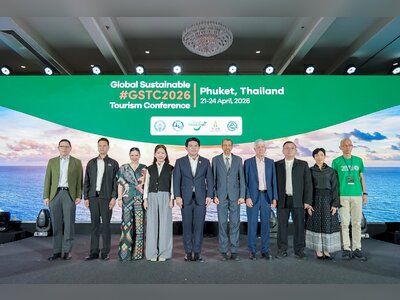
Thailand’s tourism strategy is undergoing a deliberate structural shift, and the Global Sustainable Tourism Conference 2026 in Phuket has been used as a platform to formalize and export that transition to the rest of the industry.
The four-day gathering, held from April 21 to 24, brought together more than 600–660 policymakers, industry leaders, and sustainability experts from roughly 30 to 60 countries, making it one of the largest events of its kind and a focal point for redefining how global tourism operates.
What is confirmed is that Thai authorities are explicitly moving away from a volume-driven model—long defined by high visitor numbers toward a system built on value, longer stays, and lower environmental impact.
This shift is not rhetorical.
It is being operationalized through policies discussed and showcased at the conference, including low-carbon tourism, redistribution of visitors away from overcrowded hotspots, and deeper integration of local communities into tourism supply chains.
The mechanism behind this transition is twofold.
First, Thailand is aligning itself with international sustainability standards set by the Global Sustainable Tourism Council, an organization that defines benchmarks for hotels, destinations, and travel operators.
Second, it is embedding those standards into domestic policy, with a focus on measurable outcomes such as carbon reduction, biodiversity protection, and economic distribution beyond primary tourist hubs.
Conference sessions and policy discussions centered on practical tools: managing carrying capacity, using data to disperse tourist flows, and building resilience in cities and coastal destinations vulnerable to climate stress.
Phuket was not chosen as a backdrop by accident.
As one of the world’s most visited island destinations, it embodies both the economic power and environmental strain of mass tourism.
Thai officials used the island to demonstrate applied solutions, including waste management systems, marine conservation efforts, and community-based tourism initiatives designed to retain more revenue locally.
Delegates were taken to observe these systems in practice, signaling an attempt to move beyond theory into replicable models.
The conference itself was structured as a live demonstration of sustainable operations.
Organizers eliminated single-use plastics, reduced paper consumption through digital systems, and offset carbon emissions, including a program to plant one tree per participant.
These measures are modest in isolation but significant as standardized practices for large-scale international events, which are typically resource-intensive.
The stakes extend well beyond Thailand.
Global tourism is under increasing pressure from climate targets, overtourism backlash, and uneven economic benefits.
By reframing tourism as a managed system rather than an open flow of visitors, the approach promoted in Phuket challenges the industry’s traditional growth model.
It also reflects a broader recalibration in which destinations prioritize yield per visitor over raw arrivals, a shift that could reshape airline routes, hotel investment strategies, and destination marketing worldwide.
There is also a clear economic calculation.
Thailand expects the model to increase per-visitor spending, extend average stays, and stabilize income for secondary cities and rural communities.
This redistribution is intended to reduce congestion in major destinations while broadening the economic base of tourism—a sector that remains central to the country’s GDP.
What remains contested is how quickly such a model can scale globally.
While the conference produced alignment on principles, implementation depends on political will, enforcement capacity, and industry compliance across vastly different markets.
The gap between stated commitments and measurable outcomes remains a critical pressure point.
Even so, the immediate outcome is concrete.
Thailand has positioned itself not just as a host of a global conference, but as a test case for a redesigned tourism system—one that prioritizes sustainability, resilience, and economic distribution as core operating principles rather than optional add-ons.
The four-day gathering, held from April 21 to 24, brought together more than 600–660 policymakers, industry leaders, and sustainability experts from roughly 30 to 60 countries, making it one of the largest events of its kind and a focal point for redefining how global tourism operates.
What is confirmed is that Thai authorities are explicitly moving away from a volume-driven model—long defined by high visitor numbers toward a system built on value, longer stays, and lower environmental impact.
This shift is not rhetorical.
It is being operationalized through policies discussed and showcased at the conference, including low-carbon tourism, redistribution of visitors away from overcrowded hotspots, and deeper integration of local communities into tourism supply chains.
The mechanism behind this transition is twofold.
First, Thailand is aligning itself with international sustainability standards set by the Global Sustainable Tourism Council, an organization that defines benchmarks for hotels, destinations, and travel operators.
Second, it is embedding those standards into domestic policy, with a focus on measurable outcomes such as carbon reduction, biodiversity protection, and economic distribution beyond primary tourist hubs.
Conference sessions and policy discussions centered on practical tools: managing carrying capacity, using data to disperse tourist flows, and building resilience in cities and coastal destinations vulnerable to climate stress.
Phuket was not chosen as a backdrop by accident.
As one of the world’s most visited island destinations, it embodies both the economic power and environmental strain of mass tourism.
Thai officials used the island to demonstrate applied solutions, including waste management systems, marine conservation efforts, and community-based tourism initiatives designed to retain more revenue locally.
Delegates were taken to observe these systems in practice, signaling an attempt to move beyond theory into replicable models.
The conference itself was structured as a live demonstration of sustainable operations.
Organizers eliminated single-use plastics, reduced paper consumption through digital systems, and offset carbon emissions, including a program to plant one tree per participant.
These measures are modest in isolation but significant as standardized practices for large-scale international events, which are typically resource-intensive.
The stakes extend well beyond Thailand.
Global tourism is under increasing pressure from climate targets, overtourism backlash, and uneven economic benefits.
By reframing tourism as a managed system rather than an open flow of visitors, the approach promoted in Phuket challenges the industry’s traditional growth model.
It also reflects a broader recalibration in which destinations prioritize yield per visitor over raw arrivals, a shift that could reshape airline routes, hotel investment strategies, and destination marketing worldwide.
There is also a clear economic calculation.
Thailand expects the model to increase per-visitor spending, extend average stays, and stabilize income for secondary cities and rural communities.
This redistribution is intended to reduce congestion in major destinations while broadening the economic base of tourism—a sector that remains central to the country’s GDP.
What remains contested is how quickly such a model can scale globally.
While the conference produced alignment on principles, implementation depends on political will, enforcement capacity, and industry compliance across vastly different markets.
The gap between stated commitments and measurable outcomes remains a critical pressure point.
Even so, the immediate outcome is concrete.
Thailand has positioned itself not just as a host of a global conference, but as a test case for a redesigned tourism system—one that prioritizes sustainability, resilience, and economic distribution as core operating principles rather than optional add-ons.