
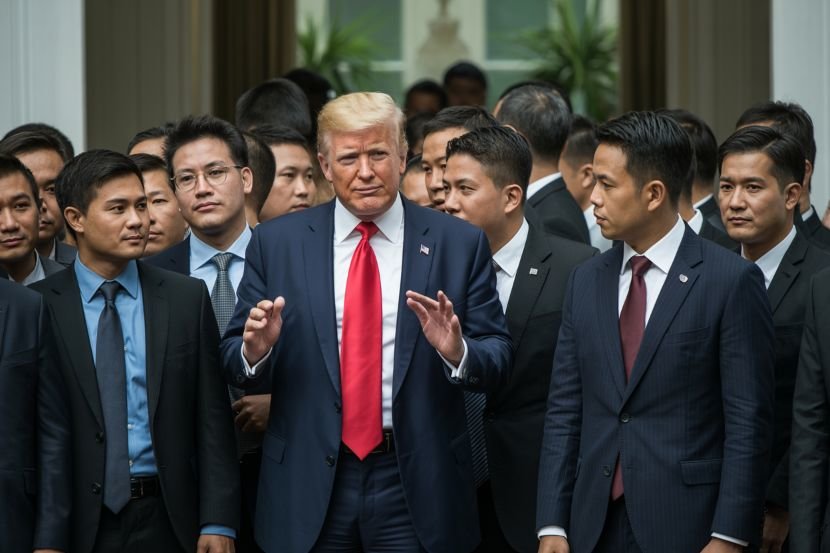
Trump Drives Security-Trade Agenda in Southeast Asia: Peace Deal, Trade Accords and Rare-Earth Strategy
During his tour through Malaysia, Thailand and Cambodia, President Trump brokers a historic border pact and finalises pivotal trade agreements as part of a broader counter-China strategy
US President Donald Trump has used his diplomatic tour across Southeast Asia to stitch together a multi-layered strategy combining peace-making, trade reform and supply-chain realignment.
Arriving in Kuala Lumpur for the 47th Association of Southeast Asian Nations (ASEAN) Summit, Mr Trump oversaw the signing of an expanded cease-fire agreement between Thailand and Cambodia, and brought new trade frameworks with regional partners into sharper focus.
The peace accord signed on 26 October in Kuala Lumpur commits both nations to withdraw heavy weapons from their border, form an ASEAN-observer team, clear land-mines and release prisoners of war.
The ceremony, attended by Mr Trump, Thailand’s Prime Minister Anutin Charnvirakul and Cambodia’s Prime Minister Hun Manet, aims to secure stability along a border that erupted into its worst clashes in years this July.
Paralleling the security breakthrough, the United States finalised trade deals with Malaysia and Cambodia and moved ahead with frameworks involving Thailand and Vietnam.
The agreements cover digital trade, services, investment screening and rare-earth-critical-minerals cooperation and are widely seen as part of the US push to diversify supply chains away from China’s dominance.
While the baseline reciprocal tariff rate remains at 19 %, the agreements signal deeper alignment with US standards and strategic goals.
Analysts view the trip as a clear display of American leadership in the region—marrying diplomacy with economic policy to reinforce alliances, deepen market access and advance geopolitical objectives.
As Mr Trump proceeds to Japan and South Korea for further talks on China, the Southeast Asia outcomes may serve as a template for his approach: blend trade incentives with security outcomes, and leverage partnerships to reshape the Indo-Pacific order.
The next tests will be implementation of the peace deal, execution of the trade frameworks and how China responds to this recalibrated US regional strategy.
Arriving in Kuala Lumpur for the 47th Association of Southeast Asian Nations (ASEAN) Summit, Mr Trump oversaw the signing of an expanded cease-fire agreement between Thailand and Cambodia, and brought new trade frameworks with regional partners into sharper focus.
The peace accord signed on 26 October in Kuala Lumpur commits both nations to withdraw heavy weapons from their border, form an ASEAN-observer team, clear land-mines and release prisoners of war.
The ceremony, attended by Mr Trump, Thailand’s Prime Minister Anutin Charnvirakul and Cambodia’s Prime Minister Hun Manet, aims to secure stability along a border that erupted into its worst clashes in years this July.
Paralleling the security breakthrough, the United States finalised trade deals with Malaysia and Cambodia and moved ahead with frameworks involving Thailand and Vietnam.
The agreements cover digital trade, services, investment screening and rare-earth-critical-minerals cooperation and are widely seen as part of the US push to diversify supply chains away from China’s dominance.
While the baseline reciprocal tariff rate remains at 19 %, the agreements signal deeper alignment with US standards and strategic goals.
Analysts view the trip as a clear display of American leadership in the region—marrying diplomacy with economic policy to reinforce alliances, deepen market access and advance geopolitical objectives.
As Mr Trump proceeds to Japan and South Korea for further talks on China, the Southeast Asia outcomes may serve as a template for his approach: blend trade incentives with security outcomes, and leverage partnerships to reshape the Indo-Pacific order.
The next tests will be implementation of the peace deal, execution of the trade frameworks and how China responds to this recalibrated US regional strategy.