Inside Thailand’s Abandoned Mega-Projects: Five Ambitions That Never Left the Blueprint Stage
From high-speed rail expansions to futuristic airports, repeated delays, political shifts, and funding constraints have stalled some of Thailand’s most ambitious infrastructure plans
SYSTEM-DRIVEN infrastructure planning in Thailand has repeatedly produced large-scale development proposals that ultimately stalled before construction or failed to advance beyond early planning stages.
These so-called mega-projects reflect the country’s long-term ambition to transform transport, logistics, and urban capacity, but they also expose structural constraints in financing, political continuity, and implementation capacity.
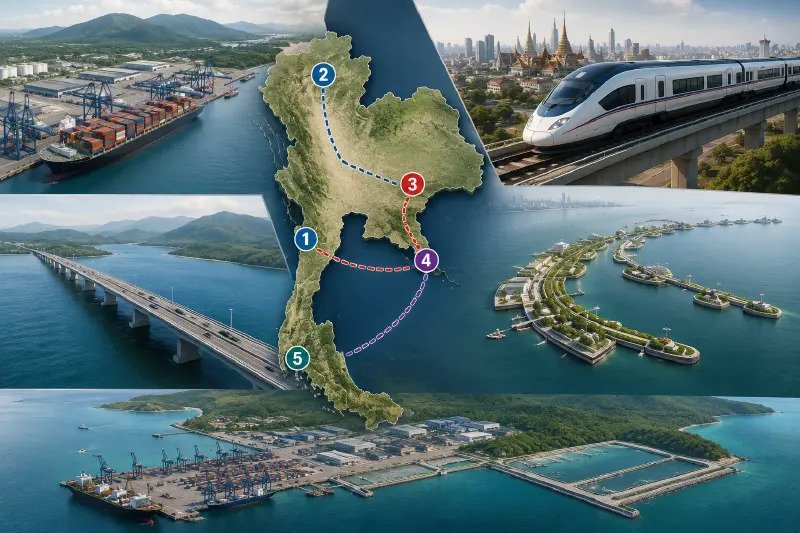
Across multiple administrations, Thailand has announced expansive infrastructure visions aimed at repositioning the country as a regional transport hub linking mainland Southeast Asia.
These plans typically include high-speed rail corridors, expanded airport systems, deep-sea port developments, and integrated logistics zones.
While some projects have progressed, others have remained largely on paper due to shifting policy priorities and budget limitations.
One recurring category involves high-speed rail extensions beyond initial pilot routes.
Early sections connecting major domestic corridors have advanced, but proposed regional links and secondary branches have faced repeated delays.
The key issue is not technical feasibility but financing structure, with many proposals relying on complex public-private partnerships or foreign investment arrangements that have not fully materialized.
Another set of stalled initiatives involves new airport capacity expansions intended to relieve pressure on Bangkok’s main aviation hub.
Several concepts for secondary international airports or major terminal expansions have been introduced over the past decade, but land acquisition challenges, environmental assessments, and changing passenger demand forecasts have slowed or suspended progress.
What is confirmed is that Thailand’s aviation system continues to rely heavily on existing infrastructure rather than the expanded network once envisioned.
A third category includes deep-sea port and logistics corridor projects designed to strengthen Thailand’s role in regional trade.
These proposals often depend on coordination between multiple provinces and long-term industrial investment commitments.
In practice, fragmented regulatory oversight and competition between regional development zones have complicated execution, leaving many plans in extended feasibility stages.
Urban redevelopment schemes in Bangkok and surrounding metropolitan areas also feature prominently among unrealized projects.
Proposals for large-scale transit-oriented development and waterfront regeneration have been repeatedly revised or delayed due to legal disputes over land use, budget reallocations, and changes in urban planning priorities.
These projects highlight the difficulty of aligning private development incentives with public infrastructure goals.
The pattern across these initiatives is not a lack of ambition but a gap between planning cycles and execution continuity.
Thailand’s political transitions often lead to recalibration of infrastructure priorities, which in turn disrupts long-term project timelines.
Combined with fiscal constraints and evolving economic conditions, this has created a recurring cycle in which major proposals are announced, partially developed in feasibility terms, and then left dormant or significantly scaled down.
Despite these setbacks, several previously delayed projects have eventually been revived in modified form, indicating that abandonment is often procedural rather than final.
However, the broader outcome remains consistent: Thailand’s infrastructure strategy continues to produce high-profile proposals that test the limits of long-term policy consistency and investment coordination.
These so-called mega-projects reflect the country’s long-term ambition to transform transport, logistics, and urban capacity, but they also expose structural constraints in financing, political continuity, and implementation capacity.
Across multiple administrations, Thailand has announced expansive infrastructure visions aimed at repositioning the country as a regional transport hub linking mainland Southeast Asia.
These plans typically include high-speed rail corridors, expanded airport systems, deep-sea port developments, and integrated logistics zones.
While some projects have progressed, others have remained largely on paper due to shifting policy priorities and budget limitations.
One recurring category involves high-speed rail extensions beyond initial pilot routes.
Early sections connecting major domestic corridors have advanced, but proposed regional links and secondary branches have faced repeated delays.
The key issue is not technical feasibility but financing structure, with many proposals relying on complex public-private partnerships or foreign investment arrangements that have not fully materialized.
Another set of stalled initiatives involves new airport capacity expansions intended to relieve pressure on Bangkok’s main aviation hub.
Several concepts for secondary international airports or major terminal expansions have been introduced over the past decade, but land acquisition challenges, environmental assessments, and changing passenger demand forecasts have slowed or suspended progress.
What is confirmed is that Thailand’s aviation system continues to rely heavily on existing infrastructure rather than the expanded network once envisioned.
A third category includes deep-sea port and logistics corridor projects designed to strengthen Thailand’s role in regional trade.
These proposals often depend on coordination between multiple provinces and long-term industrial investment commitments.
In practice, fragmented regulatory oversight and competition between regional development zones have complicated execution, leaving many plans in extended feasibility stages.
Urban redevelopment schemes in Bangkok and surrounding metropolitan areas also feature prominently among unrealized projects.
Proposals for large-scale transit-oriented development and waterfront regeneration have been repeatedly revised or delayed due to legal disputes over land use, budget reallocations, and changes in urban planning priorities.
These projects highlight the difficulty of aligning private development incentives with public infrastructure goals.
The pattern across these initiatives is not a lack of ambition but a gap between planning cycles and execution continuity.
Thailand’s political transitions often lead to recalibration of infrastructure priorities, which in turn disrupts long-term project timelines.
Combined with fiscal constraints and evolving economic conditions, this has created a recurring cycle in which major proposals are announced, partially developed in feasibility terms, and then left dormant or significantly scaled down.
Despite these setbacks, several previously delayed projects have eventually been revived in modified form, indicating that abandonment is often procedural rather than final.
However, the broader outcome remains consistent: Thailand’s infrastructure strategy continues to produce high-profile proposals that test the limits of long-term policy consistency and investment coordination.