Thai Police Roll Out Domestic AI Smart Patrol System to Upgrade Urban Policing
A new ‘Made in Thailand’ artificial intelligence platform is being deployed to support patrol officers, enhance surveillance analysis, and accelerate incident response across key urban areas.
ACTOR-DRIVEN technological modernization within Thailand’s national police force is driving the deployment of a domestically developed artificial intelligence system designed to support patrol operations and improve public safety management in real time.
What is confirmed is that Thai police authorities have begun integrating a new AI-enabled “smart patrol” system developed in Thailand into operational policing units.
The system is designed to assist officers by processing surveillance data, identifying incidents more quickly, and supporting decision-making during patrol operations in urban environments.
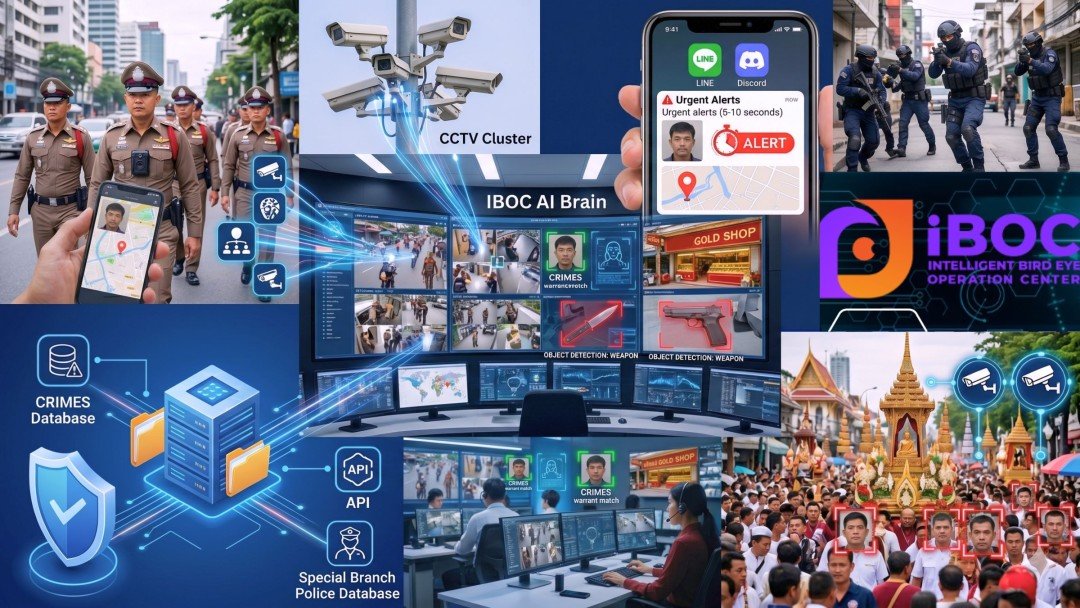
The platform, described as part of a broader internal modernization initiative, is intended to enhance situational awareness by aggregating inputs from multiple sources, including CCTV networks, patrol reports, and digital monitoring systems.
The system uses AI-assisted analytics to flag anomalies, track potential security threats, and prioritize alerts for human officers to review.
The key issue is not replacement of police personnel but augmentation of operational capacity.
Authorities emphasize that the system is designed to function as a decision-support tool, reducing response times and improving coordination rather than automating law enforcement actions.
Human officers remain responsible for final decisions in all operational contexts.
The deployment reflects a wider shift in Thailand’s public security strategy toward data-driven policing.
Urban centers, particularly Bangkok and major provincial cities, generate large volumes of surveillance data that can be difficult to process in real time through traditional systems.
The AI platform is intended to bridge that gap by filtering and organizing information into actionable intelligence.
The system is also positioned as a domestically produced solution, developed under Thailand’s “Made in Thailand” technology initiative.
This reflects a policy direction aimed at reducing dependence on foreign security technologies while strengthening national capability in artificial intelligence, data infrastructure, and cybersecurity.
Operationally, the system is expected to support patrol units by identifying high-risk areas, tracking incident patterns, and improving coordination between field officers and command centers.
It can also assist in managing large-scale public events, where rapid interpretation of crowd conditions and incident reports is critical.
From a governance perspective, the introduction of AI-assisted policing raises structural considerations around data management, privacy safeguards, and algorithmic transparency.
While the system is intended for public safety enhancement, its effectiveness depends on the quality of underlying data and the protocols governing its use.
The broader implication is a gradual transformation of policing in Thailand toward integrated digital infrastructure, where artificial intelligence functions as a central layer between surveillance systems and frontline response units.
This marks a shift from reactive policing models to more predictive and data-driven operational frameworks.
With the rollout of AI smart patrol systems, Thai police are entering a phase of operational digitization that aligns law enforcement practices with broader regional trends in smart city security and AI-supported public administration.
What is confirmed is that Thai police authorities have begun integrating a new AI-enabled “smart patrol” system developed in Thailand into operational policing units.
The system is designed to assist officers by processing surveillance data, identifying incidents more quickly, and supporting decision-making during patrol operations in urban environments.
The platform, described as part of a broader internal modernization initiative, is intended to enhance situational awareness by aggregating inputs from multiple sources, including CCTV networks, patrol reports, and digital monitoring systems.
The system uses AI-assisted analytics to flag anomalies, track potential security threats, and prioritize alerts for human officers to review.
The key issue is not replacement of police personnel but augmentation of operational capacity.
Authorities emphasize that the system is designed to function as a decision-support tool, reducing response times and improving coordination rather than automating law enforcement actions.
Human officers remain responsible for final decisions in all operational contexts.
The deployment reflects a wider shift in Thailand’s public security strategy toward data-driven policing.
Urban centers, particularly Bangkok and major provincial cities, generate large volumes of surveillance data that can be difficult to process in real time through traditional systems.
The AI platform is intended to bridge that gap by filtering and organizing information into actionable intelligence.
The system is also positioned as a domestically produced solution, developed under Thailand’s “Made in Thailand” technology initiative.
This reflects a policy direction aimed at reducing dependence on foreign security technologies while strengthening national capability in artificial intelligence, data infrastructure, and cybersecurity.
Operationally, the system is expected to support patrol units by identifying high-risk areas, tracking incident patterns, and improving coordination between field officers and command centers.
It can also assist in managing large-scale public events, where rapid interpretation of crowd conditions and incident reports is critical.
From a governance perspective, the introduction of AI-assisted policing raises structural considerations around data management, privacy safeguards, and algorithmic transparency.
While the system is intended for public safety enhancement, its effectiveness depends on the quality of underlying data and the protocols governing its use.
The broader implication is a gradual transformation of policing in Thailand toward integrated digital infrastructure, where artificial intelligence functions as a central layer between surveillance systems and frontline response units.
This marks a shift from reactive policing models to more predictive and data-driven operational frameworks.
With the rollout of AI smart patrol systems, Thai police are entering a phase of operational digitization that aligns law enforcement practices with broader regional trends in smart city security and AI-supported public administration.