Thailand Expands Indigenous Amphibious Armored Fleet With New 8×8 Vehicle Procurement
The Royal Thai Navy is adding more domestically built AWAV 8×8 amphibious armored vehicles to strengthen border security, disaster response capacity, and local defense industry development.
SYSTEM-DRIVEN defense procurement policy in Thailand is driving a new expansion of the Royal Thai Navy’s amphibious armored vehicle fleet, centered on the acquisition of additional 8×8 Armoured Wheeled Amphibious Vehicles (AWAVs) designed and produced domestically.
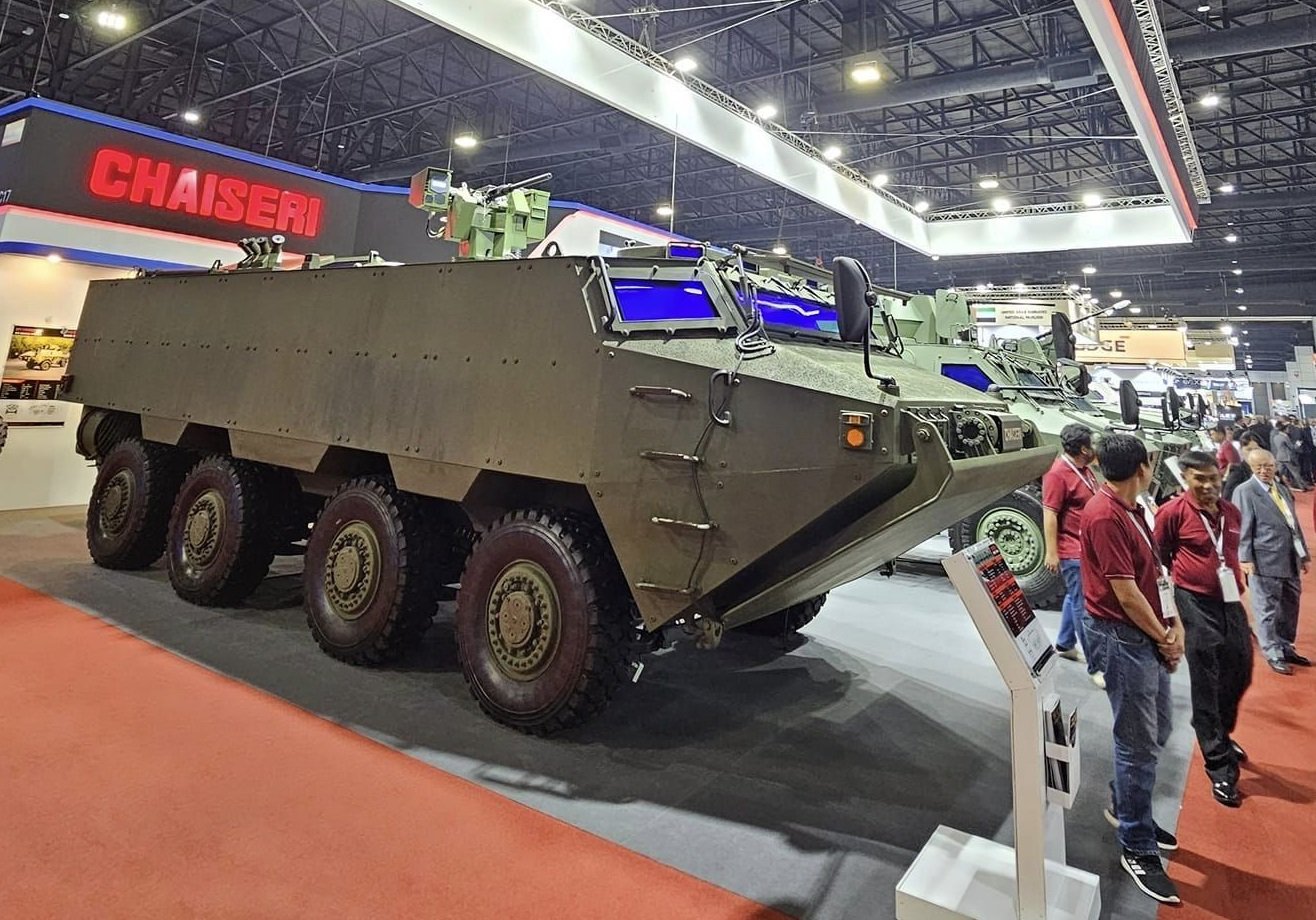
What is confirmed is that the Royal Thai Navy has approved the procurement of additional AWAV 8×8 vehicles from Thai manufacturer Chaiseri Metal and Rubber Co. Ltd. The decision was announced by a navy spokesperson, who stated the acquisition is intended to strengthen operational capability along Thailand’s eastern maritime and border zones while also improving readiness for disaster relief and emerging security threats.
The AWAV is a domestically engineered amphibious armored platform designed for both land mobility and water operations.
It is used primarily by the Royal Thai Marine Corps and supports missions that require rapid movement between coastal, riverine, and inland environments.
The vehicle class is already in service in limited numbers following earlier deliveries completed in recent years.
The new procurement follows a structured domestic defense production model in which Thailand prioritizes local manufacturing and technology transfer.
The AWAV program is built around Thai industrial participation, with a significant portion of its components and production value sourced within the country.
This approach is intended to reduce dependence on foreign suppliers while strengthening national defense industrial capacity.
The key issue is Thailand’s effort to align military modernization with domestic industrial policy.
The AWAV program is not only a force upgrade but also a structured investment in local defense manufacturing capability, involving Thai engineers, local assembly, and domestic supply chains.
This reduces procurement risk and increases control over maintenance and long-term sustainment.
Operationally, the vehicles are intended to support a broad range of missions, including amphibious assault support, coastal defense, rapid troop movement, and humanitarian response during flooding and natural disasters, which are frequent in Thailand.
Their amphibious capability allows movement across waterways without reliance on fixed infrastructure, a critical factor in regional terrain and climate conditions.
The expansion comes amid evolving security considerations in Southeast Asia, where maritime sovereignty enforcement and border stability remain strategic priorities.
While the procurement is framed primarily in defensive and logistical terms, it also reflects broader regional modernization trends, where mid-sized powers are investing in mobile armored platforms suited to hybrid land-sea operational environments.
Earlier phases of the AWAV program included limited production batches delivered to the Royal Thai Marine Corps after competitive domestic development and testing cycles.
These earlier units underwent mobility and amphibious trials before entering operational service, establishing a baseline for further procurement and incremental fleet expansion.
The latest acquisition signals continuity rather than a shift in direction: Thailand is scaling an existing indigenous platform rather than introducing a new foreign system.
The result is a steadily expanding amphibious armored fleet designed to integrate with naval operations, coastal defense planning, and national emergency response structures.
What is confirmed is that the Royal Thai Navy has approved the procurement of additional AWAV 8×8 vehicles from Thai manufacturer Chaiseri Metal and Rubber Co. Ltd. The decision was announced by a navy spokesperson, who stated the acquisition is intended to strengthen operational capability along Thailand’s eastern maritime and border zones while also improving readiness for disaster relief and emerging security threats.
The AWAV is a domestically engineered amphibious armored platform designed for both land mobility and water operations.
It is used primarily by the Royal Thai Marine Corps and supports missions that require rapid movement between coastal, riverine, and inland environments.
The vehicle class is already in service in limited numbers following earlier deliveries completed in recent years.
The new procurement follows a structured domestic defense production model in which Thailand prioritizes local manufacturing and technology transfer.
The AWAV program is built around Thai industrial participation, with a significant portion of its components and production value sourced within the country.
This approach is intended to reduce dependence on foreign suppliers while strengthening national defense industrial capacity.
The key issue is Thailand’s effort to align military modernization with domestic industrial policy.
The AWAV program is not only a force upgrade but also a structured investment in local defense manufacturing capability, involving Thai engineers, local assembly, and domestic supply chains.
This reduces procurement risk and increases control over maintenance and long-term sustainment.
Operationally, the vehicles are intended to support a broad range of missions, including amphibious assault support, coastal defense, rapid troop movement, and humanitarian response during flooding and natural disasters, which are frequent in Thailand.
Their amphibious capability allows movement across waterways without reliance on fixed infrastructure, a critical factor in regional terrain and climate conditions.
The expansion comes amid evolving security considerations in Southeast Asia, where maritime sovereignty enforcement and border stability remain strategic priorities.
While the procurement is framed primarily in defensive and logistical terms, it also reflects broader regional modernization trends, where mid-sized powers are investing in mobile armored platforms suited to hybrid land-sea operational environments.
Earlier phases of the AWAV program included limited production batches delivered to the Royal Thai Marine Corps after competitive domestic development and testing cycles.
These earlier units underwent mobility and amphibious trials before entering operational service, establishing a baseline for further procurement and incremental fleet expansion.
The latest acquisition signals continuity rather than a shift in direction: Thailand is scaling an existing indigenous platform rather than introducing a new foreign system.
The result is a steadily expanding amphibious armored fleet designed to integrate with naval operations, coastal defense planning, and national emergency response structures.