Thailand Revives $31 Billion Land Bridge Project as Global Shipping Routes Face Growing Strain
Bangkok is pushing a long-debated cross-country transport corridor linking the Gulf of Thailand and the Andaman Sea to bypass congested maritime chokepoints and reshape regional trade flows.
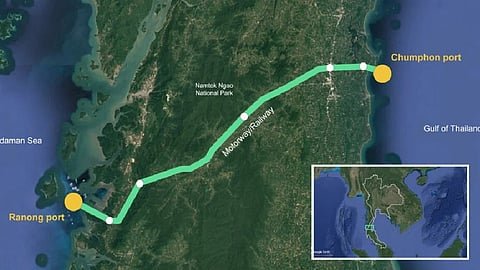
SYSTEM-DRIVEN infrastructure planning is at the center of Thailand’s renewed push to develop a multi-billion-dollar “land bridge” megaproject designed to connect its eastern Gulf coast with the western Andaman Sea, offering an overland alternative to the heavily trafficked Strait of Malacca maritime route.
What is confirmed is that Thai authorities are actively reviving and promoting a large-scale infrastructure proposal estimated at around thirty-one billion dollars, aimed at building deep-sea ports on both coasts of southern Thailand linked by rail and highway freight corridors.
The project is being positioned as a strategic logistics bypass for global shipping traffic that currently depends heavily on the narrow Malacca Strait between Malaysia, Singapore, and Indonesia.
The concept involves transporting containers overland between two new ports, effectively shortening shipping time for vessels traveling between the Indian Ocean and the Pacific without passing through one of the world’s busiest and most congested maritime chokepoints.
The plan has been under discussion for years in various forms, but recent geopolitical and logistical pressures have brought it back to the center of Thailand’s infrastructure agenda.
The key issue is whether the economic and strategic benefits of bypassing maritime bottlenecks justify the enormous capital cost, environmental impact, and engineering complexity of the project.
Supporters argue that global shipping disruptions, rising freight volatility, and increasing geopolitical risk around key sea lanes are making alternative logistics corridors more attractive than in the past.
The Strait of Malacca currently handles a significant share of global trade flows between Asia, the Middle East, and Europe.
It is widely regarded as one of the most strategically sensitive maritime passages in the world due to its narrow geography and high traffic density.
Any disruption in this corridor can have immediate global supply chain effects, including fuel price volatility and shipping delays.
Thailand’s land bridge proposal is intended to position the country as a regional logistics hub competing with established maritime centers such as Singapore.
By offering a faster overland transfer route, Thai planners aim to attract shipping lines seeking to reduce congestion-related delays and diversify away from single-route dependencies.
The project would require the construction of deep-sea port facilities, freight rail infrastructure, highways, logistics zones, and customs systems capable of handling large-scale container transshipment.
It also involves significant land acquisition and environmental assessment processes, particularly in southern Thailand’s narrow isthmus region.
Financing remains a central challenge.
The estimated cost places it among the largest infrastructure undertakings in Thailand’s history, requiring a combination of public investment, foreign capital participation, and long-term private sector partnerships.
Previous iterations of the plan stalled in part due to concerns over cost-benefit viability and political continuity.
The broader implication is a strategic recalibration of Thailand’s role in global trade logistics.
Rather than relying solely on maritime proximity advantages, the country is attempting to convert its geography into an engineered transit corridor that competes directly with existing sea routes.
If realized, the land bridge would mark a structural shift in Southeast Asian logistics architecture, reducing dependence on a single maritime chokepoint while embedding Thailand more deeply into global supply chain routing decisions.
What is confirmed is that Thai authorities are actively reviving and promoting a large-scale infrastructure proposal estimated at around thirty-one billion dollars, aimed at building deep-sea ports on both coasts of southern Thailand linked by rail and highway freight corridors.
The project is being positioned as a strategic logistics bypass for global shipping traffic that currently depends heavily on the narrow Malacca Strait between Malaysia, Singapore, and Indonesia.
The concept involves transporting containers overland between two new ports, effectively shortening shipping time for vessels traveling between the Indian Ocean and the Pacific without passing through one of the world’s busiest and most congested maritime chokepoints.
The plan has been under discussion for years in various forms, but recent geopolitical and logistical pressures have brought it back to the center of Thailand’s infrastructure agenda.
The key issue is whether the economic and strategic benefits of bypassing maritime bottlenecks justify the enormous capital cost, environmental impact, and engineering complexity of the project.
Supporters argue that global shipping disruptions, rising freight volatility, and increasing geopolitical risk around key sea lanes are making alternative logistics corridors more attractive than in the past.
The Strait of Malacca currently handles a significant share of global trade flows between Asia, the Middle East, and Europe.
It is widely regarded as one of the most strategically sensitive maritime passages in the world due to its narrow geography and high traffic density.
Any disruption in this corridor can have immediate global supply chain effects, including fuel price volatility and shipping delays.
Thailand’s land bridge proposal is intended to position the country as a regional logistics hub competing with established maritime centers such as Singapore.
By offering a faster overland transfer route, Thai planners aim to attract shipping lines seeking to reduce congestion-related delays and diversify away from single-route dependencies.
The project would require the construction of deep-sea port facilities, freight rail infrastructure, highways, logistics zones, and customs systems capable of handling large-scale container transshipment.
It also involves significant land acquisition and environmental assessment processes, particularly in southern Thailand’s narrow isthmus region.
Financing remains a central challenge.
The estimated cost places it among the largest infrastructure undertakings in Thailand’s history, requiring a combination of public investment, foreign capital participation, and long-term private sector partnerships.
Previous iterations of the plan stalled in part due to concerns over cost-benefit viability and political continuity.
The broader implication is a strategic recalibration of Thailand’s role in global trade logistics.
Rather than relying solely on maritime proximity advantages, the country is attempting to convert its geography into an engineered transit corridor that competes directly with existing sea routes.
If realized, the land bridge would mark a structural shift in Southeast Asian logistics architecture, reducing dependence on a single maritime chokepoint while embedding Thailand more deeply into global supply chain routing decisions.