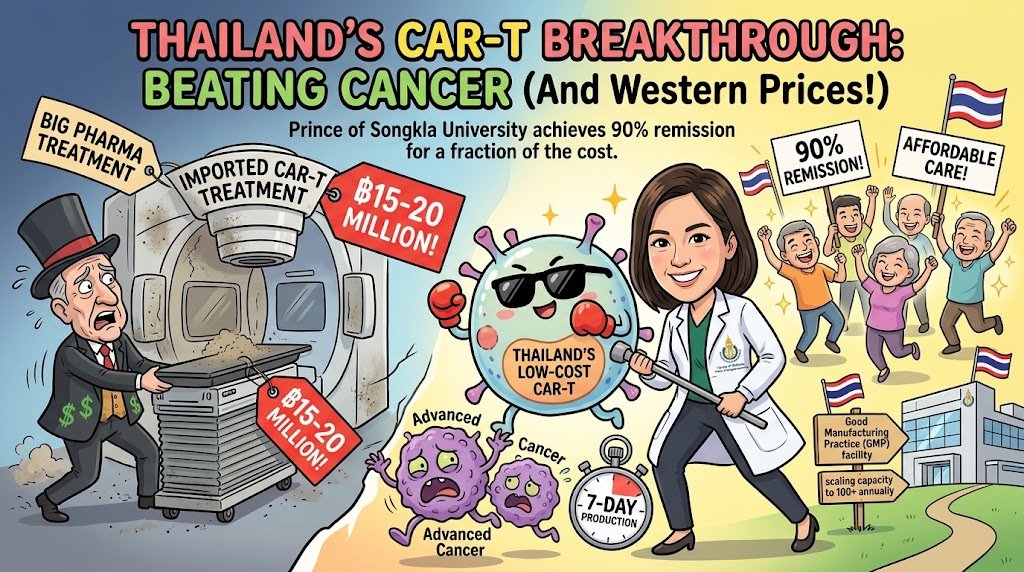
Thai University Unveils Low-Cost CAR-T Therapy Achieving 90 Percent Cancer Remission
Prince of Songkla University develops indigenous immunotherapy cutting treatment costs tenfold while achieving complete remission in advanced blood cancers and autoimmune cases.
The Faculty of Medicine at Prince of Songkla University in Thailand has unveiled clinical progress for its locally engineered CAR-T cell therapy, reporting a complete remission rate near 90 percent in patients with late-stage blood cancers and severe autoimmune conditions.
The treatment targets patients with relapsed or treatment-resistant leukemia, lymphoma, and systemic lupus erythematosus who have exhausted conventional therapies.
Developed under the university's Center of Excellence for Stem Cell Transplantation and Cell Therapy, the domestic platform modifies a patient's own T-cells with specialized genetic receptors to identify and destroy malignant cells.
Beyond high clinical efficacy, the Thai development slashes production timelines from cell extraction to reinfusion down to seven days.
Crucially, local patented manufacturing reduces treatment costs to roughly 2 million Thai baht—approximately $57,000—compared to imported commercial alternatives that frequently exceed 15 to 20 million baht.
To meet expanding demand and lower barriers for regional care, the university is constructing a Good Manufacturing Practice facility designed to scale treatment capacity from 30 patients per year to more than 100 annually.
Academic leaders have simultaneously established commercial partnerships, including an agreement with Bangkok Hospital Phuket, to standardize clinical protocols and extend advanced cellular therapies across southern Thailand and international medical channels.
The treatment targets patients with relapsed or treatment-resistant leukemia, lymphoma, and systemic lupus erythematosus who have exhausted conventional therapies.
Developed under the university's Center of Excellence for Stem Cell Transplantation and Cell Therapy, the domestic platform modifies a patient's own T-cells with specialized genetic receptors to identify and destroy malignant cells.
Beyond high clinical efficacy, the Thai development slashes production timelines from cell extraction to reinfusion down to seven days.
Crucially, local patented manufacturing reduces treatment costs to roughly 2 million Thai baht—approximately $57,000—compared to imported commercial alternatives that frequently exceed 15 to 20 million baht.
To meet expanding demand and lower barriers for regional care, the university is constructing a Good Manufacturing Practice facility designed to scale treatment capacity from 30 patients per year to more than 100 annually.
Academic leaders have simultaneously established commercial partnerships, including an agreement with Bangkok Hospital Phuket, to standardize clinical protocols and extend advanced cellular therapies across southern Thailand and international medical channels.