Viral Video Raises Questions Over Twelve-Dollar Croissants at Manhattan Bakery
A customer accused Le Parisien Bakery of reselling Costco pastries at a steep markup, but the footage does not establish where her pistachio croissant was made and neither business has confirmed a supply relationship.
A viral customer video has placed Le Parisien Bakery, a French-style café near Times Square, under scrutiny after appearing to show packaged croissants being delivered to the Manhattan business while it markets its pastries through the language of freshness and artisanal preparation.
The footage has driven a wider argument about transparency in restaurant sourcing, but it does not by itself prove that the twelve-dollar pistachio croissant purchased by the customer came from Costco.
The video was posted by a New York food creator who uses the name TallBrownGirlll.
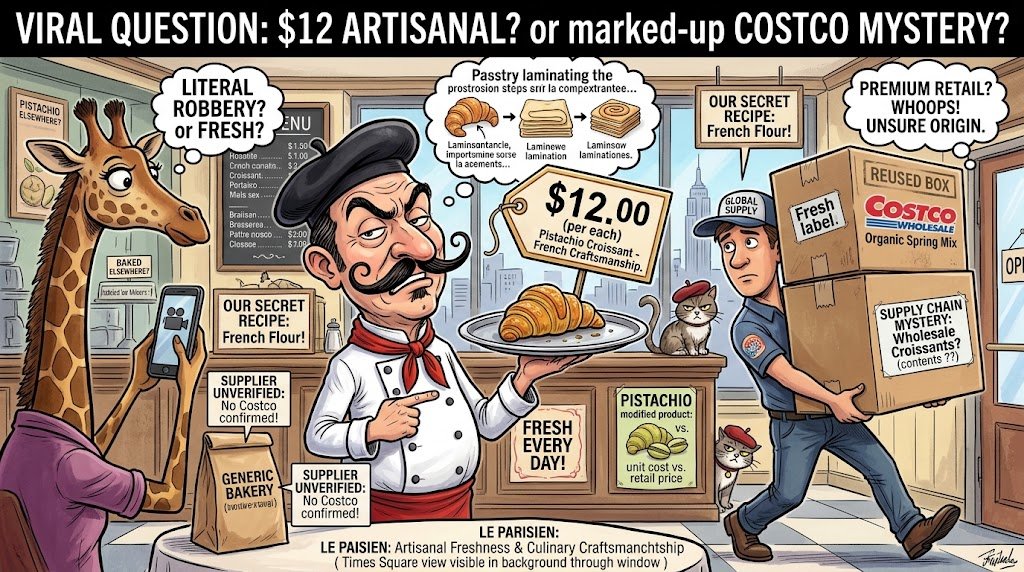
While inside the bakery, she filmed a delivery worker carrying boxes of croissants toward the counter and declared that the pastries were from Costco.
She said she had paid about twelve dollars for a pistachio croissant, called the situation "literal robbery" and advised viewers not to visit the café.
What is visible in the circulating footage is a worker bringing packaged pastries into the premises.
One container bears Costco branding associated with organic spring mix, but the use of a reused cardboard box does not establish where its contents were purchased.
Public reporting has not produced an invoice, supplier record, Costco label on the pastries themselves or confirmation from either company that the bakery buys croissants from the warehouse retailer.
The central accusation therefore remains unverified.
The price claim also requires precision.
Le Parisien's published brunch menu lists a croissant selection at twelve dollars and fifty cents, while ordinary croissants on its direct-order menu may be priced differently depending on variety and filling.
A pistachio croissant is a modified product rather than a plain wholesale pastry: even when a café begins with a commercially sourced croissant, it may add cream, nuts, syrup, decoration or a second bake before serving it.
None of that determines what happened in this case, but it means the retail price cannot be compared reliably with the unit cost of an unfilled Costco croissant without knowing what preparation occurred.
The bakery's own promotional language makes the sourcing question more consequential.
Its website describes French culinary craftsmanship, flaky croissants and a commitment to fresh, exceptional quality.
Such language creates an expectation of skilled preparation, although it is not necessarily an explicit representation that every component is mixed, laminated, proofed and baked entirely on the premises.
The legal and ethical issue would depend on the exact claims made to customers and whether those claims were materially false or misleading.
Restaurants routinely resell products made elsewhere.
Bread may come from a wholesale bakery, desserts from a specialist supplier, and frozen pastries from a food-service distributor.
Businesses are generally free to set prices that cover rent, labor, preparation, spoilage, service, taxes and the premium attached to location.
A large markup is not, by itself, evidence of fraud.
The more serious question is disclosure.
If a business expressly represents a mass-produced item as baked from scratch on-site when it is not, that statement may attract scrutiny under consumer-protection rules prohibiting deceptive commercial practices.
New York authorities can investigate businesses suspected of fraudulent or misleading conduct and seek remedies including refunds or changes in business practices.
No public enforcement action against Le Parisien has been identified in connection with the video.
The episode gained traction because it taps into a recurring consumer suspicion: that premium cafés sometimes rely on inexpensive wholesale products while allowing décor, presentation and suggestive language to imply a more elaborate provenance.
Similar controversies have involved frozen pizzas sold as gourmet dishes, wholesale cakes divided into individual portions and produce presented at markets as locally grown.
In each instance, the decisive distinction is not whether a reseller earned a margin, but whether customers received an accurate description of what they were buying.
Costco itself sells ordinary butter croissants in multipacks and has also offered filled, twice-baked pistachio versions.
That overlap makes the allegation superficially plausible, but similarity is not verification.
Croissants produced at scale often share comparable shapes, colors and packaging conventions, and social-media footage rarely supplies the purchasing records needed to establish a commercial chain of custody.
The café and Costco had not publicly confirmed or denied a supply arrangement when the controversy spread.
Without documentary evidence or a substantive response from the bakery, the responsible conclusion is narrower than the online verdict: the video raises a legitimate question about sourcing and marketing, but it does not prove that Le Parisien sold a fifty-cent Costco croissant unchanged for twelve dollars.
The concrete next step is for the bakery to disclose how the disputed pastries are sourced and prepared so customers can judge whether the product matches the presentation and price.
The footage has driven a wider argument about transparency in restaurant sourcing, but it does not by itself prove that the twelve-dollar pistachio croissant purchased by the customer came from Costco.
The video was posted by a New York food creator who uses the name TallBrownGirlll.
While inside the bakery, she filmed a delivery worker carrying boxes of croissants toward the counter and declared that the pastries were from Costco.
She said she had paid about twelve dollars for a pistachio croissant, called the situation "literal robbery" and advised viewers not to visit the café.
What is visible in the circulating footage is a worker bringing packaged pastries into the premises.
One container bears Costco branding associated with organic spring mix, but the use of a reused cardboard box does not establish where its contents were purchased.
Public reporting has not produced an invoice, supplier record, Costco label on the pastries themselves or confirmation from either company that the bakery buys croissants from the warehouse retailer.
The central accusation therefore remains unverified.
The price claim also requires precision.
Le Parisien's published brunch menu lists a croissant selection at twelve dollars and fifty cents, while ordinary croissants on its direct-order menu may be priced differently depending on variety and filling.
A pistachio croissant is a modified product rather than a plain wholesale pastry: even when a café begins with a commercially sourced croissant, it may add cream, nuts, syrup, decoration or a second bake before serving it.
None of that determines what happened in this case, but it means the retail price cannot be compared reliably with the unit cost of an unfilled Costco croissant without knowing what preparation occurred.
The bakery's own promotional language makes the sourcing question more consequential.
Its website describes French culinary craftsmanship, flaky croissants and a commitment to fresh, exceptional quality.
Such language creates an expectation of skilled preparation, although it is not necessarily an explicit representation that every component is mixed, laminated, proofed and baked entirely on the premises.
The legal and ethical issue would depend on the exact claims made to customers and whether those claims were materially false or misleading.
Restaurants routinely resell products made elsewhere.
Bread may come from a wholesale bakery, desserts from a specialist supplier, and frozen pastries from a food-service distributor.
Businesses are generally free to set prices that cover rent, labor, preparation, spoilage, service, taxes and the premium attached to location.
A large markup is not, by itself, evidence of fraud.
The more serious question is disclosure.
If a business expressly represents a mass-produced item as baked from scratch on-site when it is not, that statement may attract scrutiny under consumer-protection rules prohibiting deceptive commercial practices.
New York authorities can investigate businesses suspected of fraudulent or misleading conduct and seek remedies including refunds or changes in business practices.
No public enforcement action against Le Parisien has been identified in connection with the video.
The episode gained traction because it taps into a recurring consumer suspicion: that premium cafés sometimes rely on inexpensive wholesale products while allowing décor, presentation and suggestive language to imply a more elaborate provenance.
Similar controversies have involved frozen pizzas sold as gourmet dishes, wholesale cakes divided into individual portions and produce presented at markets as locally grown.
In each instance, the decisive distinction is not whether a reseller earned a margin, but whether customers received an accurate description of what they were buying.
Costco itself sells ordinary butter croissants in multipacks and has also offered filled, twice-baked pistachio versions.
That overlap makes the allegation superficially plausible, but similarity is not verification.
Croissants produced at scale often share comparable shapes, colors and packaging conventions, and social-media footage rarely supplies the purchasing records needed to establish a commercial chain of custody.
The café and Costco had not publicly confirmed or denied a supply arrangement when the controversy spread.
Without documentary evidence or a substantive response from the bakery, the responsible conclusion is narrower than the online verdict: the video raises a legitimate question about sourcing and marketing, but it does not prove that Le Parisien sold a fifty-cent Costco croissant unchanged for twelve dollars.
The concrete next step is for the bakery to disclose how the disputed pastries are sourced and prepared so customers can judge whether the product matches the presentation and price.