Thailand and Laos Tighten Regional Cooperation as Cross-Border Haze Crisis Intensifies Across the Mekong
New joint measures focus on agricultural burning, real-time monitoring systems, and coordinated fire prevention as PM2.5 pollution continues to cross borders and threaten public health
ACTOR-DRIVEN coordination between Thailand and Laos is now the central force shaping the region’s response to worsening transboundary haze pollution, a recurring environmental crisis driven by seasonal agricultural burning and forest fires that routinely spread across national borders in mainland Southeast Asia.
What is confirmed is that senior environmental and agriculture officials from both countries met in Vientiane to deepen bilateral cooperation under an existing regional framework commonly referred to as the CLEAR Sky strategy.
The talks focused on strengthening joint mechanisms to reduce cross-border smoke, improve air quality monitoring, and coordinate responses during peak burning seasons when fine particulate matter (PM2.5) levels regularly exceed safe health thresholds.
The meeting builds on a broader 2024–2030 action plan already agreed between Thailand, Laos, and Myanmar, which outlines shared responsibilities in fire suppression, hotspot detection, and agricultural transition policies designed to reduce reliance on slash-and-burn farming.
The current discussions extend that framework with more operational detail, including faster information exchange and institutional coordination across environmental agencies.
A key development is the expansion of shared monitoring infrastructure.
Both sides are advancing systems that integrate satellite fire detection, cross-border hotspot mapping, and national air quality reporting platforms.
These tools are intended to identify fires earlier and coordinate rapid suppression efforts before smoke spreads across borders.
Authorities are also working on centralized data systems that would allow Laos to strengthen its air-quality tracking capacity while aligning standards with neighboring countries.
Another confirmed element is the operational push for real-time communication channels between agencies.
This includes rapid coordination mechanisms at director-general level designed to shorten response times during fire outbreaks.
The goal is to move beyond periodic meetings toward continuous operational coordination during the high-risk dry season, when haze episodes typically peak.
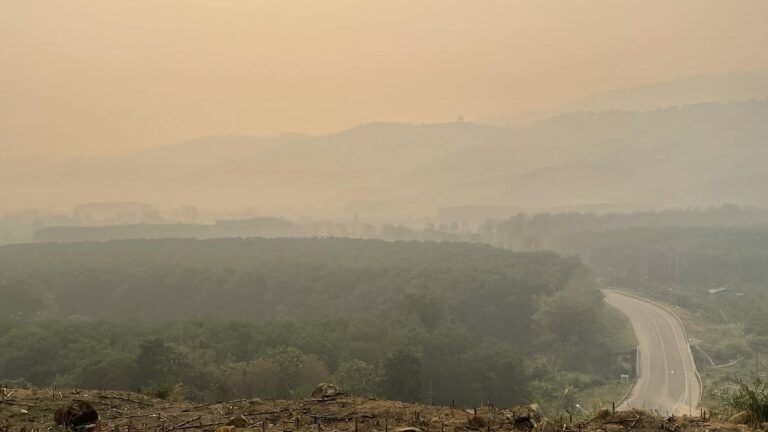
At the root of the crisis remains a structural problem: widespread agricultural burning in upland farming regions and forest-edge areas, combined with dry-season weather patterns that trap smoke across the Mekong basin.
These emissions are not confined within national borders.
Wind patterns routinely carry pollution from Laos and Myanmar into northern Thailand, creating recurring spikes in PM2.5 that affect urban and rural populations alike.
The economic and public health stakes are significant.
High particulate pollution is associated with respiratory illness, reduced labor productivity, and increased healthcare burdens.
It also disrupts tourism in affected regions, particularly northern Thailand, where seasonal haze can deter visitors during what is normally a key travel period.
Governments across the region have therefore increasingly framed haze not as a domestic environmental issue but as a shared regional risk requiring synchronized policy enforcement.
Current cooperation efforts also include long-term structural measures aimed at reducing burning practices altogether.
These include promoting alternative agricultural techniques, strengthening enforcement against open burning, and developing traceability systems for agricultural supply chains linked to fire-prone commodities such as animal feed crops.
Local awareness campaigns and community-level participation are also being integrated into the strategy to improve compliance in rural areas.
Despite these measures, the system remains dependent on enforcement capacity and economic incentives at the local level, where farmers often rely on burning as a low-cost land management tool.
This gap between policy design and ground-level practice remains the central constraint on progress.
The immediate direction of policy is therefore focused on incremental operational improvements rather than rapid elimination of burning.
The reinforced Thailand–Laos coordination framework, combined with shared monitoring systems and faster response protocols, represents a shift toward more integrated regional management of a pollution problem that continues to move freely across borders regardless of national controls.
What is confirmed is that senior environmental and agriculture officials from both countries met in Vientiane to deepen bilateral cooperation under an existing regional framework commonly referred to as the CLEAR Sky strategy.
The talks focused on strengthening joint mechanisms to reduce cross-border smoke, improve air quality monitoring, and coordinate responses during peak burning seasons when fine particulate matter (PM2.5) levels regularly exceed safe health thresholds.
The meeting builds on a broader 2024–2030 action plan already agreed between Thailand, Laos, and Myanmar, which outlines shared responsibilities in fire suppression, hotspot detection, and agricultural transition policies designed to reduce reliance on slash-and-burn farming.
The current discussions extend that framework with more operational detail, including faster information exchange and institutional coordination across environmental agencies.
A key development is the expansion of shared monitoring infrastructure.
Both sides are advancing systems that integrate satellite fire detection, cross-border hotspot mapping, and national air quality reporting platforms.
These tools are intended to identify fires earlier and coordinate rapid suppression efforts before smoke spreads across borders.
Authorities are also working on centralized data systems that would allow Laos to strengthen its air-quality tracking capacity while aligning standards with neighboring countries.
Another confirmed element is the operational push for real-time communication channels between agencies.
This includes rapid coordination mechanisms at director-general level designed to shorten response times during fire outbreaks.
The goal is to move beyond periodic meetings toward continuous operational coordination during the high-risk dry season, when haze episodes typically peak.
At the root of the crisis remains a structural problem: widespread agricultural burning in upland farming regions and forest-edge areas, combined with dry-season weather patterns that trap smoke across the Mekong basin.
These emissions are not confined within national borders.
Wind patterns routinely carry pollution from Laos and Myanmar into northern Thailand, creating recurring spikes in PM2.5 that affect urban and rural populations alike.
The economic and public health stakes are significant.
High particulate pollution is associated with respiratory illness, reduced labor productivity, and increased healthcare burdens.
It also disrupts tourism in affected regions, particularly northern Thailand, where seasonal haze can deter visitors during what is normally a key travel period.
Governments across the region have therefore increasingly framed haze not as a domestic environmental issue but as a shared regional risk requiring synchronized policy enforcement.
Current cooperation efforts also include long-term structural measures aimed at reducing burning practices altogether.
These include promoting alternative agricultural techniques, strengthening enforcement against open burning, and developing traceability systems for agricultural supply chains linked to fire-prone commodities such as animal feed crops.
Local awareness campaigns and community-level participation are also being integrated into the strategy to improve compliance in rural areas.
Despite these measures, the system remains dependent on enforcement capacity and economic incentives at the local level, where farmers often rely on burning as a low-cost land management tool.
This gap between policy design and ground-level practice remains the central constraint on progress.
The immediate direction of policy is therefore focused on incremental operational improvements rather than rapid elimination of burning.
The reinforced Thailand–Laos coordination framework, combined with shared monitoring systems and faster response protocols, represents a shift toward more integrated regional management of a pollution problem that continues to move freely across borders regardless of national controls.