California Desert Data-Centre Plan Stalls as Water and Power Disputes Mount
Imperial County has extended a development moratorium while Sebastian Rucci contests restrictions on his proposed $10 billion artificial-intelligence campus.
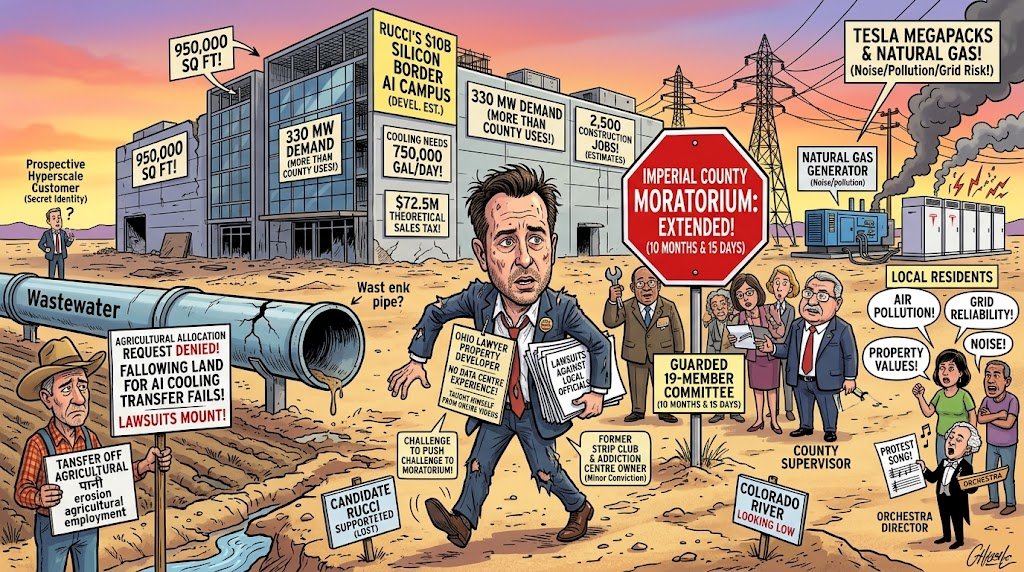
Sebastian Rucci, an Ohio-born lawyer and property developer, is pressing ahead with a proposed $10 billion artificial-intelligence data centre in California’s Imperial Valley despite a county moratorium, competing lawsuits and widening opposition over its demand for electricity, water and regulatory scrutiny.
The project’s fate now depends less on Rucci’s salesmanship than on court rulings and new local rules governing an industry expanding faster than many communities can regulate it.
Imperial Valley Computer Manufacturing, the company Rucci founded, proposes a 950,000-square-foot campus near the cities of Imperial and El Centro.
Its published design specifies 330 megawatts of power capacity, 862 megawatt-hours of battery storage and 220 Tesla Megapack units.
Natural-gas generators would provide further backup.
At full operation, the facility could use more electricity in a year than Imperial County consumed in 2024.
The company presents the development as an economic counterweight to the region’s persistent unemployment and the contraction of traditional industries.
Its projections have varied as plans evolved, but it now advertises more than 2,500 construction jobs, at least 100 permanent positions, $72.5 million in one-time sales-tax receipts and about $28.75 million in annual property taxes.
Earlier court filings cited 1,688 construction jobs.
These are developer estimates, not guaranteed public revenues or employment commitments.
Rucci calls his broader ambition the “Silicon Border”: a technology corridor intended to attract operators whose established data-centre markets face scarce land, congested grids and higher costs.
He has said he entered the sector without prior operating experience, teaching himself through online videos, consultations and visits to facilities in Silicon Valley.
He says he has personally invested about $5 million.
The identity of the prospective hyperscale customer has not been disclosed, and a major technology company linked to the project in local discussion has denied involvement.
Water has become the sharpest point of conflict.
The facility could require roughly 750,000 gallons a day for cooling.
Rucci initially emphasised a closed-loop system supplied entirely with reclaimed wastewater, arguing that the project would not burden the region’s Colorado River allocation.
When negotiations over municipal wastewater stalled, the company sought access to agricultural water by acquiring farmland, leaving it uncultivated and redirecting its allocation.
The Imperial Irrigation District rejected the request, prompting the developer to sue.
The litigation seeks access to approximately 287 million gallons annually.
That dispute reaches beyond one industrial project.
Imperial Valley agriculture depends on the region’s exceptionally large entitlement to Colorado River water, while the river system remains under long-term pressure.
The developer contends that fallowing land would prevent any net increase in demand.
Opponents argue that transferring water from farming to computing could erode agricultural employment and establish a consequential precedent for allocating a publicly managed, increasingly contested resource.
Residents living near the planned campus have also raised concerns about air pollution, generator emissions, round-the-clock noise, grid reliability and property values.
The site adjoins residential neighbourhoods and farmland.
The company says reclaimed water, battery storage and interruptible electricity service would reduce the facility’s environmental and grid impact, but those assertions have not yet been tested through the comprehensive environmental review sought by its critics.
Imperial County supervisors advanced the project in April by approving the consolidation of several parcels.
The Sierra Club subsequently sued, alleging that the county had improperly separated the land decision from the larger development to avoid a full review under the California Environmental Quality Act.
The City of Imperial has mounted a separate challenge.
Rucci maintains that data centres are permitted as of right under the site’s industrial zoning and that the project is exempt from the deeper assessment demanded by opponents.
Those competing interpretations remain before the courts.
The county changed course in June, imposing a 45-day halt on new and pending data-centre approvals and establishing a 19-member committee to examine zoning, environmental safeguards and minimum distances from homes and schools.
Supervisors extended the moratorium in July by another 10 months and 15 days.
Rucci has challenged the pause, arguing that officials failed to establish the legally required urgency.
The dispute has become unusually personal.
Rucci has sued local officials and other parties he accuses of obstructing the development.
A local orchestra director helped organise opposition and wrote a protest song, while Rucci financially supported a challenger to an incumbent irrigation-district director; that candidate lost the June election.
In April, authorities arrested a 22-year-old El Centro resident over alleged online threats against a data-centre developer.
The publicly released account did not identify the intended target, so the claim that Rucci was threatened cannot be treated as confirmed.
Rucci’s earlier ventures have also entered the debate.
He opened an Ohio strip club in 2007 and later faced charges that included promoting prostitution, money laundering, perjury and selling beer without a licence.
He was acquitted of the principal allegations but convicted of the licensing offence and served 30 days in jail.
He described the prosecution as politically motivated; the prosecutor rejected that characterisation.
The property later became the California Palms hotel and an addiction-treatment facility.
Federal agents seized $603,902.89 during a 2021 investigation, after which Ohio authorities revoked the centre’s provider certification and terminated its Medicaid agreement.
The federal government ultimately dismissed its forfeiture proceeding and returned the money with interest.
Neither Rucci nor the facility was criminally charged.
In November 2025, a federal appeals court revived the remaining portion of his civil case seeking disclosure of the affidavits supporting the seizure warrants, without deciding whether he was entitled to receive them.
The immediate question is whether Imperial County will allow a project of unprecedented local scale to proceed under existing industrial zoning or require a bespoke framework for its environmental and infrastructure demands.
The county committee is due to recommend new siting and operating rules by January 2027, while the extended moratorium prevents officials from approving the development.
The project’s fate now depends less on Rucci’s salesmanship than on court rulings and new local rules governing an industry expanding faster than many communities can regulate it.
Imperial Valley Computer Manufacturing, the company Rucci founded, proposes a 950,000-square-foot campus near the cities of Imperial and El Centro.
Its published design specifies 330 megawatts of power capacity, 862 megawatt-hours of battery storage and 220 Tesla Megapack units.
Natural-gas generators would provide further backup.
At full operation, the facility could use more electricity in a year than Imperial County consumed in 2024.
The company presents the development as an economic counterweight to the region’s persistent unemployment and the contraction of traditional industries.
Its projections have varied as plans evolved, but it now advertises more than 2,500 construction jobs, at least 100 permanent positions, $72.5 million in one-time sales-tax receipts and about $28.75 million in annual property taxes.
Earlier court filings cited 1,688 construction jobs.
These are developer estimates, not guaranteed public revenues or employment commitments.
Rucci calls his broader ambition the “Silicon Border”: a technology corridor intended to attract operators whose established data-centre markets face scarce land, congested grids and higher costs.
He has said he entered the sector without prior operating experience, teaching himself through online videos, consultations and visits to facilities in Silicon Valley.
He says he has personally invested about $5 million.
The identity of the prospective hyperscale customer has not been disclosed, and a major technology company linked to the project in local discussion has denied involvement.
Water has become the sharpest point of conflict.
The facility could require roughly 750,000 gallons a day for cooling.
Rucci initially emphasised a closed-loop system supplied entirely with reclaimed wastewater, arguing that the project would not burden the region’s Colorado River allocation.
When negotiations over municipal wastewater stalled, the company sought access to agricultural water by acquiring farmland, leaving it uncultivated and redirecting its allocation.
The Imperial Irrigation District rejected the request, prompting the developer to sue.
The litigation seeks access to approximately 287 million gallons annually.
That dispute reaches beyond one industrial project.
Imperial Valley agriculture depends on the region’s exceptionally large entitlement to Colorado River water, while the river system remains under long-term pressure.
The developer contends that fallowing land would prevent any net increase in demand.
Opponents argue that transferring water from farming to computing could erode agricultural employment and establish a consequential precedent for allocating a publicly managed, increasingly contested resource.
Residents living near the planned campus have also raised concerns about air pollution, generator emissions, round-the-clock noise, grid reliability and property values.
The site adjoins residential neighbourhoods and farmland.
The company says reclaimed water, battery storage and interruptible electricity service would reduce the facility’s environmental and grid impact, but those assertions have not yet been tested through the comprehensive environmental review sought by its critics.
Imperial County supervisors advanced the project in April by approving the consolidation of several parcels.
The Sierra Club subsequently sued, alleging that the county had improperly separated the land decision from the larger development to avoid a full review under the California Environmental Quality Act.
The City of Imperial has mounted a separate challenge.
Rucci maintains that data centres are permitted as of right under the site’s industrial zoning and that the project is exempt from the deeper assessment demanded by opponents.
Those competing interpretations remain before the courts.
The county changed course in June, imposing a 45-day halt on new and pending data-centre approvals and establishing a 19-member committee to examine zoning, environmental safeguards and minimum distances from homes and schools.
Supervisors extended the moratorium in July by another 10 months and 15 days.
Rucci has challenged the pause, arguing that officials failed to establish the legally required urgency.
The dispute has become unusually personal.
Rucci has sued local officials and other parties he accuses of obstructing the development.
A local orchestra director helped organise opposition and wrote a protest song, while Rucci financially supported a challenger to an incumbent irrigation-district director; that candidate lost the June election.
In April, authorities arrested a 22-year-old El Centro resident over alleged online threats against a data-centre developer.
The publicly released account did not identify the intended target, so the claim that Rucci was threatened cannot be treated as confirmed.
Rucci’s earlier ventures have also entered the debate.
He opened an Ohio strip club in 2007 and later faced charges that included promoting prostitution, money laundering, perjury and selling beer without a licence.
He was acquitted of the principal allegations but convicted of the licensing offence and served 30 days in jail.
He described the prosecution as politically motivated; the prosecutor rejected that characterisation.
The property later became the California Palms hotel and an addiction-treatment facility.
Federal agents seized $603,902.89 during a 2021 investigation, after which Ohio authorities revoked the centre’s provider certification and terminated its Medicaid agreement.
The federal government ultimately dismissed its forfeiture proceeding and returned the money with interest.
Neither Rucci nor the facility was criminally charged.
In November 2025, a federal appeals court revived the remaining portion of his civil case seeking disclosure of the affidavits supporting the seizure warrants, without deciding whether he was entitled to receive them.
The immediate question is whether Imperial County will allow a project of unprecedented local scale to proceed under existing industrial zoning or require a bespoke framework for its environmental and infrastructure demands.
The county committee is due to recommend new siting and operating rules by January 2027, while the extended moratorium prevents officials from approving the development.