Durian Glut in Thailand Sparks Price Pressure as Influencers Push Global Demand
A surplus of Thailand’s ‘pungent fruit’ is reshaping farm economics while digital marketing campaigns attempt to stabilize export-driven demand.
SYSTEM-DRIVEN agricultural and export-market dynamics are reshaping Thailand’s durian industry as a domestic oversupply collides with global demand cycles, pricing pressure, and increasingly digital marketing strategies.
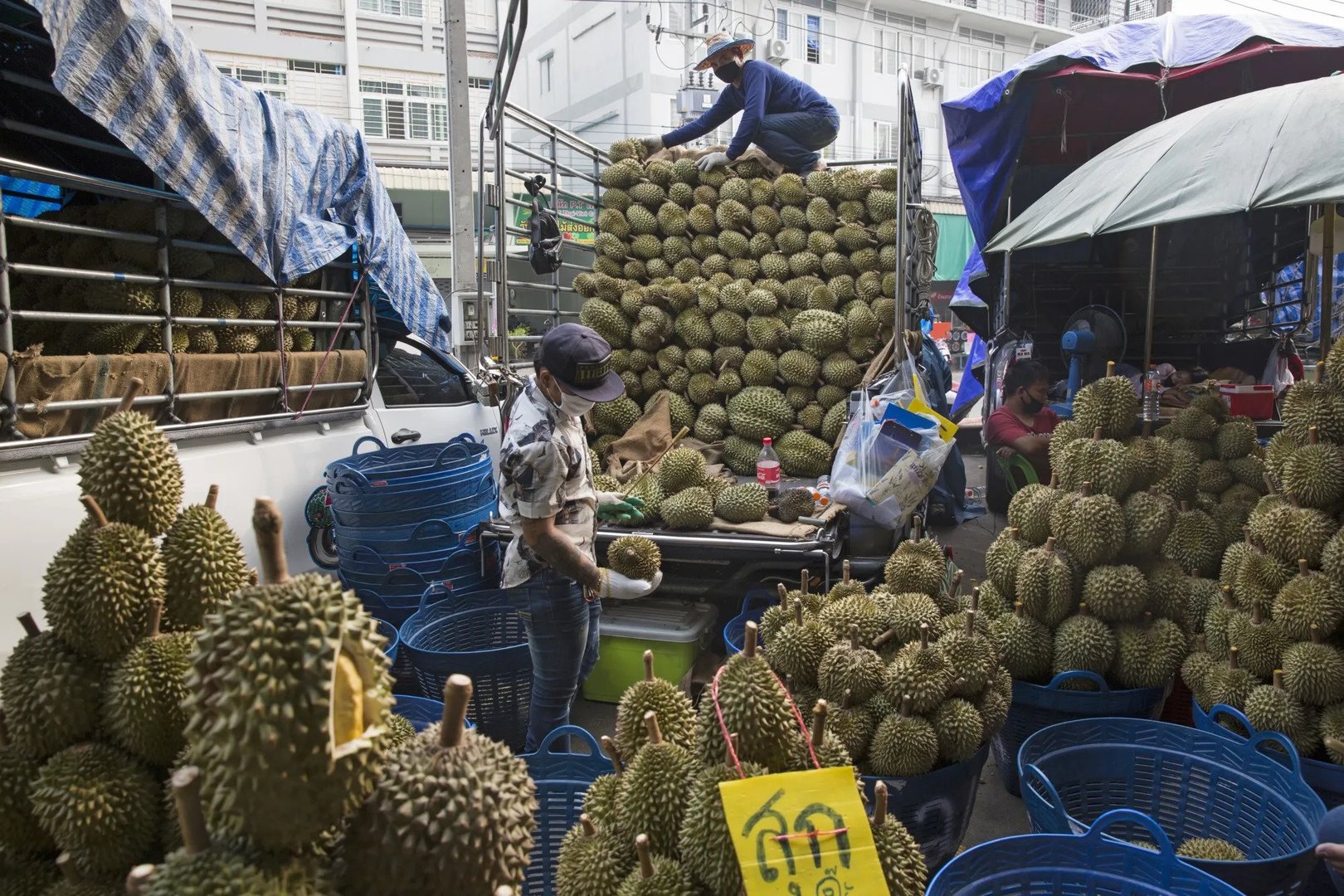
What is confirmed is that Thailand, the world’s largest exporter of durian, is currently facing a supply glut that has pushed down farmgate prices and increased pressure on growers and exporters.
Durian production has expanded significantly in recent years due to strong demand from key overseas markets, particularly in East Asia, but recent harvest cycles have outpaced short-term consumption growth.
The key mechanism behind the glut is the lag between agricultural expansion and market absorption.
Durian trees require years to mature, and when farmers respond to high prices by expanding plantations, supply often arrives in concentrated waves several seasons later.
This creates cyclical oversupply conditions that are difficult to correct quickly without reducing production or finding new markets.
In response, exporters and marketing groups have increasingly turned to digital promotion, including influencer campaigns, to sustain international demand.
Social media-driven marketing has become a tool to reshape consumer perception of durian, positioning it not only as a niche tropical fruit but as a premium export product with culinary and cultural value.
These campaigns are particularly aimed at younger consumers in China and other Asian markets where online food trends can significantly influence purchasing behavior.
Durian’s economic importance in Thailand is substantial.
It is one of the country’s highest-value agricultural exports, with supply chains involving farmers, middlemen, packing facilities, and cross-border logistics networks.
When prices fall sharply at the farm level, the impact propagates quickly through rural incomes and regional economies that depend heavily on seasonal fruit harvests.
The current price pressure highlights structural vulnerabilities in export-dependent agriculture.
While international demand for durian has grown strongly over the past decade, it remains concentrated in a limited number of markets, making the sector sensitive to regulatory changes, shipping costs, and consumer sentiment shifts in those destinations.
Influencer-backed campaigns are therefore not simply marketing efforts but attempts to stabilize a volatile commodity system by smoothing demand perception in real time.
However, such strategies can only partially offset oversupply conditions if production remains significantly above absorption capacity.
The broader implication is a familiar agricultural cycle intensified by globalization: rapid expansion driven by strong export prices, followed by oversupply, price compression, and eventual rebalancing through either reduced planting, expanded consumption markets, or structural consolidation in the supply chain.
Thailand’s durian sector is now operating within that adjustment phase, where market forces are forcing a recalibration between production scale and international demand growth.
What is confirmed is that Thailand, the world’s largest exporter of durian, is currently facing a supply glut that has pushed down farmgate prices and increased pressure on growers and exporters.
Durian production has expanded significantly in recent years due to strong demand from key overseas markets, particularly in East Asia, but recent harvest cycles have outpaced short-term consumption growth.
The key mechanism behind the glut is the lag between agricultural expansion and market absorption.
Durian trees require years to mature, and when farmers respond to high prices by expanding plantations, supply often arrives in concentrated waves several seasons later.
This creates cyclical oversupply conditions that are difficult to correct quickly without reducing production or finding new markets.
In response, exporters and marketing groups have increasingly turned to digital promotion, including influencer campaigns, to sustain international demand.
Social media-driven marketing has become a tool to reshape consumer perception of durian, positioning it not only as a niche tropical fruit but as a premium export product with culinary and cultural value.
These campaigns are particularly aimed at younger consumers in China and other Asian markets where online food trends can significantly influence purchasing behavior.
Durian’s economic importance in Thailand is substantial.
It is one of the country’s highest-value agricultural exports, with supply chains involving farmers, middlemen, packing facilities, and cross-border logistics networks.
When prices fall sharply at the farm level, the impact propagates quickly through rural incomes and regional economies that depend heavily on seasonal fruit harvests.
The current price pressure highlights structural vulnerabilities in export-dependent agriculture.
While international demand for durian has grown strongly over the past decade, it remains concentrated in a limited number of markets, making the sector sensitive to regulatory changes, shipping costs, and consumer sentiment shifts in those destinations.
Influencer-backed campaigns are therefore not simply marketing efforts but attempts to stabilize a volatile commodity system by smoothing demand perception in real time.
However, such strategies can only partially offset oversupply conditions if production remains significantly above absorption capacity.
The broader implication is a familiar agricultural cycle intensified by globalization: rapid expansion driven by strong export prices, followed by oversupply, price compression, and eventual rebalancing through either reduced planting, expanded consumption markets, or structural consolidation in the supply chain.
Thailand’s durian sector is now operating within that adjustment phase, where market forces are forcing a recalibration between production scale and international demand growth.