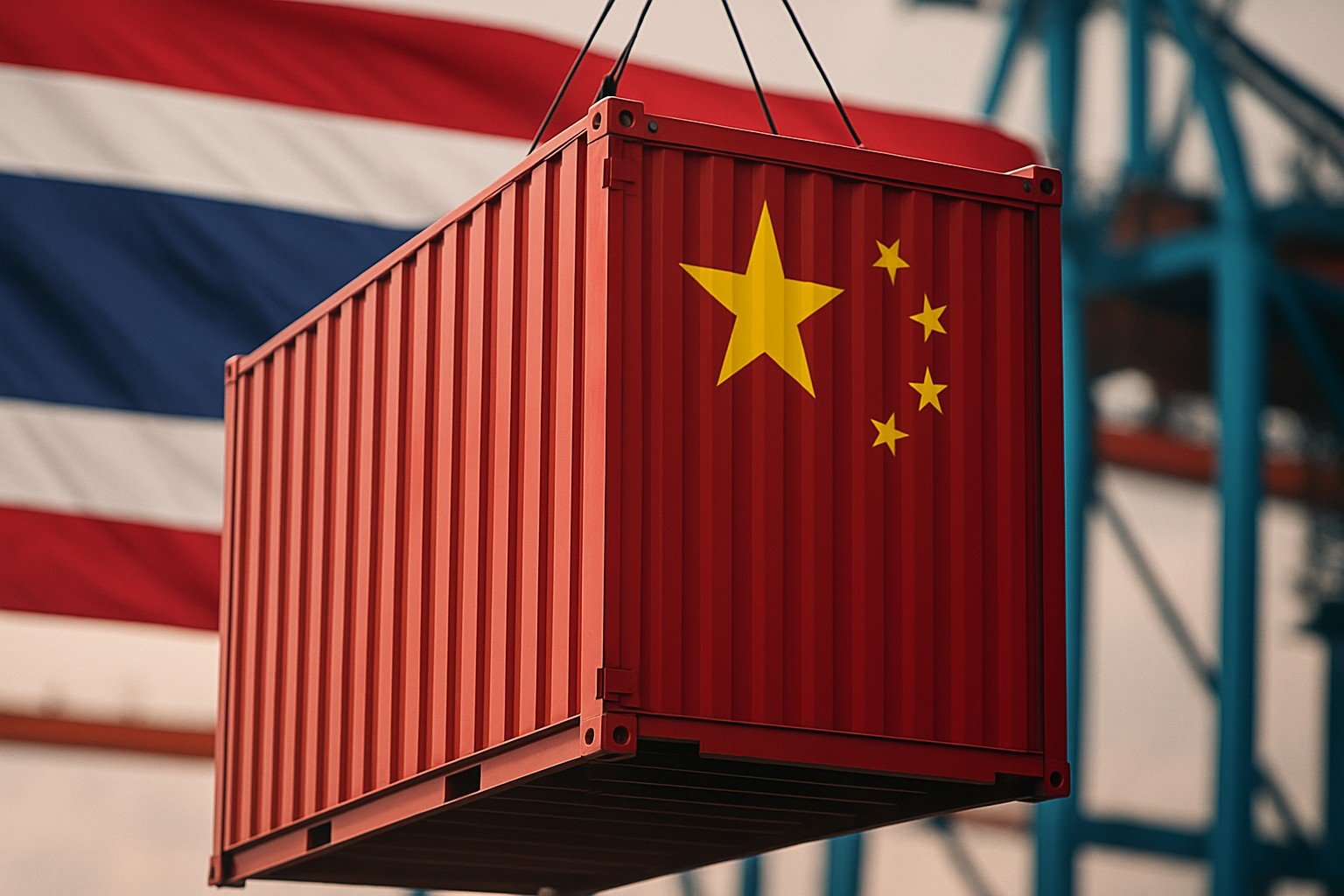
Thailand’s Trade Deficit With China Set to Hit Record as Imports Surge Amid Global Shifts
Data show Thai imports from China outpacing exports sharply, pushing the deficit toward an unprecedented two-trillion-baht imbalance
Thailand’s bilateral trade imbalance with China is widening rapidly and is on track to reach an unprecedented record of around two trillion baht over an eleven-month period as imports from the world’s largest trading partner continue to grow faster than exports.
Trade statistics released by the Thai Commerce Ministry and independent analysts show that the value of goods flowing into Thailand from China has surged, driven by capital equipment, intermediate goods and consumer products, while Thai exports have struggled to keep pace.
In the first half of the year, Thailand’s trade deficit with China approached nearly one trillion baht, with imports climbing significantly ahead of exports, reflecting strong demand for Chinese machinery and manufactured components used in Thai production as well as cheaper consumer imports.
Economists attribute part of the trend to global tariff shifts, with higher levies in other markets such as the United States prompting some Chinese exporters to redirect shipments to Southeast Asia, particularly Thailand, in search of alternative demand.
This has contributed to a record monthly import figure, with Thailand bringing in Chinese goods worth billions of dollars, even as export growth to the Chinese market remains modest.
The widening deficit has drawn attention from business groups and policymakers concerned about structural trade imbalances, competitiveness and the long-term impact on Thailand’s manufacturing base.
The gap between imports and exports with China has been rising for several years, reflecting broader integration in regional supply chains; however, the current pace of import growth has intensified discussions on industrial policy and export diversification.
Despite efforts by Thai authorities to support exporters and improve trade facilitation, the scale of Chinese imports has outstripped these gains, creating the largest deficit with any single country in Thailand’s trading history.
As the year draws to a close, data through November suggest the imbalance could surpass two trillion baht, a threshold that would mark a new high in the long-standing trade relationship between Thailand and China.
Analysts say addressing the deficit will require targeted measures to boost Thai export competitiveness, encourage domestic value-added production and manage the influx of lower-priced goods, particularly in sectors where local producers face heightened competition.
The evolving dynamics of Thailand–China trade underscore the challenges and opportunities posed by deeper economic links between the two nations as Thailand seeks to balance trade flows while strengthening broader bilateral economic cooperation.
Trade statistics released by the Thai Commerce Ministry and independent analysts show that the value of goods flowing into Thailand from China has surged, driven by capital equipment, intermediate goods and consumer products, while Thai exports have struggled to keep pace.
In the first half of the year, Thailand’s trade deficit with China approached nearly one trillion baht, with imports climbing significantly ahead of exports, reflecting strong demand for Chinese machinery and manufactured components used in Thai production as well as cheaper consumer imports.
Economists attribute part of the trend to global tariff shifts, with higher levies in other markets such as the United States prompting some Chinese exporters to redirect shipments to Southeast Asia, particularly Thailand, in search of alternative demand.
This has contributed to a record monthly import figure, with Thailand bringing in Chinese goods worth billions of dollars, even as export growth to the Chinese market remains modest.
The widening deficit has drawn attention from business groups and policymakers concerned about structural trade imbalances, competitiveness and the long-term impact on Thailand’s manufacturing base.
The gap between imports and exports with China has been rising for several years, reflecting broader integration in regional supply chains; however, the current pace of import growth has intensified discussions on industrial policy and export diversification.
Despite efforts by Thai authorities to support exporters and improve trade facilitation, the scale of Chinese imports has outstripped these gains, creating the largest deficit with any single country in Thailand’s trading history.
As the year draws to a close, data through November suggest the imbalance could surpass two trillion baht, a threshold that would mark a new high in the long-standing trade relationship between Thailand and China.
Analysts say addressing the deficit will require targeted measures to boost Thai export competitiveness, encourage domestic value-added production and manage the influx of lower-priced goods, particularly in sectors where local producers face heightened competition.
The evolving dynamics of Thailand–China trade underscore the challenges and opportunities posed by deeper economic links between the two nations as Thailand seeks to balance trade flows while strengthening broader bilateral economic cooperation.