Thailand Advances $28 Billion Landbridge Plan to Create New Asia-Pacific-India Trade Route
Bangkok pitches strategic infrastructure project to shorten shipping times and reduce costs by connecting Pacific and Indian Ocean ports across the Kra Isthmus
Thailand has proposed a transformative $28 billion landbridge project aimed at reshaping global maritime trade by establishing a new overland route between the Pacific and Indian Oceans, allowing cargo to bypass the congested Strait of Malacca.
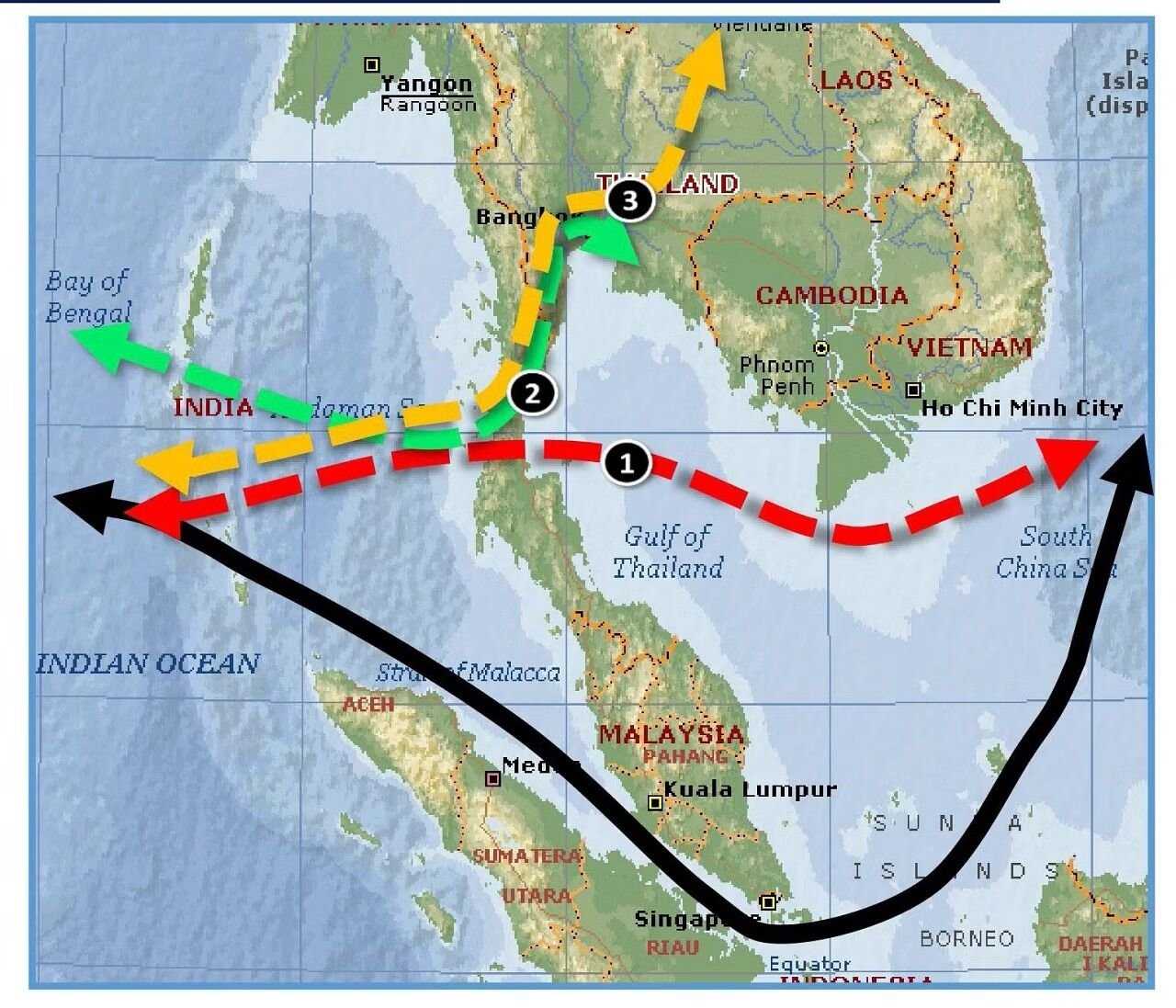
The initiative, championed by Prime Minister Srettha Thavisin, would link deep-sea ports on the Gulf of Thailand and the Andaman Sea with highway and rail networks across the Kra Isthmus, cutting average shipping times by roughly four days and lowering logistics costs by up to 15 per cent, according to government projections.
The proposed Landbridge plan is designed to alleviate mounting capacity pressures in one of the world’s busiest sea lanes, where traffic volumes are expected to exceed sustainable limits by 2030. Under the blueprint, seaports at Ranong on the west coast and Chumphon to the east would be connected over about 100 kilometres of terrain, facilitating faster movement of containers and bulk cargo between Asia-Pacific markets, India and the Middle East.
Thailand’s transport authorities say the ports could together handle about 23 per cent of the cargo volume of the nearby Malacca hub, underscoring the potential competitive impact of the route.
Officials have pitched the mega-infrastructure plan to international investors in recent months, highlighting its economic and strategic appeal.
Proponents argue that the corridor could generate more than 280,000 jobs, stimulate sustained economic growth and reinforce Thailand’s role as a critical logistics and trade gateway.
Bangkok aims to complete the first phase of the landbridge by the early 2030s, with planning bodies allowing significant foreign participation in joint ventures for construction and operation of ports and associated infrastructure.
The project also reflects Thailand’s broader ambitions to broaden regional connectivity and leverage its geostrategic location at the crossroads of Asia’s key trade routes.
By offering an alternative to the narrow Strait of Malacca, which sees roughly a quarter of global maritime cargo traffic, Thai leaders believe the landbridge could enhance supply chain resilience, reduce maritime risks and attract global shipping lines to diversify their transit options.
As the initiative advances toward financing and potential ground-breaking, investors and policymakers will be watching closely to gauge its feasibility and impact on the future of Indo-Pacific trade networks.
The initiative, championed by Prime Minister Srettha Thavisin, would link deep-sea ports on the Gulf of Thailand and the Andaman Sea with highway and rail networks across the Kra Isthmus, cutting average shipping times by roughly four days and lowering logistics costs by up to 15 per cent, according to government projections.
The proposed Landbridge plan is designed to alleviate mounting capacity pressures in one of the world’s busiest sea lanes, where traffic volumes are expected to exceed sustainable limits by 2030. Under the blueprint, seaports at Ranong on the west coast and Chumphon to the east would be connected over about 100 kilometres of terrain, facilitating faster movement of containers and bulk cargo between Asia-Pacific markets, India and the Middle East.
Thailand’s transport authorities say the ports could together handle about 23 per cent of the cargo volume of the nearby Malacca hub, underscoring the potential competitive impact of the route.
Officials have pitched the mega-infrastructure plan to international investors in recent months, highlighting its economic and strategic appeal.
Proponents argue that the corridor could generate more than 280,000 jobs, stimulate sustained economic growth and reinforce Thailand’s role as a critical logistics and trade gateway.
Bangkok aims to complete the first phase of the landbridge by the early 2030s, with planning bodies allowing significant foreign participation in joint ventures for construction and operation of ports and associated infrastructure.
The project also reflects Thailand’s broader ambitions to broaden regional connectivity and leverage its geostrategic location at the crossroads of Asia’s key trade routes.
By offering an alternative to the narrow Strait of Malacca, which sees roughly a quarter of global maritime cargo traffic, Thai leaders believe the landbridge could enhance supply chain resilience, reduce maritime risks and attract global shipping lines to diversify their transit options.
As the initiative advances toward financing and potential ground-breaking, investors and policymakers will be watching closely to gauge its feasibility and impact on the future of Indo-Pacific trade networks.